Fix the pumps

Thursday, October 26, 2006

Back to the floodgates - a Fixthepumps Follow-up

Updated, see below

After my five (and then six) part series, "Problems at the floodgates," I figured there'd be some action on the items I uncovered. The record has been mixed so far. Some areas remain totally unaddressed, while others have had a little response. Overall, I'd say we're still at the same point we were when the special report was published.

Part 1 of the report was about the distinct lack of security at the three floodgate sites. I'm pleased to report that there has been some improvement at the Orleans and London Avenue sites, but 17th Street remains scarily wide open for anyone to move around and do mischief.

At Orleans and London Avenues, eight foot high chain link fences have been erected around each control/engine structure, except for the east control building at London Avenue. At that structure, half of the chain link fabric has not been attached to the poles, leaving that structure vulnerable to mischief at night (there's still no on duty security). The fences are topped with three strands of barbed wire. All the gates on these fences are kept locked. Here's a picture of the fence around the west side control building at Orleans Avenue:
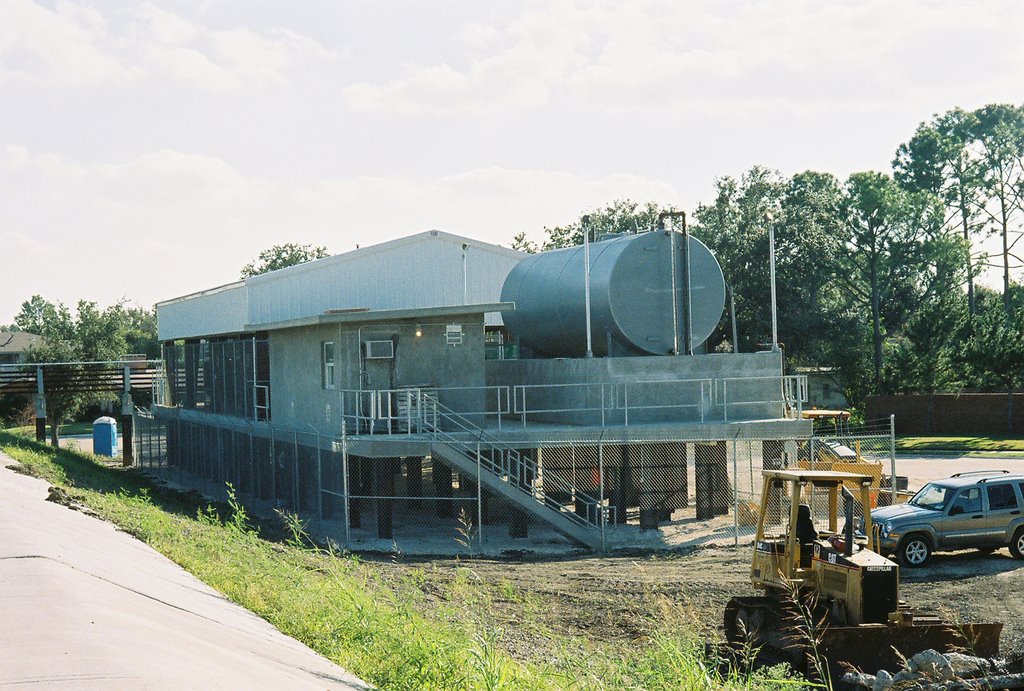
If you click on the picture and blow it up a bit, you'll see the fence around the perimeter of the structure.

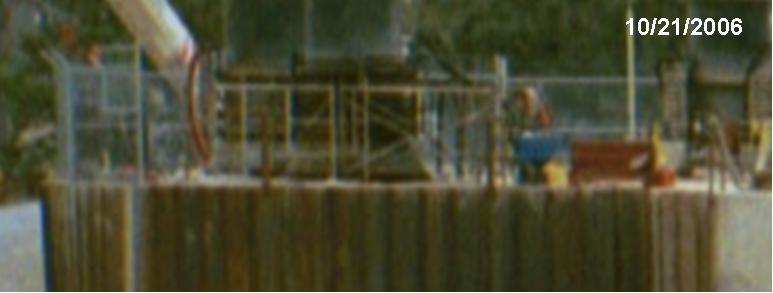
The contractors at this site also must access the gates structures themselves through another chain link fence-and-gate on each bank of the canal. Before my special report, these gates were routinely left wide open in the evening after the contractors left for the day. Now they are always locked. You can see the gates on this picture of the Orleans Avenue gates.
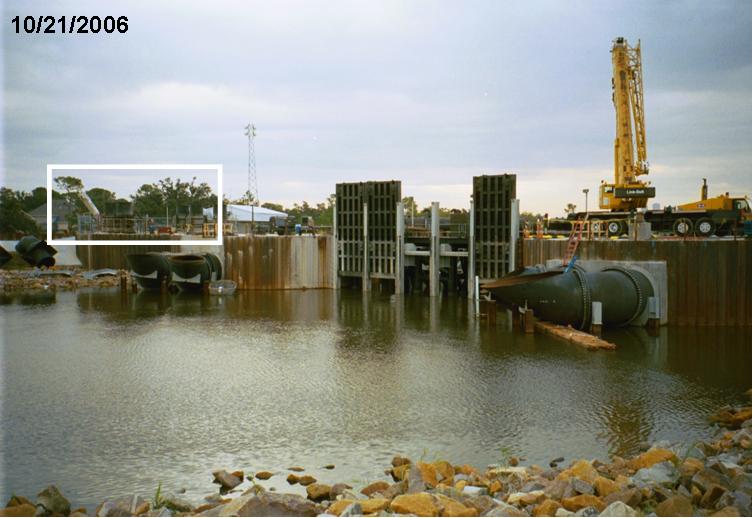

Here's an enlargement to make it clearer:

So Orleans Avenue is pretty secure now, and London Avenue is getting there. However, the 17th St. site is still swiss cheese when it comes to security. And it's not like Boh Brothers and the Corps don't know where the fences are supposed to be. The 17th Street floodgates construction specifications say the following about fencing:


i. Security Fence. The Contractor shall provide, erect, and maintain a temporary security fence around the accessible limits of the land side construction easement shown on the rights of way drawing [my emphasis]. Fencing shall consist of a 8 foot high chain link fence with three strands of barbed wire supported on angled arms at the top. To provide access, the fence shall have a minimum 16 foot wide gate with keyed lock. The Contractor shall provide and maintain on the fence "KEEP OUT" signs every 100 feet facing out from the staging area. Details of the security fence and location shall be submitted to the Contracting Officer for approval. No separate measurement will be made for this work. Payment for all work associated with the security fence shall be included in the contract lump sum price for “CHAIN LINK FENCE”.

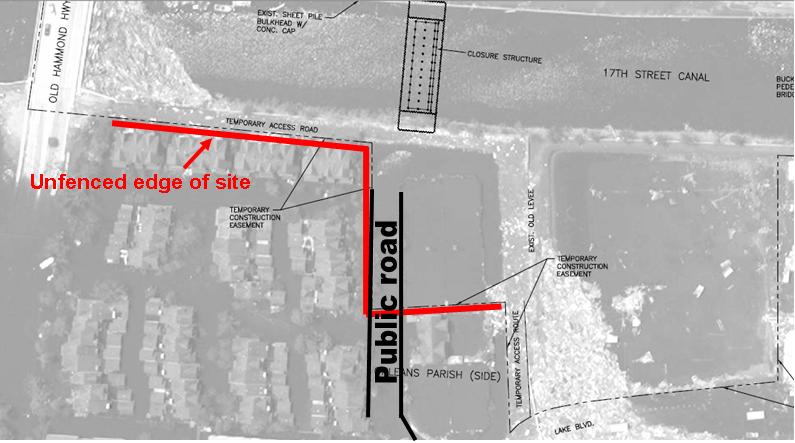
Here's the construction easement drawing:
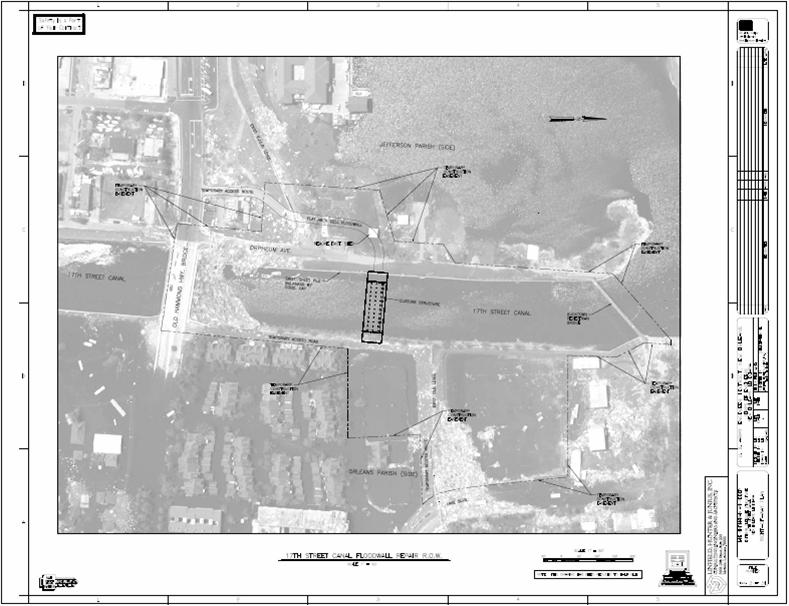

Here's the area that has no fence. I've highlighted the exact length that is missing in red.

And here's a picture of the same area from last weekend. I roughed in where the fence is supposed to be:
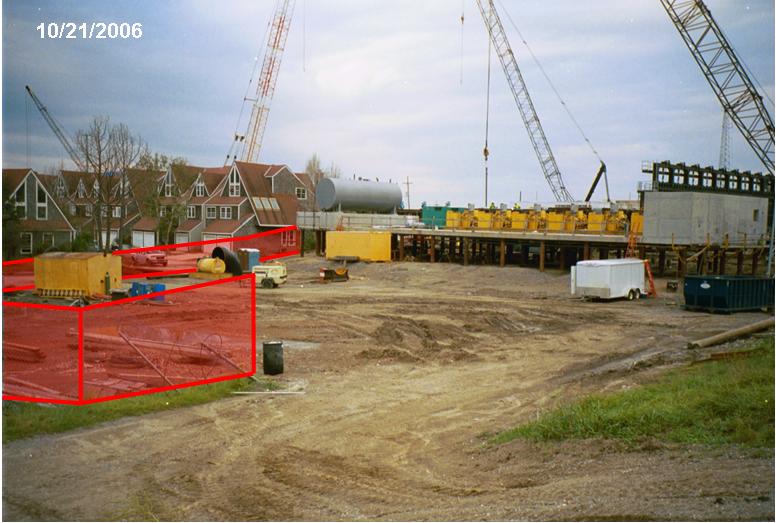

It's been this way since the beginning of the job. Boh Brothers and the Corps are ignoring their own specifications at the peril of whatever yahoo wants to wander on the site. Heaven help us if someone hurts themselves because they could just wander up on the gate structures and plunk themselves into the canal, which is 18 feet deep.

[Update, 7/9/07:
The Corps eventually got its contractor to put up the fence where it belonged. It went up in November or December, 2006. This shot of the east drive platform from June of 2007 shows the fence in the foreground:

end update]

But it's not just security that is still lax at the gates. In part 2 of the special report, I wrote about workplace safety, and how the 17th Street canal site is a huge mess of violations of OSHA and Corps of Engineers safety standards. At the time of my report, I couldn't report on the behavior of workers because Deep Flood's pictures were taken after the workers had left for the day (more about that later...).

When I went out there over the weekend, it was in the morning after the contractors had reported for work. At that time, I observed an unsafe behavior that would easily get someone fired on the spot at any private industrial facility in the country. It is a very strong indication that there is very little - if any - emphasis on working safely on the 17th Street site.

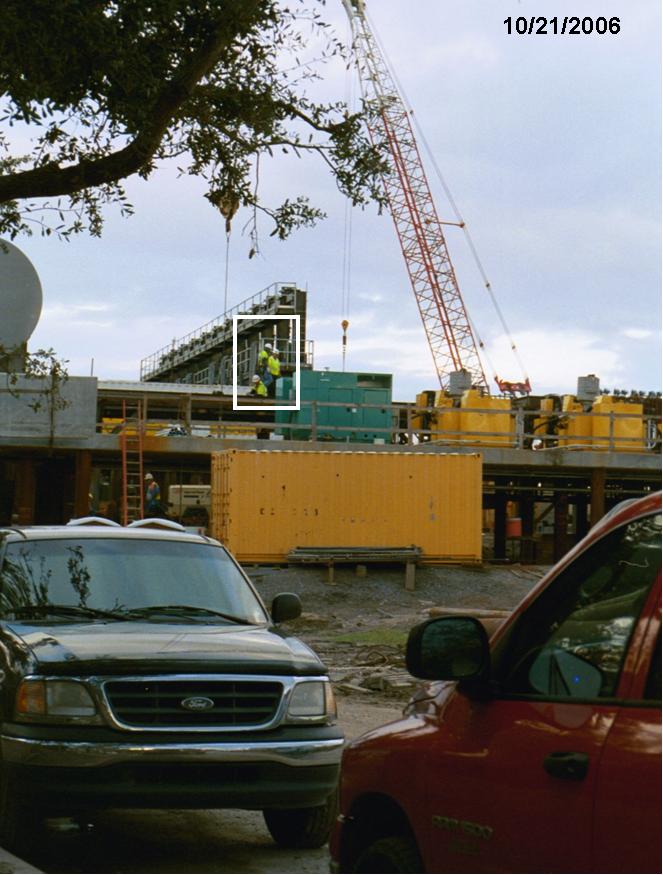
Here's the first photo. I've highlighted the area of interest. Note how high the people in the box are above the ground. It's about 20 feet.

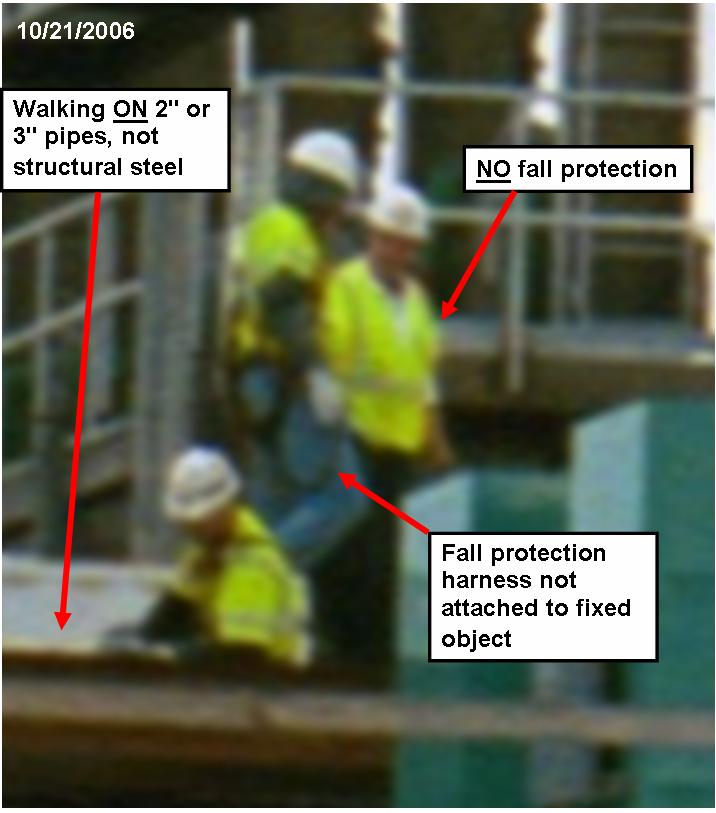
Here's that area blown up, with notes about what's going on. The man on the right appears to be a supervisor of some sort.

For reference, here's a Deep Flood photo of the area on which these men are walking:


Here's another picture taken shortly afterward. You can see how high off the ground the highlighted worker is:
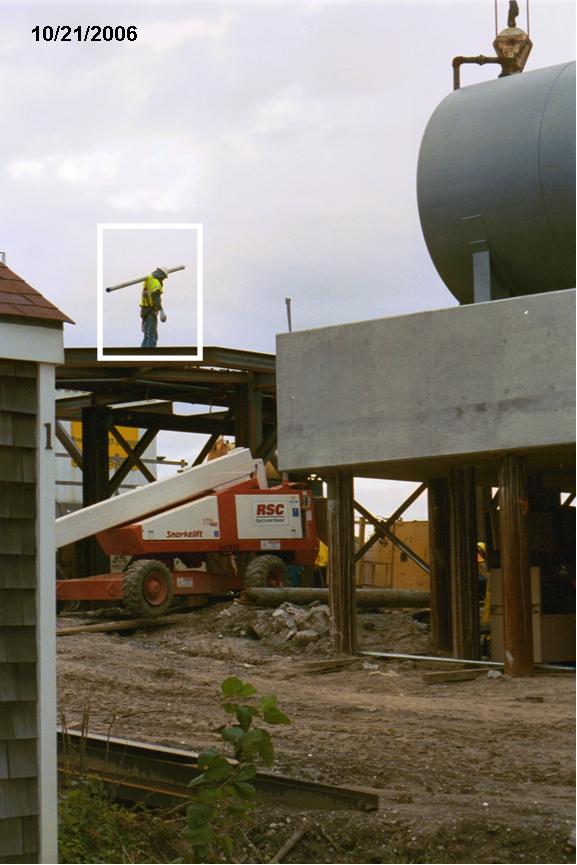

And again, here's a blowup of the highighted area showing the worker:


As I mentioned in my original report, the contractor on the job is obliged to follow all the safety regulations found in 29 CFR 1910 (OSHA's regular workplace safety regulations) and 29 CFR 1926 (OSHA's construction site safety regulations). Here's the particular regulation whose violation is captured in the above photos:

29 CFR 1926.501(b)(1)
"Unprotected sides and edges. Each employee on a walking/working surface (horizontal and vertical surface) with an unprotected side or edge which is 6 feet (1.8 m) or more above a lower level shall be protected from falling by the use of guardrail systems, safety net systems, or personal fall arrest systems."

This is found in the section of the regulations titled "Duty To Have Fall Protection." At some private industrial facilities, the standard is actually 4 feet.

The Corps has their own safety manual, EM 385-1-1. It has this to say about the requirements for fall protection in chapter 21:

a. Employees exposed to fall hazards shall be protected by standard guardrail, catch platforms, temporary floors, safety nets, personal fall protection devices, or the equivalent, in the following situations:
(1) On accessways (excluding ladders), work platforms, or walking/working surfaces from which they may fall 6 ft (1.8m) or more;
(2) On accessways or work platforms over water, machinery, or dangerous operations;
(3) On runways from which they may fall 4 ft (1.2 m) or more; and
(4) On installing or removing sheet pile, h-piles, cofferdams, or other interlocking materials from which they may fall 6 ft (1.8 m) or more.
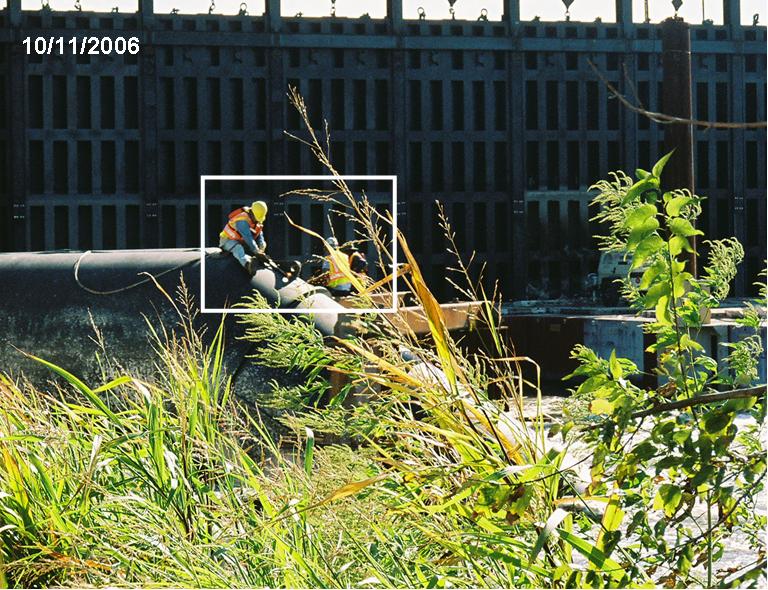
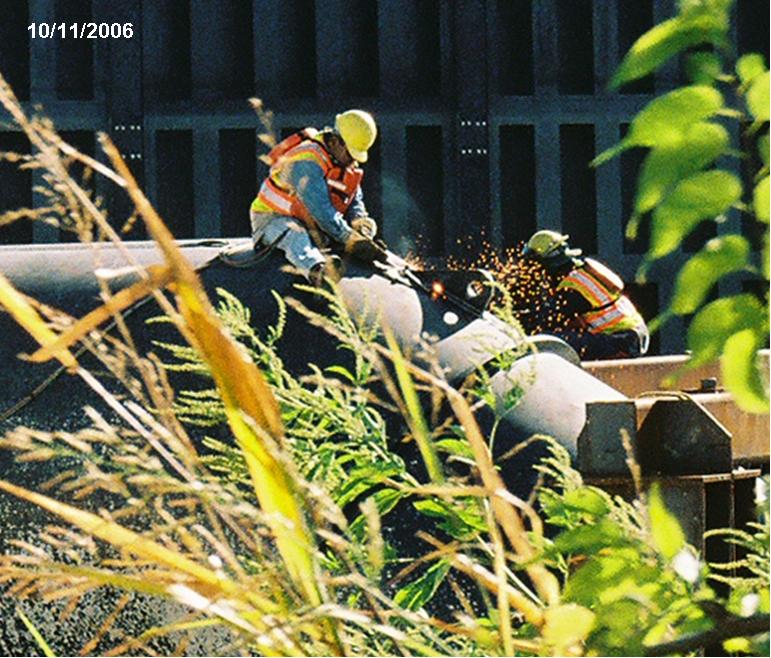
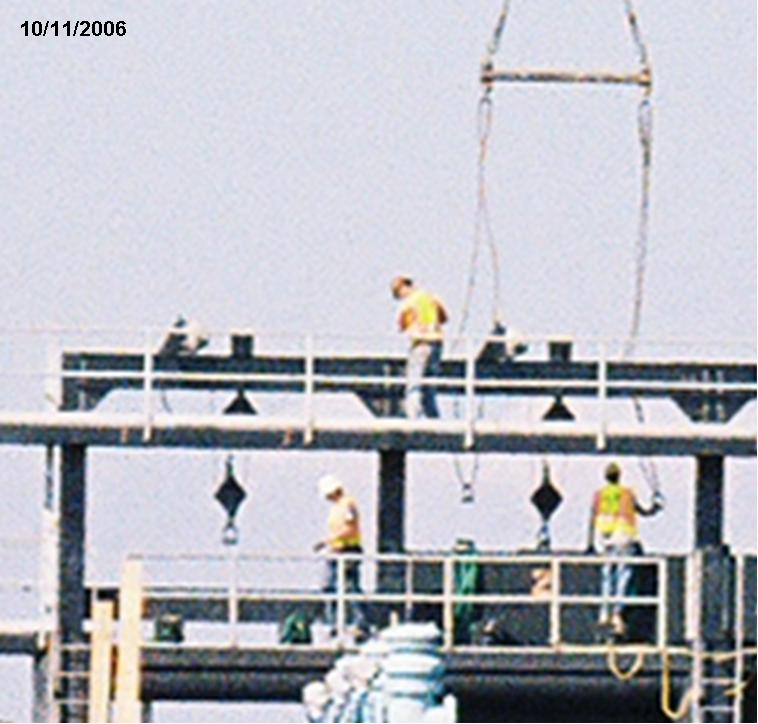
And this is not a one-time occurrence. Here's some welders working on modifying the discharge pipes on the east side of the canal at 17th Street on October 11th. All three of these workers are over the water:


And, as before, the highlighted area:
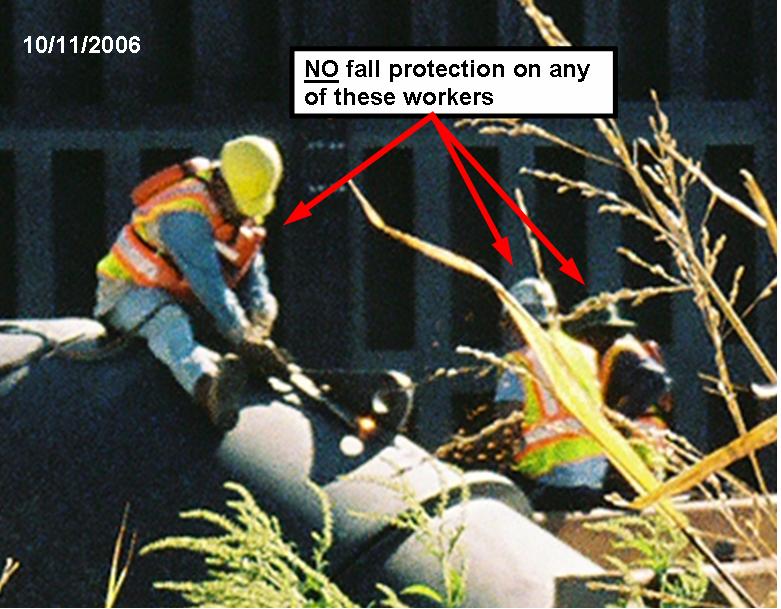

The lack of fall protection seems to more of a endemic pattern than a rare exception. I pity the workers whose managers and Corps overseers care so little about their safety that they refuse to enforce the rules.

There is something you can do about this. Another provision of the contract specifications relating to contractor safety talks about what happens in the event of a violation:

"Whenever the Contracting Officer becomes aware of any noncompliance with these requirements or any condition which poses a serious or imminent danger to the health or safety of the public or Government personnel, the Contracting Officer shall notify the Contractor orally, with written confirmation, and request immediate initiation of corrective action. This notice, when delivered to the Contractor or the Contractor's representative at the work site, shall be deemed sufficient notice of the noncompliance and that corrective action is required. After receiving the notice, the Contractor shall immediately take corrective action. If the Contractor fails or refuses to promptly take corrective action, the Contracting Officer may issue an order stopping all or part of the work until satisfactory corrective action has been taken. The Contractor shall not be entitled to any equitable adjustment of the contract price or extension of the performance schedule on any stop work order issued under this clause."
The provisions don't say how the Contracting Officer is to be made aware, so I suppose reading it on a website is as good a method as any. I would suggest you help me make the Corps aware of these OSHA violations. You can email the upper reaches of the Corps New Orleans District with an email such as the following:

Dear Corps personnel:

Please be aware that photos of violations of OSHA and Corps of Engineers regulations relating to the use of fall protection by contracted employees the 17th Street Canal Interim Closure Structure have recently been posted at the following website: http://www.fixthepumps.blogspot.com/. Please pass this information along to the responsible Contracting Officer, so that he or she may notify the Contractor and corrective action may be taken.

Sincerely,

[Your name]

Here's a list of email addresses to put in the "To:" field

Richard.P.Wagenaar@mvn02.usace.army.mil, Murray.P.Starkel.LTC@mvn02.usace.army.mil, Jeffrey.A.Bedey@nwo02.usace.army.mil, James.J.StGermain@mvn02.usace.army.mil, christophor.e.gilmore@mvn02.usace.army.mil, Gregory.E.Breerwood@mvn02.usace.army.mil, walter.o.baumy@mvn02.usace.army.mil, Michael.L.Lowe@mvn02.usace.army.mil, robert.crear@mvd02.usace.army.mil, albert.m.bleakley@mvd02.usace.army.mil, david.w.sills@mvd02.usace.army.mil, Dianne.Allen@MVN02.usace.army.mil

I already sent one. I'll let you know if I receive a response.

Monday, October 23, 2006

Pump station roofing update (with bonus rewinding update!)

This past week, I took another tour of pump stations to check on the little bit of work the Corps has deigned to put out for contract. I am pleased to report that the roofing work is proceeding swiftly. Here's the status at each of the seven pump stations with roofs being repaired by Crown Roofing Services of Kenner, LA:

Station 2: Soprema Lastobond Shield HT underlayment has been applied to three of the four sides of the roof. Once the underlayment is up, they'll be able to start placing the metal sheathing (at least I assume it will be metal, since that's what they've used at all their other sites). There's probably about two to three more weeks on this job.

Note that rewinding work of the final pump motor in station 2, pump "C," appears to be on hold while the roof is under reconstruction. Almost all of the major equipment inside the station, including the partially disassembled motor on pump "C," has been draped in plastic. Some of the rewinding work can be completed at a shop away from the station, but the rest must be completed on the motor in the station.

Station 3: Work has not started here yet, but probably will any day now.

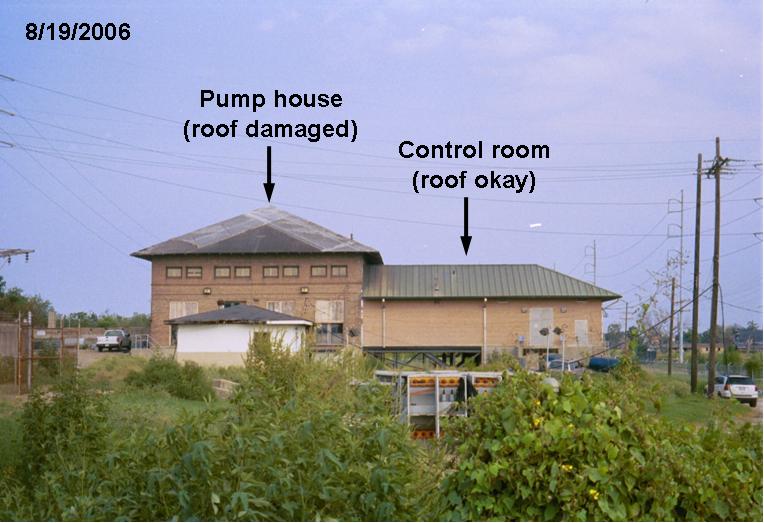
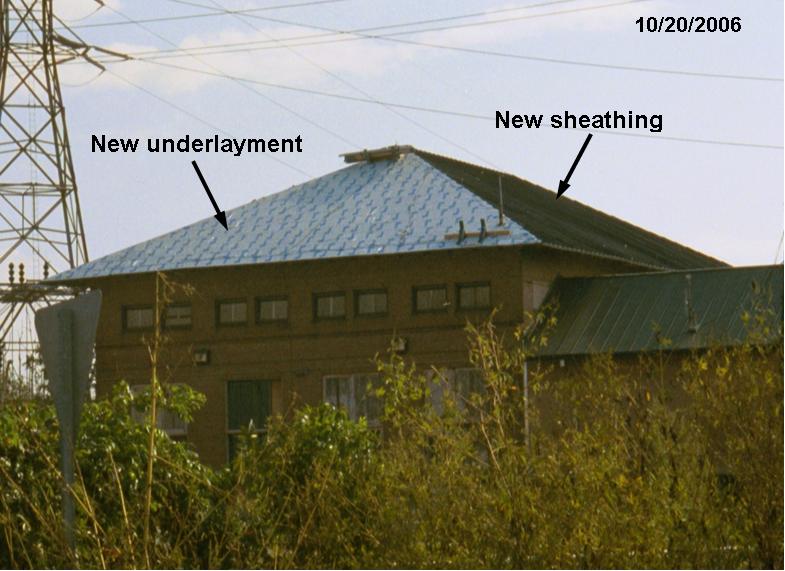
Station 5: I was very pleased to see a great deal of work happening here. The old, shingled pump house roof has been scraped off, underlayment has been applied to all four sides of the roof, and sheathing is down on over the underlayment on two sides. Here's what station 5 looked like back in August:


And here is how it looked this past week:


I assume that rewinding work at this station is also suspended until they finish the roof, but I can't confirm that.

Only stations 2 and 5 have unfinished motor rewinding work.

Station 6: Work is complete here.

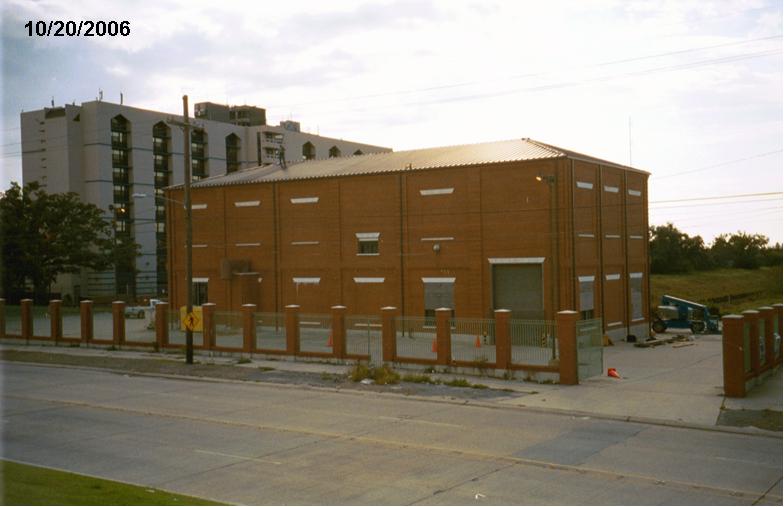
Station 10: As of Saturday, October 21, work is complete here. Here's how the station looked back in August:


And here it is this past week:

Look at that shiny new roof!

Station 11: Work here is complete. Here's how it looked before:


And this past week:


Station 13: Work here is very nearly complete.

When contractors are let loose on these jobs like roofing and rewinding, they do a good job. It is the Corps with their ridiculous lack of focus and cult of paperwork that is the problem in getting the Orleans Parish pump station repairs done.

Remember this key fact: $30 million still remains unspent on repairs to the stations, even though the funds were appropriated December 30th, 2005 and were officially transferred in February, 2006. As the Corps says, that's "phenomenal."

Saturday, October 21, 2006

What's up at the floodgates? New work underway

I have inserted the pictures that go with this post, and I have also modified some of the text. Since the changes make such a difference in the feel of the post, I am reposting the whole thing today. Enjoy.

As I've mentioned earlier, the Corps tests the floodgate pumps out of the media spotlight quite often. October 11 was one of those times.

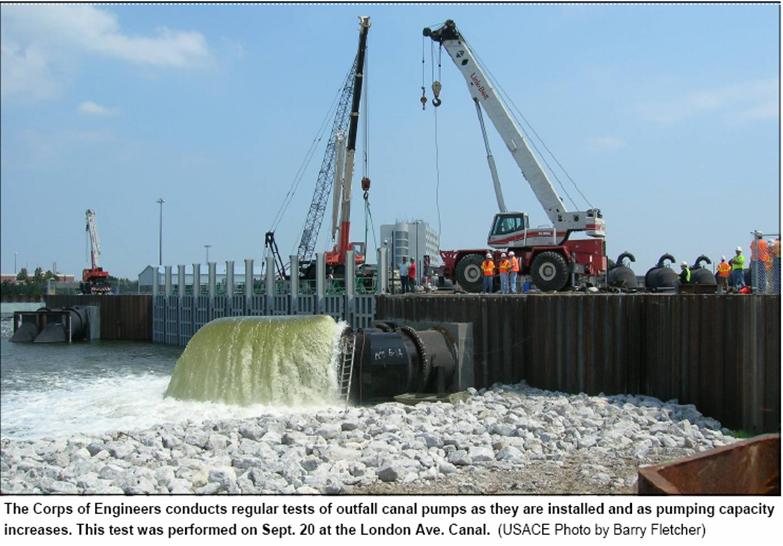
I visited all three outfall canal sites on the 11th and found there are a significant amount of changes going on at all three canals. Remember when the Corps invited the media to witness their testing of the pumps last month at the Orleans Avenue and London Avenue canals, and they temporarily turned the discharge pipes upward? There's a picture of a September 20 London Avenue test (which was not open to the press) showing this on page 5 of this Corps update. Here's the picture:


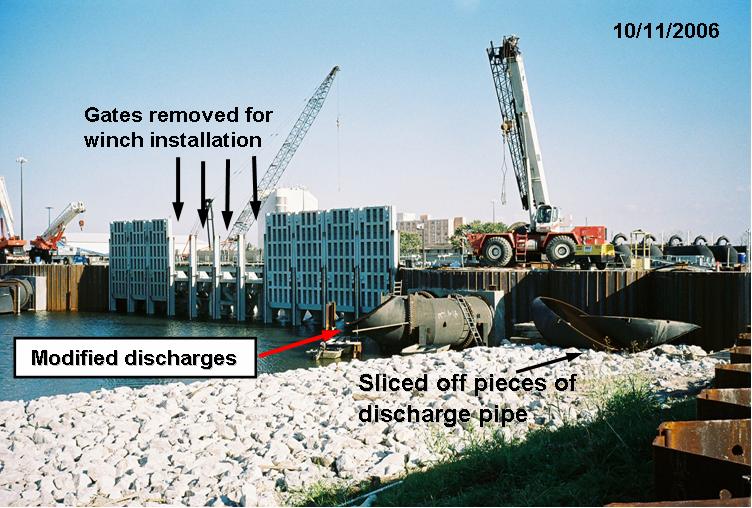
The idea was to roughly simulate storm surge conditions on the lake side of the gates by forcing the water to push against something - the upturned discharge. Well, they are making that change permanent by actually slicing off large chunks of those pieces of the pipe and turning the pipe 180 degrees so its discharge will permanently point skyward.

For reference, here is what the pump discharges at the 17th Street canal looked like before:


On the 11th, they were testing the effectiveness of those changes by running three of the pumps on the west side of the 17th St canal after altering the pipes on that side of the canal. The pipes on the east side of the canal are in the process of being modified. Here's a couple of pictures of the testing on the west side of the canal from October 11th. I have highlighted and labeled the modified discharge pipes.


Here's a welder cutting off what is known as a "padeye" on the east side discharge, in anticipation of slicing the entire end of the pipe off:


These changes are also being implemented at the other two outfall canal gate structures. They have done two of the four discharge pipes at Orleans Ave., and two of four at London Ave. as well.

Here's Orleans Avenue:


And here's London Avenue:


In addition, five of the ten Orleans Avenue pumps have been pulled out a second time, assumedly for further repairs. This is very surprising. Supposedly, the Corps had finished messing with the pumps. Here's a quote from the Times-Picayune article that described the September 14th Orleans Ave testing:

"After the vibration problems surfaced last month, the corps and its contractors building post-Katrina floodgates and pumping systems on the Orleans Avenue, London Avenue and 17th Street canals had the motors in all 34 new
pumps
[emphasis mine] retrofitted in hopes of reducing the shaking."

But now five of them are out - again. So what is the reason for the pumps being pulled again? The pumps are currently sitting on the east side of the deck at the Orleans Ave. gates. Here's a picture with the pumps highlighted:


What does all this mean? As I see it, there are two possible explanations:

Explanation 1. The change is closely related to the vibration problems. Turning the discharge pipe outlets upward would help keep the pipes full of water during testing and operating. However, such a solution would be totally different from what the Corps said was the problem: hydraulic motors. Coupled with the fact that the pumps have been pulled at Orleans Avenue a second time, I think the pump vibration story is still going. I'm wondering if the vibration problem is permanent and this modification to the piping is the Corps' way of simply living with it.

This is a little (not a lot) worrying, because it seems that "living with it" entails a decrease in pumping capacity. According to the September 16th Times-Picayune article about the London Avenue testing, the pumps are to be run at reduced capacity:

"Two pumps that were run at almost 85 percent capacity [my emphasis] did not vibrate, and a third experienced an insignificant amount of pulsation, said Col. Jeffrey Bedey, commander of the Army Corps of Engineers' Hurricane Protection Office."

So in order to keep the shaking away, they can't run the pumps full out?

Explanation 2. The Corps realized they didn't follow their own regulations for backflow prevention, as found at the bottom right of page 1 here, and are rectifying the situation. That is, the original design for the pump discharge lines only included a single method of backflow prevention (siphon breaker valves), while the regulation says, "...two means shall be provided to prevent backflow when the discharge is through the protection." I think this idea of correcting the design is a more remote possibility. However, on the good side, the change does make backflow a little less likely.

For more about backflow prevention at the gates, you can read this post.

In any case, I think the Corps needs to update the public on why they are literally slicing and dicing a design that has already been constructed. It certainly brings into question how adequate the rest of their design is and whether they'll be making other changes. However, if it is meant to improve things, they should say so. They're so reticent to announce any news, even when it's good news.

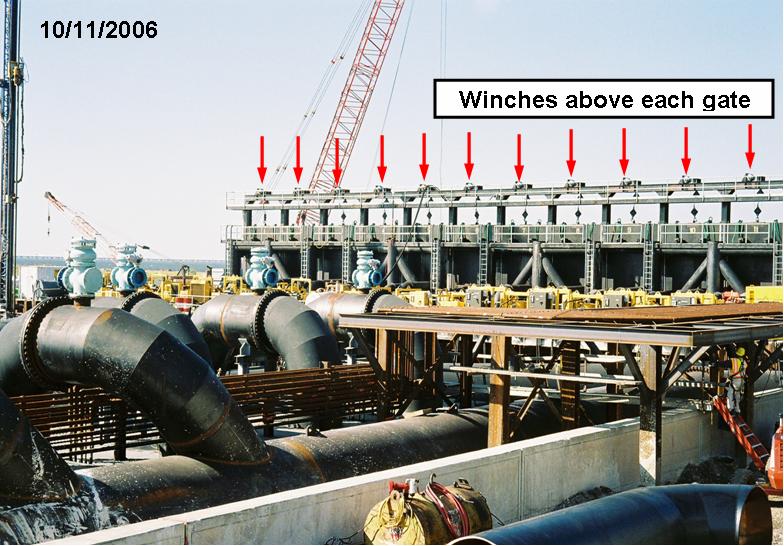
In other floodgate news, the Corps is moving toward installation of automatic hydraulic winches at all three gates. This is good. It will eventually take the cranes out of the equation. The cranes currently raising and lowering the gates cannot operate in winds over 30 mph. With the automatic winches, that problem goes away, meaning the gates can be lowered at a time much closer to landfall, which in turn means that the city can continue to pump out rainwater for much longer.

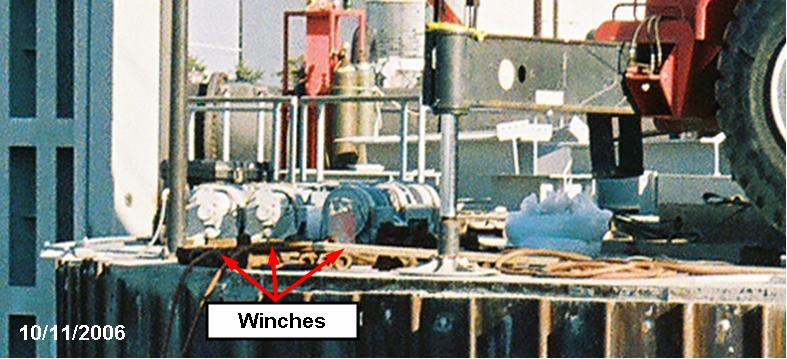
The winch installation at 17th St was finished about 2.5 weeks ago, but the winches are not operational yet. Here they are highlighted:


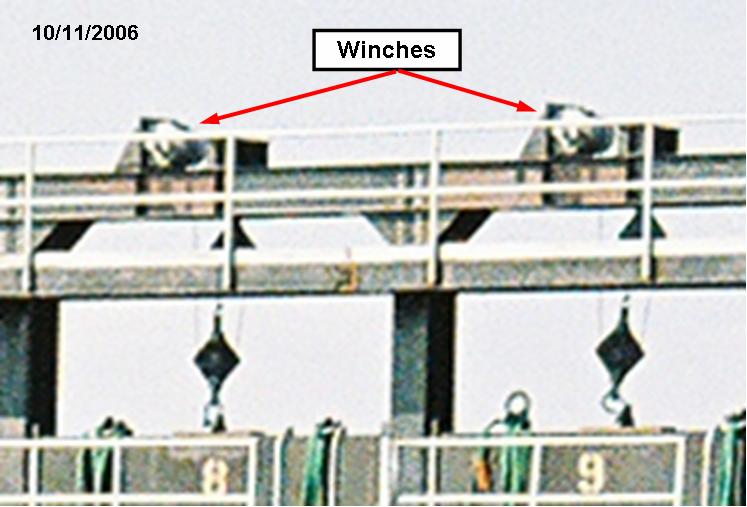
And here's a blowup from that picture:

Note the green straps. That's what the crane hooks on to in order to raise and lower the gates.

Since the winches are working yet, they are still using a crane to move the gate sections up and down at 17th Street. Here's a picture of the crane doing so with needle gate number two:


Here's a detail from the above photo. It shows the workers handling the crane line and the green straps just after securing needle gate number two:


At London Ave, they have actually removed four of the gate sections completely (a scary sight considering we're still in hurricane season) in anticipation of installing a framework to support the winches. The winches are on site and can be seen on the west side of the gates. Here's a closeup of them:


They have not begun winch work at Orleans Avenue yet.

You can find the exact model of winches at this link.

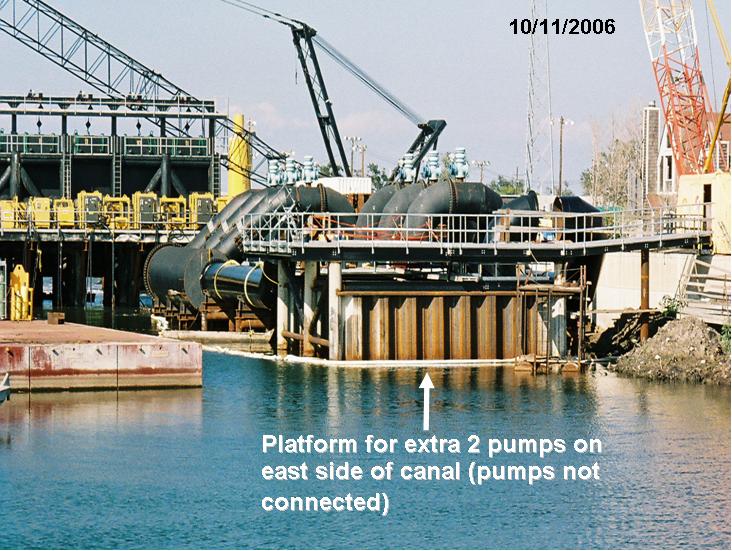
Finally, it is worth pointing out again that the Corps missed a deadline at the 17th Street gates at the beginning of this month. You can find the deadline at this webpage. They were supposed to have two extra pumps on line on the Orleans side of the canal on September 30th. The pumps are not ready, and won't be for a number of weeks. Here's a picture of the platform on the east side with both pumps not hooked up:


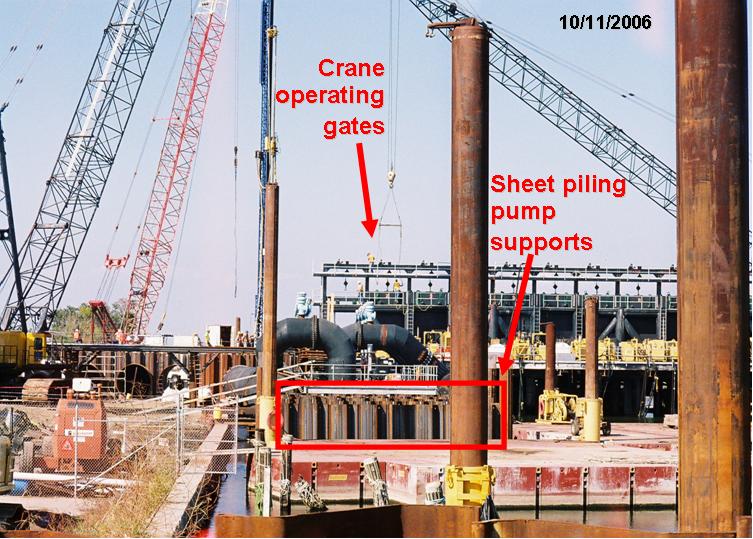
In addition, the Corps is supposed to have four more pumps ready on the Jefferson side of the canal by the end of this month. They will definitely not be ready. The pumps and their engines have not even arrived on site yet, and the Corps only started driving piles for the platform to hold those pumps within the last three weeks. The Corps will be fortunate to have those four pumps running by Thanksgiving.

And once again, here's the picture of the west side, in which I've noted the beginning of the work for the quartet of pumps:

Sunday, October 15, 2006

Roofing work continues

Yesterday, the Times-Picayune covered the roofing work at the pump stations - sort of.

They ran the following picture on the front of the Metro section:


These are Crown Roofing Services workers on top of the roof of Station 2 in Mid-City. The caption says, "Wearing biohazard suits and respirators, workers scrape and bag asbestos tiles as the begin repairs to the roof of the New Orleans Sewerage & Water Board's Pump Station No. 2 on North Broad this week"

Crown has ripped off the shingles on all four sides of the roof as of today, and has placed Soprema Lastobond Shield HT underlayment on three sides of the roof. There is significant damage to the gutters and downspouts at station 2, so work there may take another three weeks.

Work has not yet commenced at Station 3. I do not know the status of work at station 5 since I visited there two weeks ago. Those are the other two stations on Crown's seven-station roofing contract, as I described a few posts back.

Friday, October 13, 2006

A step back

Let's take one step back and summarize the "phenomenal" job the Corps has done:

Missed deadlines for installation of pumps at 17th St canal floodgates: June 1, July 9, September 7, September 30, October 31 (anticipated).

Missed deadlines for work on Orleans Parish pump station repairs: three sets (set given on March 15th to S&WB, set given on June 22nd to City Council, set given on August 17th to industry vendors).

Money remaining unspent on Orleans Parish pump station repairs: $30 million.

Days since Katrina: 410.

Days since Corps gave itself a medal for fabulous job rehabbing the flood control system after their own mistakes: 135.

That last one refers to the awarding of the Wheeler Medal to Walter Baumy, the Chief of the Engineering Division at the Corps' New Orleans District.

You see, the professional organization to which most of the Corps' professional staff belongs, the Society of American Military Engineers (SAME) held a banquet the night of the first day of hurricane season this year, June 1. At that banquet, called the Society Ball, they gave out a bunch of awards, among them the Wheeler Medal. Here's the press release announcing Baumy's win. The key quote is this:

"Baumy served as the senior civilian and engineer within the USACE Task Force Guardian, leading the effort to repair the Greater New Orleans Hurricane Protection System by June 2006. As such, he oversaw the restoration of more than 169-miles of ravaged hurricane protection system, 68 pumping stations and four water control structures. This $800 million construction program was executed in the 276 days between Aug. 29, 2005, when hurricane Katrina struck and June 1, 2006, the start of the new hurricane season. Baumy also was personally involved in the engineering of improved designs of the earthen levees protecting the city of New Orleans, and in the stability improvements to miles of floodwall repairs."

As we now know, there were no pump stations restored under Task Force Guardian's watch. Don't take my word for it. Here's a Corps project manager quoted in the September 25th New Orleans CityBusiness:

"Since June 1 the pace has been phenomenal," [Corps project manager Daniel Bolinger] said. Prior to that, Task Force Guardian, the Corps agency overseeing repairs to levees and floodwalls damaged by Katrina, was not focused on repairing pump stations. TFG had begun assessing damages to pump stations, but the majority of pump station repairs never began under TFG, Bolinger said. TFG dissolved June 1.

So one would wonder how one person could get an award for restoration of 68 pump stations, when that restoration was obviously not done? Well, if that award wasn't bestowed by an independent organization, but was instead given by that person's clueless bosses, then it might be possible, right?

That's exactly what happened. The winner of the Wheeler Medal - titularly given by SAME for "outstanding contributions to military engineering by a civilian or uniformed member of the Army," - is actually selected by the Army Corps of Engineers! What chutzpah!

By the by, I have verified this information with the head of SAME, Dr. Robert Wolff (rwolff@same.org), who promised he would pass my concerns along to the right people at the Corps. I have never heard back.

Here's a picture of Baumy getting his award from Major General Ronald Johnson, the number two military man in the entire Corps of Engineers who gave the keynote address at the conference:


By the way, the local Public Affairs office at the New Orleans District must have known what an embarrassment this was, because they didn't even announce it themselves until August 8th, in this newsletter.

So just in case you'd like to voice your feelings about this, here's some email addresses:

Colonel Richard P. Wagenaar, Commander, New Orleans District of the Corps Richard.P.Wagenaar@mvn02.usace.army.mil

Lieutenant Colonel Murray P. Starkel, Deputy Commander, New Orleans District Murray.P.Starkel.LTC@mvn02.usace.army.mil

Colonel Jeffrey Bedey, head of the Hurricane Protection Office at the New Orleans District, which has direct responsibility over the pump station repair contracts and the floodgate projects Jeffrey.A.Bedey@nwo02.usace.army.mil

Jim St. Germain, Project Manager, New Orleans District; author of the Orleans Pump Station PIR James.J.StGermain@mvn02.usace.army.mil

Christophor Gilmore, Project Manager, New Orleans District; author of the Floodgates PIR Christophor.e.gilmore@mvn02.usace.army.mil

Greg Breerwood, Deputy for Planning, Programs and Project Management, New Orleans District Gregory.E.Breerwood@mvn02.usace.army.mil

Walter Baumy, Chief of Engineering Division, New Orleans District walter.o.baumy@mvn02.usace.army.mil

Michael Lowe, Chief of Emergency Operations, New Orleans District Michael.L.Lowe@mvn02.usace.army.mil

Brigadier General Robert Crear, Commander, Mississippi Valley Division (MVD) of the Corps (MVD is above New Orleans) robert.crear@mvd02.usace.army.mil

Colonel Albert M. Bleakley, Deputy Commander, Mississippi Valley Division albert.m.bleakley@mvd02.usace.army.mil (this one is a guess based on BG Crear's address above; I couldn't find it online)

David Sills, Chief of Emergency Management and Security Division, Mississippi Valley Division david.w.sills@mvd02.usace.army.mil

To make copying into a "to:" field easier, here they are all together: Richard.P.Wagenaar@mvn02.usace.army.mil, Murray.P.Starkel.LTC@mvn02.usace.army.mil, Jeffrey.A.Bedey@nwo02.usace.army.mil, James.J.StGermain@mvn02.usace.army.mil, christophor.e.gilmore@mvn02.usace.army.mil, Gregory.E.Breerwood@mvn02.usace.army.mil, walter.o.baumy@mvn02.usace.army.mil, Michael.L.Lowe@mvn02.usace.army.mil, robert.crear@mvd02.usace.army.mil, albert.m.bleakley@mvd02.usace.army.mil, david.w.sills@mvd02.usace.army.mil

Tuesday, October 10, 2006

The Corps knows best

Let's take a closer look at the roofing repairs at the pump stations...

I found a pdf version of the September 25th New Orleans CityBusiness article on pump station repairs. I've downloaded just the article and made it available here. Or you can look at the entire edition of CityBusiness from that day here.

The pdf version includes the sidebars that were in the print edition but not the online edition. One of the items in those sidebars is the list of seven pump stations at which Crown Roofing Services will be doing roof repairs.

That list is:
Station 11 (repairs underway)
Station 13 (repairs underway)
Station 10 (repairs underway)
Station 6 (repairs underway)
Station 2 (repairs not yet started)
Station 3 (repairs not yet started)
Station 5 (repairs not yet started)

I applaud the Corps for getting this work underway and (hopefully) completed within 60 days, as the article says. Just for reference, the repairs at 2 and 3 and not particularly critical, as there isn't any equipment under tarps at those two stations. However, at station 5, in the Lower Ninth Ward, a motor-generator set (basically a small frequency changer) does have a tarp over it due to roof leaks. Here's a picture of the station 5 roof:

The section on the left is the part of the building where the pumping equipment is housed. The section on the right is the control room. The control room roof is fine, but you can see the pump house roof is in bad shape at its peaks. Considering the fast pace Crown Roofing is setting, I wouldn't be surprised to see work commence at station 5 within the next week.

However, the Corps appears to be a little short in the amount of roofing work that is necessary. Here's the station-by-station status report from the Sewerage & Water Board as of June 22nd. The first column lists all the stations requiring roofing work, and prioritizes them from 1 to 3, with 1 being the most critical need.

While the seven stations included in Crown's contract are on the S&WB list, there are SEVEN others that are not. I've listed those stations below, along with their S&WB repair priority and the applicable text from the Corps' own Orleans Parish Pump Station repair PIR:

Station 4 (S&WB priority 3): Corps says, "About 40’ of the metal roof along the north edge was peeled back, and should be repaired."
Station 7 (S&WB priority 3): Corps says nothing; roofing is not mentioned in PIR.
Station 14 (S&WB priority 2): Corps says, "The entire flat built-up roof and copper flashing were damaged. Approximate dimensions are 28.5’ X 37’...The control room roof and concrete block walls are damaged and require replacement."
Station 15 (S&WB priority 2): Corps says nothing; roofing is not mentioned in PIR.
Station 19 (S&WB priority 2): Corps says, "The roof is leaking along the valley running lengthwise along the center of the building, as well as over the electrical panels on the south side of the building. Repair of copper standing seam roof is recommended."
Station 20 (S&WB priority 2): Corps says, "The roof of the office building (41’ X 43’), consisting of a flat concrete slab, topped by built-up roofing, was cracked and leaking. There was evidence that the built-up material had blown off. It is recommended that the existing concrete roof be replaced (without the 5’ overhang), and that the new built-up roofing be installed."
I-10 station (S&WB priority 2): Corps says, "The roof leaks. It is apparent that the joint sealant between the pre-cast panels had blown out; therefore, all the joints should be resealed."
As you can see, most of that list is a priority 2. From what I can recall, there's no equipment with tarps at stations 4 and 7. I don't know about any tarping at stations 14, 15, 19, or I-10. However, I can definitely say that station 20 has a tarp over one of the control panels for one of the two pumps at that station. Who but the S&WB would know best which stations need roof repairs? Apparently the Corps would, because despite the Corps' own report recommending roof repairs, those repairs aren't included in Crown Roofing's contract.

Let's look a bit at the results of the Corps' delays and know-it-all attitude. Station 20 today stands as a monument to Corps inaction. The place looks like the storm came through yesterday. Here's a picture of a piece of the roof on the ground next to station 20:


The roofing is the black stuff laying on the grating.

And here's a ladder that was ripped off the second floor walkway:


In the photo above, you can see brand new levee repairs along the north side of the Gulf Intracoastal Waterway about 500 feet from the ladder.

Here's a picture taken from atop those repairs. The generator building is on the right, and the pump house is on the left. At the bottom of the photo is the new armoring on the levee. As you can see, it's not like the Corps didn't know there was work to be done on the station. They were working within sight of it for most of the winter and spring. By the way, you can see in the two photos above that they have not put down grass on the levee, which means it still remains vulnerable.

Up close, you would never even recognize the station as a functioning facility, but it is - barely. There are two 250 cubic feet per second (cfs) vertical pumps at this station:

Their motors are housed inside the building. Power is transmitted via a right angle gearbox at the top of those large black columns to the pumps near the bases of the columns. By the way, look closely and you can see that all the flashing around the edge of the roof is gone. I couldn't see the roof when I visited, but I doubt it's in terrific shape.

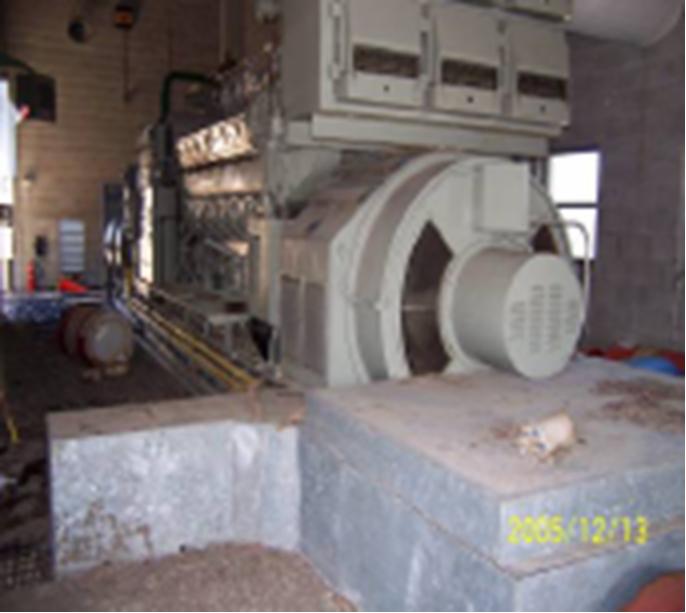
The station has its own backup generator. The generator was placed at ground level when the station was first built. It was inundated by the Katrina storm surge. Here's a picture of the generator taken in December, from the Corps' own Orleans Parish Pump Station repair PIR. I can tell you that it still looks exactly the same. It will need to be replaced, as will much of the building surrounding it.

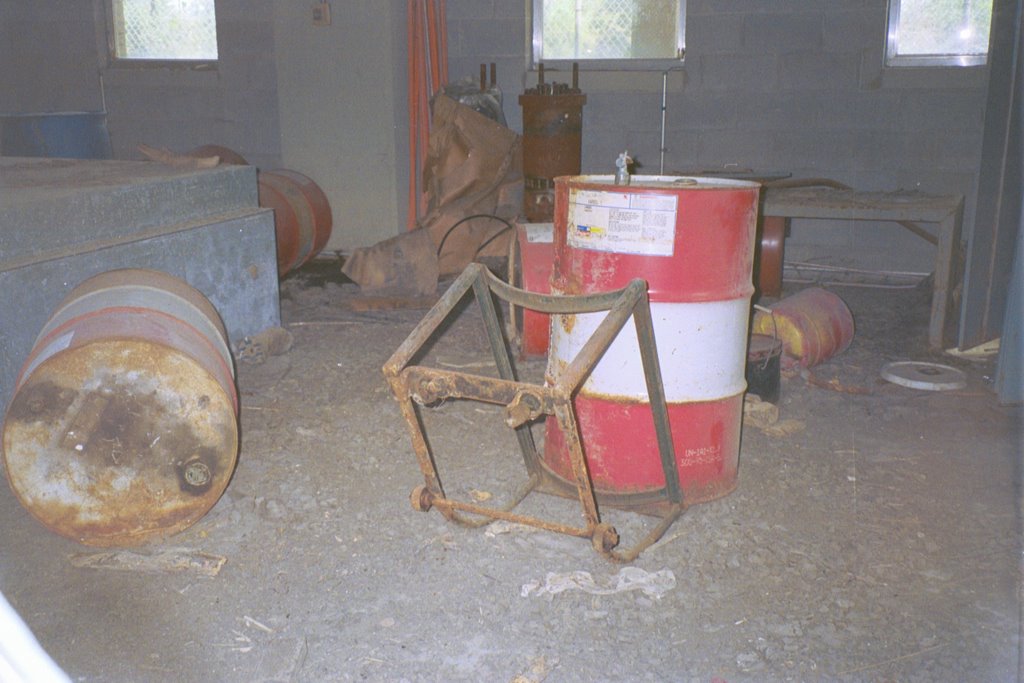
Yes, that is mud in the lower left of the frame. The floor of the generator building is covered in about a foot of mud that came washing in during Katrina. It is all still there, along with a particularly acrid smell of fuel. Here's a picture of the area just to the right of the above photo, taken just a couple of weeks ago:

Note the barrel on the left in my picture. You can see the edge of it in the picture taken by the Corps back in December. This place has not been touched in over a year, which is obvious from all the weeds you can see in the pictures above.

There's a kind of tragicomic beauty to Station 20. It's isolated, literally at the end of a dirt road, and there's no one around except for the birds. It's pretty in the same way that ruins elsewhere are pretty.

However, it shouldn't look like a ruin. It's a real, functioning piece of our city's infrastructure for which citizens pay taxes. Local residents and business owners depend on it for drainage. The Corps has let it rot, as with many of the other stations around town. All because they know best.

Monday, October 09, 2006

Bid solicitations are hard!

At least, that's what the Corps would have you believe. Let's look at the September 25th article from New Orleans CityBusiness again, specifically, the passage about why the Corps says bid solicitations on the Orleans Parish pump station repairs have been delayed:

"It wasn’t until May 1, eight months after Katrina, that the Corps approved a project information report detailing the pump station damages, [Corps of Engineers project manager Daniel Bolinger] said. On May 3, the city of New Orleans signed an agreement authorizing the repairs, he said.

Another factor is the time it takes to design the repairs, which are then bundled into contracts, advertised for bids and awarded, he said."

What they are speaking about there is the creation of specifications for the repairs. That can take a very brief time (if the item has been purchased many times before or the specification author has experience in the area) or it can take a little while (if the item is unusual or the author has little experience in the area).

So let's look at the Corps' bid solicitations and try to find the parts that would cause a 13 month delay. I've gotten my hands on a few since the storm.

One of the jobs that still has to be bid is the repair of the four frequency changers in New Orleans. Frequency changers are huge devices that convert 60 cycle per second (or Hertz, abbreviated Hz) electrical current received from the local utility - Entergy New Orleans - to 25 Hz current that can be used by the older pumps in the Sewerage & Water Board drainage system. Those pumps can be found at nearly every station west of the Industrial Canal, and at station 5 east of the Industrial Canal in the Lower Ninth Ward.

The frequency changers provide a ready supply of power to 25 Hz pumps while the main S&WB generators are started. I have been told that it can take about twenty to twenty-five minutes to get the drainage pumps' generators started. In that time, water could be pooling in the streets. So the frequency changers are started immediately when it starts raining really hard and can provide power during that fallow period.

However, the frequency changers cannot provide power to every pump in the system. Only one 25 Hz pump per station is set up to receive power from the changers. In general, it is pump "C." But when one considers that each of those pumps is 1000 cubic feet per second (cfs), it is a significant amount of pumping that is enabled in that critical time when the rain really starts falling.

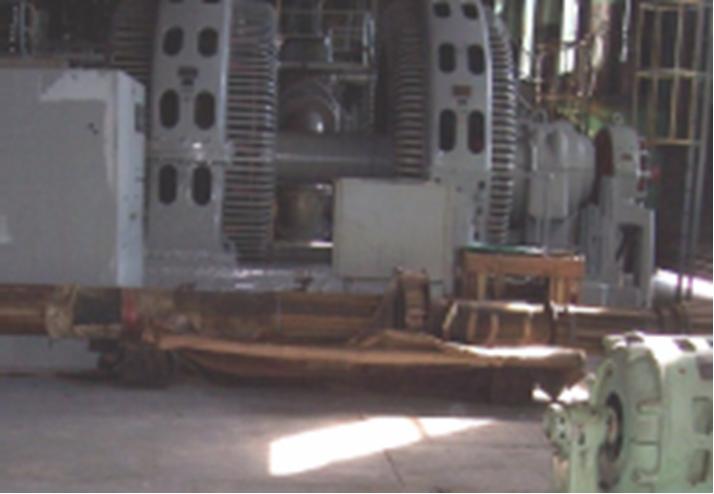
The frequency changers are basically two very big motors rotating on the same shaft. Here's a picture of one, taken from the Orleans Parish Pump Stations PIR (surrounded by a white line):


One motor is powered by the incoming 60 Hz power and turns the shaft for the other, which acts as a 25 Hz generator. Similar devices are still used today to convert power between the European power frequency standard (50 Hz) and the U.S. standard (60 Hz), or the other way. Another application is for use in the aerospace industry, where 400 Hz is a common frequency aboard planes. Frequency changers are used to power the plane when it's on the ground hooked up the airport's 60 Hz or 50 Hz power system. The job of changing frequencies can also be handled electronically with no moving parts. These devices are normally called frequency converters.

As I said, there are four frequency changers in New Orleans. Two (numbers 1 and 2) are located in a non-descript building called the Carrollton Facility at 8404 Earhart Blvd. The others (numbers 3 and 4) are located at Station 17, which is near the intersection of I-10 and I-610. It's the smaller dark green-roofed building just north of the railroad tracks in the middle of this photo.

The changers in Station 17 have been sprayed with high pressure fresh water and dried and placed back into service (just like the pump motors were just after the storm). The ones at the Carrollton Facility have not been touched since the storm, remaining out of service. All four were submerged by salty floodwaters and require rewinding, just like the pump motors. If you don't believe me, listen to the Corps in the Orleans Parish Pump Station PIR:

Station 17: "Flood waters inside the building reached a height of 2 feet. The motors for drainage pumps A and D and four motors for frequency changes [sic] 3 and 4 were submerged and require rewinding."

(Part of that quote is actually an error; pumps A and D are connected to a common motor)

Carrollton Facility: "Floodwaters reached a height of 2 feet above the floor slab. The motor pits were flooded inside the building and the transformers outside received about 2 feet of water. The four frequency changer motors require full rewinding along with rewiring conductors in the pits and replacing the battery rack and drip pans. The outdoor electrical equipment requires cleaning and repairs."

So it would seem that since the Corps issued the motor rewinding contracts in May, it would be an easy thing to issue a solicitation for rewinding of the frequency changers. After all, they are basically the same devices as the motors, so those specifications should be nearly identical. Admittedly, there's extra work because there is other equipment to be fixed, but why should it take months to get the specifications for that work together?

Maybe, as the Corps claims, the specifications are so incredibly complicated that it really does take months to write them. So let's take a really close look at the specifications for the motor rewinding contract and see if we can find the complex bits.

The motor rewinding solicitation is a single 40 page document. There were no other drawings or appendices. The first page is a title page that is filled out by Corps personnel. It has a table of contents, the date of the solicitation and some other basic information on it. It's simple.

The title page is followed by a pricing sheet that the bidder is to fill out. It shows a detailed list of the items on which the bidder is supplying prices, along with lines for the bidder to place their price. In the motor rewinding solicitation, this section takes up 3 pages and is very simple.

The pricing sheets are followed by a paragraph of special non-boilerplate directions to the bidders. This is less than a page.

After that are the actual technical specifications. These are pretty dense on the technospeak, and take up 7.5 pages. However, 1.5 pages of that is a simple list of the pumps with motors to be rewound and addresses of the pump stations. Another half page is just blank space. And another page is taken up with requirements for inspections, schedules, and submittals by the vendor. That leaves 5 pages of actual technical writing. Considering that most specifications are not written from the ground up, but are copied from other sources, and also considering that we know the S&WB had handed specs over to the Corps, there is no way the actual technical writing could have taken longer than one to two weeks, if that much.

After the technical section comes 8.5 pages of standardized wage determinations from the Labor Department. You can generate the exact same output as appears in the bid solicitation by clicking through a few questions at this government website. Choose the "Selecting SCA WD's" link and follow the prompts. It took me about a minute to generate the same table (or one very much like it) as appears in the bid solicitation. So clearly that section is not the tough one.

We're now up to page 21 of the 40 page document. From page 21 to the final page, the solicitation is boilerplate commercial provisions. By "boilerplate," I mean that there is no original writing, but copying and pasting from other sources. By far, the largest source is clauses from the government's Federal Acquisition Regulation, also known as FAR. Specifically, all the clauses referred to in this solicitation are taken from Part 52, Solicitation Provisions and Contract Clauses.

The basic idea of the commercial sections in a Corps bid solicitation is to select applicable clauses from Part 52 of the FAR and include them, either by reference or by copying and pasting the full text. I suppose those clauses that are included with their full text are more important.

The breakdown for the remaining 20 pages is as follows:
-Clauses from FAR Part 52 (reference or complete text): 10 pages
-"Accident Prevention Program - Administrative Plan" form: 8 pages (3 of which are mistakenly included twice). The form - which is meant to be filled out by the bidder and is thus blank - is a standard one for the N.O. District and has been used in many previous solicitations.
-Corps evaluation criteria - 2 pages, both of which are boilerplate from many other N.O. District solicitations.

Here's an example of the work in the commercial section. Page 21 is titled "Section E - Inspection and Acceptance" and consists of the following:


While there is obviously some effort involved in pulling together the commercial provisions, it's not like they have to be created from the ground up. It's more like choosing items from a Chinese restaurant menu. Considering how many professionals the New Orleans District Contracting office employs, and how many solicitations they routinely churn out, there's no way it would take longer than a few days to put together the commercial section of such a solicitation. Thus, the commercial section is not the tough part.

So that's it. Of the 40 pages in the solicitation, just 5 are actual technical writing that require original work. The other 35 are either generated automatically on a government website (about 8 pages), are simple pricing and title sheets (4 pages), or are boilerplate forms and provisions that are common to numerous solicitations put out for years by the New Orleans District (about 23 pages).

The frequency changer rewinding bid solicitation would look very similar to the motor rewinding solicitation, with perhaps a few more pages of technical writing. Can someone at the Corps please explain what in the world is taking so long? If it is so obviously easy to put together a solicitation (and the others I have are no more complicated), why haven't they done so and issued them? A recent college graduate could do it in less than a week.

Friday, October 06, 2006

Snake eats own tail - details at eleven!

I stumbled across this New Orleans CityBusiness story from September 25th today. I had no idea this was being written. It uses some quotes I gave the reporter before the August 24th dry run of my September 6th presentation.

It's the first news article in nearly four months that gets someone from the Corps on record about the pump station repairs. It also quotes me liberally.

There's a lot to talk about in this article. But there are some things that jumped right out at me, and ought to upset everyone in New Orleans, not to mention St. Bernard and Plaquemines Parishes.

First is these two paragraphs:
"…Task Force Guardian, the Corps agency overseeing repairs to levees and floodwalls damaged by Katrina, was not focused on repairing pump stations. TFG had begun assessing damages to pump stations, but the majority of pump station repairs never began under TFG, Bolinger said. TFG dissolved June 1.

'Task Force Guardian had a tremendous amount of work to do, did a tremendous amount of work and accomplished what I consider to be an almost unaccomplishable task,' he said."

Now note that "not focused" is the writer's words, not the Corps guy's. But, still, it's a shocking thing to say, especially in light of the following quotes from long before June 1:
"For non-federal flood damage reduction projects, including pumps and pump stations, not active in the RIP, at full federal expense use FCCE funds, to 1) undertake permanent rehabilitation to pre-storm condition" - Memorandum to Assistant Secretary of the Army (Civil Works) J. Paul Woodley titled "Recommendations for One-Time Deviations to Certain Policies Regarding Use of P.L. 84-99 (33USC701n) in New Orleans & Vicinity following Hurricane Katrina - FOR APPROVAL," dated October 7, 2005.

The recommendation quoted above was approved by Mr. Woodley on October 12, and then received approval from the Office of Management & Budget (OMB) in the White House on October 17. I don't think this recommendation was ever acted upon, though one has to wonder what happened to the money that followed the recommendation.

There are other quotes from Corps documents before June 1:
"Based upon applicable regulation and guidance, I consider the Metropolitan New Orleans Area to be under an imminent threat from flooding due to the damaged hurricane protection system. I consider this threat to remain in effect until the hurricane protection system is restored to its pre-storm condition." - Memorandum for New Orleans District Staff and all Interested Parties from the New Orleans District titled "Imminent Threat of Flooding Due to Damaged Hurricane Protection Works," dated January 5, 2006.
"Contract - Contract Award
Roof repairs - 5/1/2006
Motors & Bearings - 5/1/2006
Offices - 4/30/2006
Discharge Line - 6/20/2006
Fencing - 5/5/2006
Building Repairs - 6/15/2006"
- From presentation by Jim St. Germain, Corps project manager, to Sewerage & Water Board about the activities of Task Force Guardian, March 15, 2006. Not one of these deadlines was met.
"TF Guardian was tasked with completing repairs to 68 non-Federal pump stations damaged by Hurricane Katrina in the four parishes in the New Orleans Metropolitan Area." - U. S. Army Corps Of Engineers Response To Hurricanes Katrina & Rita In Louisiana Environmental Assessment EA #433, April 17, 2006. This was the first document released to the public regarding Task Force Guardian's work.

So was all of that just words? Apparently so. Should anyone at the Corps be surprised that no one believes them?

There's also this passage in the CityBusiness article:
"[Corps project manager] Bolinger points to multiple factors he says have delayed repairs. For one, repairs could not begin until the third supplemental spending bill funds were approved, he said. Then, a project information report detailing pump station damages had to be completed. Also, the Hurricane Protection Office overseeing pump station repairs was created June 1, only three months ago. 'Since June 1 the pace has been phenomenal,' he said."

Here's the facts:

a) As the October 7th letter quoted above shows, it certainly appears the Corps could have been spending money on pump stations last October, not waited until legislation wormed its way out of Congress. In fact, waiting for legislation was one of the other options presented and declined in that letter. But let's play on the Corps' bizarro field of play and say they absolutely, positively had to have legislation.

b) The Third Katrina Supplemental was signed into law December 30, 2005. Within five weeks after that, almost five dozen contracts had been issued for levee repairs and construction of the floodgates. That was before the money was even officially received by the New Orleans District from the Treasury in February.

c) Some of those contracts were for work that was definitely not as urgent as pump station repairs. For example, there was this bunch of work over by Lockheed-Martin's Michoud facility on the Gulf Intracoastal Waterway. There were improvements installed on the levees there that were definitely not repairs. I'm speaking of the addition of the earthen stability berm. One has to wonder why levees that were not breached, and which protect hardly any homes, can get reinforced with federal funds devoted strictly to repairs, while the outfall canal levees, which protect hundreds of thousands of homes, remain just as weak as the day of the storm. By the way, note that the project also remains uncompleted. It's not the only one. As you can see on this page, there are at least ten Task Force Guardian projects on the levees that still aren't done, despite the Corps insistence that they finished on June 1.

d) And as far as a PIR being approved, the Corps managed to get PIR's for the pump stations in Plaquemines and St. Bernard Parishes approved on January 22, 2006. That brings up two questions:

1) What took so long getting the Orleans Parish pump station PIR approved?
2) Why didn't the Corps begin work in St. Bernard & Plaquemines Parishes as soon as the PIR's were approved?

That second question is not academic. The Corps regulations on which all of Task Force Guardian's work was based specifically say these repairs are to begin within 60 days of PIR approval. That regulation was not suspended by the October 7th memo. Here's the actual regulation:
"Contracts for repair of damaged FCW's will be awarded within 60 days of project approval, or, if the equipment rental method of repair is used, then the repair work must be initiated within 60 days of project approval. Any exception to this 60-day time frame must be approved by the MSC, and reported via SITREP." - Corps Engineering Regulation ER 500-1-1, Chapter 5, paragraph 5-2.

e) From June 1 to the date of this article (September 25), the Corps issued precisely two contracts dealing with pump station repairs: one for roofing in Orleans Parish (which was not publicly advertised, and which still does not appear on the Corps page supposedly showing all their contracts awarded), and one for bearing supply and repairs in stations 1, 6, and 19. And the bearing contract was awarded just five days before the article was printed. If that's "phenomenal," I'd hate to see what normal is.

Keep in mind we are now over 13 months out from the storm. Although - to be fair - by the Corps' standards, where process and churn are results unto themselves, I'm sure they believe they've done a lot. The problem is that their standards are like nothing in the known world where the rest of us mere mortals exist. Out here, actual results are what count. By that common sense measure, their pace has been glacial.

f) Why must the Corps wait for a new bureaucracy to be formed before they pull together some specs and get a bid solicitation out? I speak from a hell of a lot of experience in this field. I have put together dozens of specifications and bids, as well as evaluating them, turning them into purchase orders, and then following up all the way through change orders, installation, and startup. It is NOT a difficult task. The work they say they are doing (but have now admitted they weren't for nine months) is baby engineering. Heck, in some cases, they've even had the specifications handed to them.

The perfect example is the roofing contract. The Sewerage & Water Board gave the roofing spec's to the Corps in April. You can see that at the bottom of this June 22nd progress chart from the S&WB ("Roof Repair Priority identified specifically for COE on 4/28/06") and on page 9 of this June 22nd S&WB update ("S&WB furnished specifications and drawings have been provided to facilitate the Corps efforts but to date, only motor work is in progress"). So why in the world did the Corps take so long to get the contract out? I'll tell you why. They don't care. They couldn't care less if a pump operator got injured because they couldn't do the simple task of putting out a contract. It's not like they don't know how to put out contracts. Look at their awarded contracts page. It's filled with contracts going out every week. The simple answer is that they just don't care.

I'll be returning to this article for more analysis and commentary in future posts.

Clock of shame, days 7 through 12

I'm afraid I've been remiss with this particular feature, so here's a catch-up post.

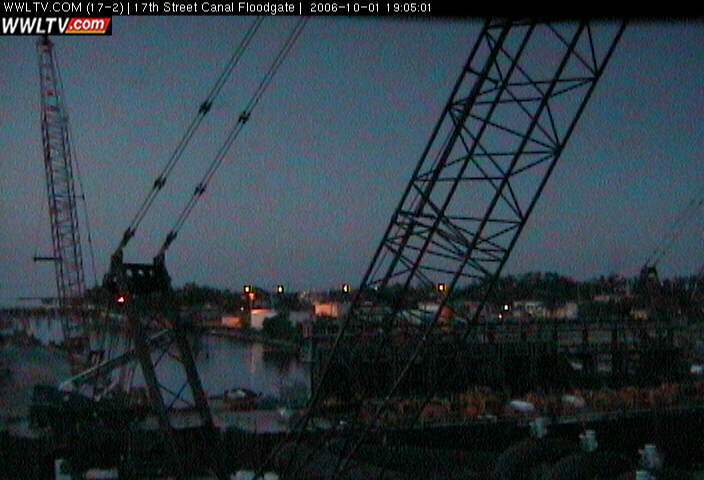
I took a screenshot one evening at dusk, so you can see both the 17th Street canal gate structure, and the usual set of lights that are on behind it. I also think it's kind of pretty in its own way:


Here's the after dark photos for the last six nights:

Sept. 30


October 1


October 2


October 3


October 4


October 5

As you can see, all those lights are coming from beyond the structure. There's still no work out there after normal quitting time, which I believe is around 6 PM.

Tuesday, October 03, 2006

Rewinding update #2

Here's an update of the progress of rewinding of pump motors which were due to be rewound under these two contracts. The original solicitation is here. The Times-Picayune article that first talked about the problem of unrewound motors is here.

Note: all the station names below are weblinks that take you to Google Maps pages with the stations' locations

Station 1
Pump "B," 550 cfs, rewinding complete
Pump "C," 1000 cfs, rewinding complete
Pump "D," 1000 cfs, rewinding complete
Pump "E," 1000 cfs, rewinding complete

Note: Pump "A," 550 cfs, burned up Dec. 15th and was rewound by the S&WB.

Station 2
Pump "A," 550 cfs, rewinding complete (as of today)
Pump "B," 550 cfs, rewinding complete
Pump "C," 1000 cfs, rewinding not started
Pump "D," 1000 cfs, rewinding complete

Note: according to solicitation, pump "C" was to be rewound before pump "B"

Station 3
Pump "A," 550 cfs, rewinding
complete
Pump "B," 550 cfs, rewinding complete
Pump "C," 1000 cfs, rewinding complete
Pump "D," 1000 cfs, not on rewinding list, but it should be. This pump has a metal housing around its motor, but the housing has not been opened for inspection since Katrina.
Pump "E," 1000 cfs, rewinding complete

Station 5
Pump "A," 550 cfs, rewinding complete
Pump "B," 550 cfs, rewinding not started (I'm not absolutely sure about this, but I'm pretty sure)
Constant duty pumps CD1 & CD2, 80 cfs each, rewinding in progress
Note: Original bid solicitation said pump "B" was to be rewound before constant duty pumps. Also, an amendment to the bid specifications said that CD2 was eliminated from the scope of work.

Station 6
Pump "D," 1000 cfs, rewinding complete
Pump "E," 1000 cfs, rewinding complete
Pump "F," 1000 cfs, rewinding
complete

Note: Pumps "A," "B," and "C" were previously rewound under S&WB contracts

Station 7
Pump "A," 550 cfs, rewinding complete
Pump "C," 1000 cfs, rewinding complete

Happy New Year!

Happy fiscal year 2007! I'm sure all of you are still getting over your hangovers from the big parties Saturday night.

Yes, we are now in the first quarter of FY2007. Why is this important? Because it marks yet another batch of deadlines which the Corps has again missed. But first, let me bring some good news.

I visited a number of pumping stations over the weekend to check on the status of work happening there. I happy to report that Crown Roofing Service's roofing work at station 11, station 13, and station 10 is proceeding expeditiously. I didn't get to station 6, but I'm sure work is going swimmingly there as well.

At station 11, where the roof is a simple peak (i.e. just two sides) they have insulation up on the entire east side of the roof and part of the west side. They have gone back with new plywood in some spots (perhaps the entire area covered by insulation). They are very close to starting to place the metal sheathing over the repaired areas. After that, the building will be ready for new gutters and downspouts. Note that all of the electrical equipment inside still has tarps (and in the case of one motor, a picnic canopy) over it. I imagine the Sewerage & Water Board will wait until the first big rainfall before removing them. I'd estimate about another week to two weeks before completion

At station 13, which is also a simple peaked roof, albeit much larger than station 11, the entire west side of the roof is done except for gutters and downspouts. They have also made a lot of progress on the east side, where they are now putting down sheathing. I'd give station 13 about another week, plus time for gutters and downspouts. Like station 11, the tarps (and the picnic umbrella!) are still in place.

At station 10, where the roof has four sides, they've got sheathing in place on the east and part of the north side. I can't see the south side from the levee, and I forgot to check the west side. I'd say they're probably about 1.5 weeks from completion there.

That's the good news. Here's the bad news.

1) None of the roofing work is happening on Sundays, but that might be moot if they finish this week.

2) There is no other new Corps-sponsored work happening at any of the other stations I visited. This includes:
Station 1
Station 4
Station 5
Station 10
Station 14
Station 16 (I refer to Corps-sponsored work at this station. I believe there is still a lot of S&WB-sponsored work happening on the electrical systems at this station)
Station 19
Station 20

That's all I could make it to in one afternoon. You can see the locations on this map.

I'm basing this on the fact that there is no new equipment, trucks, dumpsters or any evidence of new contractors on site at any of these stations (besides those of Crown Roofing at stations 11, 13, and 10).

Why am I bringing this up now? Back on August 16th and 17th, the Corps held a two day contractors-only conference to detail their plans for all the money flowing into the New Orleans District as a result of Katrina Supplemental #3 (became law 12/30/05) and Katrina Supplemental #4 (became law in June). #3 was supposed to cover all the immediate repairs, and is where one would find the Orleans Parish Pumping Station repair money (well, actually, the Corps was okayed to begin that work practically right after Katrina, but they never did).

There's still over $50 million in money from Supplemental #3 left unspent on pump station repairs across Jefferson, Orleans, St. Bernard, and Plaquemines Parishes. Much of that is devoted to repairs in Orleans Parish. On the second day of the conference, there was a PowerPoint presentation showing every contract that was to be issued by the new Hurricane Protection Office. You can find the presentation on the Corps' page here or you can find it here, where I've saved it in case it disappears.

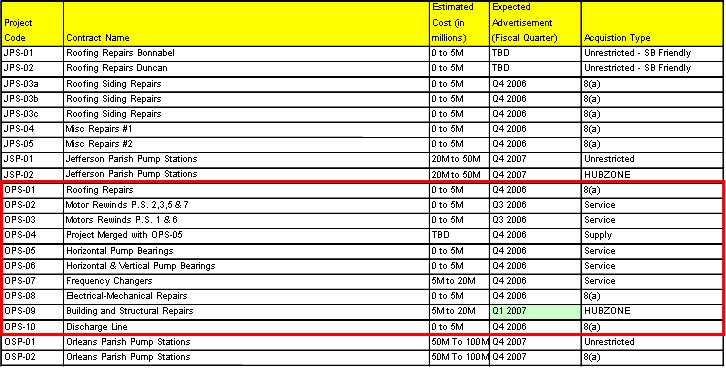
Here is the relevant excerpt from the presentation (click to enlarge):

I've surrounded the Orleans Parish Pumping Station contracts (those with an "OPS" in the project code) in a red line. The important part is the column labeled "Expected Adverstisement (Fiscal Quarter)." I've rejiggered the table a little to make it more readable:


The fiscal year runs from October 1 to September 30. The fourth quarter of fiscal 2006 ran from from July 1, 2006 to September 30, 2006. The first contract, "Roofing Repairs," is partially underway, but with a scope that reduced from what the Corps indicated back in June. It was also not advertised. The motor rewinding contracts were awarded in May after an expedited advertising period, and OPS-03 is actually complete. OPS-02 is nearly complete.

However, that leaves five other contracts that were not advertised before the end of the fourth quarter of fiscal 2006. By "advertised," the Corps is referring to a solicitation appearing on their Contracts Department webpage. They were previously scheduled to be advertised in August.

Included in those contracts are repairs to bearings in at least three dozen pumps in 13 of the 23 stations all across the city. They also include the complete rewinding of four frequency changers (they change the power frequency from 60 cycle to 25 cycle for use by the older pumps in the system), and tons of other assorted building repairs ranging from replacement of storm doors to repair of downed fences.

(Note: actually, one little bit of the horizontal bearing contract was advertised August 30, with a response date of September 11, 2006. It has apparently been awarded to a firm named IPS of Louisiana. Since it appears that IPS of Louisiana is only a supplier (their name stands for "Industrial Product Supplier," according to their webpage), they will probably be subcontracting the installation work to another firm. This might be contract OPS-05, or it might only be a part of it. There are still other pump stations with horizontal bearings requiring replacement -specifically stations 4, 5, and 12 according to the June 22nd schedule of Corps pump station repairs - so it is unclear why the Corps stopped at stations 1, 6, and 19, though they may have been placed into OPS-06. It would have been clearer if they had met their own deadline!)

It's stunning, galling, and infuriating to think that all of this still has to be done over 13 months after the storm, especially when one considers the law that included the money was signed by the President 9 months ago. And what about contract OPS-09, which might not be advertised until the end of December? What gives?!?

3) But that's not where the bad news stops. I also stopped by two of the three outfall gate structures. With regards to the security concerns I wrote about in Part 1 of my special report, the Corps does not appear to be responding. The vehicular gate on the west side of the London Avenue gates was wide open. For your orientation, here's the location of that gate on a picture taken from the Corps' webpage:


Flow of the canal is from left to right. Incidentally, the pictures of the control house in Part 1 of the special report were taken in the west control structure, which is the white structure at the top just below the word "West."

So with the vehicular gate open, not only could anyone just walk up on to the structure, they could literally drive a truck through the holes in the security.

Needless to say, there was no security at 17th Street either. As I pulled up, a tourist couple were just walking away from the site. But the bigger disappointment is the Corps' blown deadline for the east side extra pumps. As you can see from this Corps page, they called for the following in pumping capacity at 17th Street on September 30:

4000 cfs
(East 6, East 2)
(Temporary Pumps)

Let me decode. The 4000 cfs is the expected capacity at the 17th St. canal gates including all the pumps. "East 6, East 2" refers to the original six pumps planned for the Orleans Parish (i.e. east) side of the canal site (which are installed, and are probably running), as well as the two extras purchased by Boh Brothers and also to be installed on the east side. They were supposed to be running on September 30. "Temporary pumps" is the unfortunate Corps lingo for the permanent pumps now at the gates. They just didn't want those pumps confused with the real permanent pumps coming down the line sometime in Two-thousand-mumble.

Well, the extra two east side pumps are installed, but they are definitely not pumping any water. For one thing, there's no piping joining them to the rest of the system. I don't even see that piping on the site (and it's easy to see, considering the security). For another, their engines aren't hooked up. So right now, they're just paperweights. That's about 450 cfs that is definitely not ready. I think they're at least two weeks away from getting those pumps running, and who knows whether they'll vibrate or not

It is also extremely unlikely they will get the four extra pumps (representing about another 900 to 1000 cfs, not 1200 like the Corps webpage says) promised for the west side of the canal running by October 30, which is their next deadline. They are only now driving the sheet piling for the platform to hold the pumps. They still have to finish driving that piling, build the platform, install the pumps and their piping, and also install the pumps' engines, hydraulic lines, and control systems. There is no way they will have that done in four weeks. I think it'll be more like eight, if past performance is any indication.

By the way, it's bad enough that the Corps promises this stuff publicly and doesn't deliver. But they are also making these promises privately to people in the know, and thinking those people won't figure it out. Also recently posted to the Corps Hurricane Protection System webpage is a presentation given to the American Society of Civil Engineers. I'm not sure where or why this presentation was given, but it also includes the chart shown on the pump capacity webpage. You can find it as slide number 1 in Part 3 of the presentation, linked here (caution - slow link). The chart shows those two pumps as "On schedule," as well as the four west side pumps. The presentation was given on September 18th, when it was painfully obvious those two extra pumps on the east side would not be ready.

Why can't they just tell the truth?

Sunday, October 01, 2006

Problems at the floodgates - Part 5

Part 1
Part 2
Part 3
Part 4
Part 4.1

Part 5 - What can you do?

So, we've seen examples of lots of different problems at the floodgates. What can be done about them? Because, while the Corps might check in to this blog on a daily basis (and they do), will anything really happen as a result?

Who knows? What I do know is they are all civil servants that are answerable to the taxpayers, and that means addressing taxpayers' concerns. And I don't mean answerable in a "they work for people that are up for election every few years" kind of way. I mean in a 21st century way. That means they all have email addresses, and so do their bosses. So I've pulled them all together to allow you to express your concerns.

I don't think I'm breaking any code collecting their Corps emails in one place. After all, the Corps' New Orleans District did so this past May, when they published many of their employees addresses on their registration list for a hurricane seminar. Also, googling any of these addresses brings them up on other webpages, many of them Corps pages.

The reason I'm putting these particular names out there is because they are the ones with their signatures (or had someone designated to sign for them) on the approval or routing sheets in the Orleans Parish pumping stations PIR, the Floodgates PIR, or they are direct supervisors of those people.

If you do email these folks, please let them know you appreciate their hard work and all that they have done for the area since Katrina. Also realize that many of them are crazy busy, and might not write back. However, they are civil servants, and as such, are supposed to be responsive to the concerns of the American taxpayers.

Colonel Richard P. Wagenaar, Commander, New Orleans District of the Corps
Richard.P.Wagenaar@mvn02.usace.army.mil

Lieutenant Colonel Murray P. Starkel, Deputy Commander, New Orleans District
Murray.P.Starkel.LTC@mvn02.usace.army.mil

Colonel Jeffrey Bedey, head of the newly formed Hurricane Protection Office at the New Orleans District, which has direct responsibility over the pump station repair contracts and the floodgate projects
Jeffrey.A.Bedey@nwo02.usace.army.mil

Jim St. Germain, Project Manager, New Orleans District; author of the Orleans Pump Station PIR
James.J.StGermain@mvn02.usace.army.mil

Christophor Gilmore, Project Manager, New Orleans District; author of the Floodgates PIR
Christophor.e.gilmore@mvn02.usace.army.mil

Greg Breerwood, Deputy for Planning, Programs and Project Management, New Orleans District
Gregory.E.Breerwood@mvn02.usace.army.mil

Walter Baumy, Chief of Engineering Division, New Orleans District
walter.o.baumy@mvn02.usace.army.mil

Michael Lowe, Chief of Emergency Operations, New Orleans District
Michael.L.Lowe@mvn02.usace.army.mil

Brigadier General Robert Crear, Commander, Mississippi Valley Division (MVD) of the Corps (MVD is above New Orleans)
robert.crear@mvd02.usace.army.mil

Colonel Albert M. Bleakley, Deputy Commander, Mississippi Valley Division
albert.m.bleakley@mvd02.usace.army.mil
(this one is a guess based on BG Crear's address above; I couldn't find it online)

David Sills, Chief of Emergency Management and Security Division, Mississippi Valley Division
david.w.sills@mvd02.usace.army.mil

To make copying into a "to:" field easier, here they are all together:

Richard.P.Wagenaar@mvn02.usace.army.mil, Murray.P.Starkel.LTC@mvn02.usace.army.mil, Jeffrey.A.Bedey@nwo02.usace.army.mil, James.J.StGermain@mvn02.usace.army.mil, christophor.e.gilmore@mvn02.usace.army.mil, Gregory.E.Breerwood@mvn02.usace.army.mil, walter.o.baumy@mvn02.usace.army.mil, Michael.L.Lowe@mvn02.usace.army.mil, robert.crear@mvd02.usace.army.mil, albert.m.bleakley@mvd02.usace.army.mil, david.w.sills@mvd02.usace.army.mil

Problems at the floodgates - Part 4.1

Part 1
Part 2
Part 3
Part 4

As many of you who are local know, the pumps at the floodgates are experiencing vibration problems. It is unclear if those problems have been solved or not, since the local Corps office is giving mixed signals. In the latest Times-Picayune article about the vibration problems, printed September 16th - the day after the last public tests at the London Avenue gates - the local Corps officials seemed upbeat. However, a September 26th WWL-TV report indicates the Corps has only shaky (pardon the pun) confidence in the pumps.

There might be a reason for the loss of optimism on the Corps' part. A new bid solicitation was published yesterday on the Corps' Contracting page. Those of you who are regular readers remember that I check the Contracting page every day. The Technical Data Package has not been posted yet. When it is, it will be behind the FedBizOpps firewall, unreadable to members of the public.

Keep in mind, that this solicitation might just be for routine spare parts. Or it might be for a routine long term maintenance contract for the engines. However, the synopsis gives some tantalizing details that point toward something related to the recent problems out there.

First, there's the title, which mentions "a Caterpillar engine already installed at outfall canals in New Orleans, LA." Secondly, the title refers to replacement parts, not spare parts. Third, there is the simple fact that the solicitation exists at all, when one considers that the seller - in this case MWI - is usually responsible for all repairs to newly installed equipment. Fourth, there is the fact that they are advertising for a service (the NAICS code refers to repair and maintenance, not supply of parts). If it were simply supply of parts, the NAICS code, which is how the government classifies businesses, would probably reflect that. The government has an NAICS code for everything.

Now if this is just for spare parts or a regular maintenance contract, then it's nothing to worry about and I'm just talking out my rear end. But if it is for parts needed at the floodgates to assure proper operation of the pump motors, then one really has to wonder why the response date is two weeks away, considering we are still in the height of hurricane season. Is this another example of the lack of urgency?

Next: Part 5 - What can you do?

Go to older posts Go to newer posts