Fix the pumps

Sunday, February 19, 2012

Time itself

For the hurricane protection projects the Corps has been building the last few years, there have been special restrictions placed upon contractors between June 1 and November 30, better known as hurricane season. In case a storm popped up, it would not be wise to have miles of hurricane protection levee degraded or no plan to fill gaps. Typical hurricane season restrictions include:

- not knocking down existing walls without having new walls built, or at least filling in gaps left from the demolition of existing walls with equivalent protection

- not degrading (i.e. removing height) more than a specified length of levee - perhaps a few hundred or a couple thousand feet

- stockpiling supplies at the construction site in order to close gaps quickly in case of the sudden appearance of a storm in the Gulf of Mexico

But throughout 2010, it appears such terms may have been flexible, bringing into question the Corps' commitment to safety versus their meeting of deadlines.

Even before June 1, 2010, cracks started to appear. Project LPV-111 is meant to protect the southern flank of New Orleans East along. It extends about 5.3 miles mostly along the north bank of the Gulf Intracoastal Waterway (GIWW):


This is a huge project, made up mostly of levee upgrades, but also including work on T-walls around Sewerage & Water Board pump station #15 (shown as "OP#15" on the map above) and on the western end near the tie in with the IHNC Lake Borgne closure project.

At LPV-111, SLFPA-East inspectors noted on May 18, 2010:
"IHNC West Tie-in:
T-walls are being constructed aggressively to meet June 1st deadline. Currently driving piles at T10. No footers have been poured yet. Contractor is finalizing their closure plans in the occurrence of a hurricane because its not likely all the walls will be up in time. Closure plan didn't exist pre contract because of the ECI contract."

A few of the larger contracts were "ECI," which is short for Early Contractor Involvement, a term the Corps coined just before this project was put out for bid. Essentially, in ECI the construction contractor starts building stuff before the project is completely designed, in order to build stuff fast. They also work hand-in-hand with the designer while the drawings and specifictions are being developed. There's more details here.

The bid specs were kind of scanty, and they didn't include anything about hurricane season preparations. It's unclear whether the Corps intended anyone to come up with requirements for hurricane season or if they just forgot. Another possibility is the inspectors were not being given the whole story. Whatever the reason, the lack of preparedness would crop up later in the season.

The July 12, 2010 LPV-111 report said,
"Interim flood protection for west tie in: AWA sketched an idea on the white board using a structure that results from the demolition of I-wall. This concrete wall structure combined with hesco baskets and backfilling would give protection. USACE will have to analyze the design."

"AWA" is the contractor, a joint venture of Archer Western and Alberici, two very large contracting companies. The "west tie in" refers to the western end of the project which ties in with the rather large IHNC closure structure on Lake Borgne. This end was made up of about 1000 feet of T-wall. The reference to "interim" is speaking to flood protection during the huricane season while the project was under construction.

With that explanation out of the way, one has to question the propriety of a contract mechanism that favors speed so much that little things like storm protection during hurricane season are being designed for the first time on a whiteboard a month and a half into that hurricane season. Even worse is that the "design" seemingly consisted of piling up debris and sand ("Hesco baskets" are just big metal cages that hold large sandbags. Their effectiveness as flood protection is questionable, but the Corps swears by them).

Even more disturbing details came out a week later. The July 19, 2010 report mentioned,
"Interim Flood Protection - the approval to use a 16' elevation was overturned back to the original 17.5' requirement. The west tie in monolith configuration of HESCO Baskets is still not agreed upon. Contractor does not want to use 11 rows of hescos as proposed in Memphis's design. They are going to submit other designs to USACE for approval."

So nearly two months into hurricane season, not only was there no agreement on how to construct temporary flood protection, there wasn't even agreement on how high it should be. For reference, the existing height of the levees before this project started was 17.5'.

Four days later there was even more scrambling. On July 23, 2011:
"[Corps Resident Engineer] has given contractor permission to go with elevation 12' levees and floodwalls as of today. There will be a 10am meeting Saturday to reevaluate the need for 16' elevation depending on the progression of the storm in the gulf."

In the space of a few days, the Corps went from requiring 17.5' of protection to only requiring 12'. And this was with an actual storm brewing!

That storm was Tropical Storm Bonnie. On Friday, July 23rd it was crossing the southern tip of Florida and taking direct aim at Southeast Louisiana. As it turned out, they lucked out. The storm dissipated and came ashore as little more than a low pressure system. In the wake of that close call, the report from the following Monday, July 26, 2010 shows some evidence of a "come to Jesus"-type agreement to do things better. Whereas on July 19th the contractor was whinging about the Corps' Memphis District plans for use of Hesco baskets, on July 26th, after getting caught with no plan at all and a storm in the gulf, we found,
"Interim Flood Protection for West Tie-in: Contractor continues to work on alternate ideas to be reviewed by USACE and will follow Memphis District's current plan in the event of a hurricane."

But LPV-111 was not the only project which failed the Tropical Storm Bonnie test that July. LPV-101.02 also had big gaps in preparedness - literally.

LPV-101.02 is the construction of t-wall floodwalls (in place of i-walls) at the western end of the Lake Pontchartrain lakefront in Orleans Parish, running from the east side of the Interim Closure Structure at the 17th Street canal toward the east and ending at Topaz St. Here it is on a map:


On June 14, 2011 we found this out:
"Hurricane Drill: Contractor did a drill to show they could close up gaps in the even of a hurricane on Monday, June 13th, which they failed. They will be performing another one soon."

The lead contractor on LPV-101.02 is Tetra Tech. That failure would be prophetic. Because the Saturday, July 24, 2010 report - from the day when Tropical Storm Bonnie was in the Gulf of Mexico - noted
"The contractor did not complete gap closer [sic] at LPV101.02"

The next report - from Monday July 26, 2010 - actually has pictures of the gaps, along with this text:
"a review of site was made this A.M. The Gap closer plan was not 100% there are gaps in HESCO baskets behind wall four."

The pictures plainly show two separate gaps - each about two feet wide - in the line of Hesco baskets placed to close a gap left by the demolition of I-walls:


About three weeks later, on August 11, 2010, we did find out:
"HESCO basket Closure reviewed. The gaps between wall and baskets have been closed."

Just in time!

You'd think close calls like that would have been a warning. They weren't.

Two months later, the Corps decided to dispense with hurricane season construction restrictions altogether for a number of contractors, just so they could work faster. In effect, the Corps said that the 2010 hurricane season ended October 31 rather than November 30. This was not announced to the population of New Orleans and surrounding communities. The idea was to speed prjects up to meet the June 1, 2011 deadline. Note that most projects had contract provisions called "liquidated damages" which kicked in if the project was late - the contrator would have to start paying money back to the Corps.

This reverse Groundhog Day effect ("four fewer weeks of hurricane season!") started emerging in the October 15, 2010 reports, when Archer Western-Alberici, the lead contractor on LPV-111 (yes, that project again) got let out the provisions intended to safeguard public safety:
"Contractor has been given permission to stop following the strict hurricane season restrictions on November 1st as long as they have material on site in the instance of a hurricane."

More detail was given in the October 19th report:
"Advance start date for Hurricane Season: Contractor has submitted locations they would like to start working before Dec. 1st. Of the locations it was said that work at PS 15 and the pipeline through T12 at IHNC west tie in will be allowed to work with out hurricane season restrictions. The contractor will have required material onsite in the event of a hurricane."

and in the October 25th report:
"Hurricane season ending Nov 1st: AWA has submitted the plan including locations of work they would like to work on with out the hurricane season restrictions. These locations include PS 15, CTU 6, and Monolith 12 at IHNC west tie in (utilities penetration). USACE, in addition to the submittal, has requested elevations of existing and new foundation monolith at the PS 15 location. After this is received the Nov. 1st date will be approved by USACE."

CTU 6 is a small pump station run by the U.S. Fish & Wildlife Service.

Finally, the SLFPA-East inspector made explicit the Corps' overruling of the National Hurricane Center on the end date of hurricane season (after all, the Corps obviously knows much more about protecting people from hurricanes than the NHC...):
"IHNC West Tie in:
Work will begin on the utility penetration soon at T12 as a result of the ending of hurricane season effective Nov. 1st.
PS15 Fronting Monoliths:
Contractor was given permission to begin work on the pipeline penetrations at T3 on Nov. 1st in advance of the end of hurricane season. Work on the replacement of the pipelines commenced on the west pipe with construction of the new supports and removal of a portion of the pipe. Only one pipe will be out of service at a time."

Normally I'd be giving lots of details about where all this stuff is and such, but that would really obscure the larger point: the Corps decided to sacrifice better hurricane prepareness for the month of November, 2010 in order to hit their June 1, 2011 self-imposed deadline.

And lest you think the events on LPV-111 were isolated, there was this on October 22, 2010 regarding New Orleans lakefront project LPV-104.02 (contractor: Quality Enterprises, see map above for location):
"Foundation poured from T-9 to T-14 and rebar is constructed for wall sections of these monoliths. Contractor [may] wait to pour the walls so they can demo existing I-walls behind new walls. This will be contingent on the hurricane season requirements being reduced to the Nov. 1st date."

I think that's saying they were trying leave new T-walls undone and instead were moving to knock down existing I-walls, presumably leaving a gap in the hurricane protection that would otherwise not be allowed during hurricane season.

A little bit to the east, at LPV-106 (contractor: L&A, see map above for location), safety was also given up for expediency, as reported on November 4, 2010:
"USACE gave contractor permission starting Nov. 1st to continue project with out hurricane season restrictions. Contractor has degraded levee from monolith 102 to LPV - 108 intersection. Work will begin on monoliths for this section."

Again, another sizable gap in New Orleans' hurricane protection was allowed during hurricane season.

So it wasn't really a surprise when a fourth project was given the go-ahead to demolish hurricane protection inside hurricane season with no backup. At project LPV-148.02 (lead contractor: Cajun Construction), shown on this map:


I-walls on either side of the St Mary's pump station started getting knocked down on November 9, 2010. The reports about it are not well written, so I apologize in advance for their garbled nature:
"Observe demolition of I-wall at St. Mary's PS. The contractor remove the west side I-wall. This I-wall was removed without the Lake Borgne Basin Levee District and Southeast Louisiana Flood Protection Authority-East acknowledgement. The wall was removed without the contractor installing the new wall. The contractor removed the wall to have access for discharge pipes for three temporary storm water pumps. This work was scheduled after December 1, 2010 (after Hurricane Season)."

So the locals, represented by the Lake Borgne Basin Levee District (LBBLD) and the SLFPA-East, were under the impression that work which would remove hurricane protection during hurricane season wouldn't start until after hurricane season. Note that SLFPA-East had also been getting reports from their own inspectors for three weeks that at least three other projects had been given green lights similar to LPV-148.02, so this shouldn't have come as such a huge surprise.

There were pictures taken on November 9th, immortalizing what it looks like when a federal agency gives the go ahead to destroy hurricane protection during hurricane season with no real plan for replacing it:


A lot of ink was spilled in the reports the following day (again, sorry for the poor grammar):
"The issue of St. Mary Pump Station was discussed at length. The contractor removed a section of flood wall at the pump station in preparation for extra pumps to be used while work was being done at station. LBBLD was not informed that this work would be started and The Director of the district was at meeting to express his displeasure about the work being done with out a proper closure plan."

The report gives the contractor's excuse/reason:
"The work was the result of an RFI and the RFI meeting on Friday, November the 5th. The contractor felt because of this meeting he was able to move forward with his plan to demo wall. The biggest problem was a break down in line of communication between all parties. The contractor has maintained elevation 9 is required to maintain elevation 6 at all times. He is also required to maintain elevation 17 in hurricane season which end November 30. If he opens a gap in that level of protection he is required to be able to close the gap within 24 hrs of notification of the approach of a storm. The Contractor feels he has a gap closure plan in place. The plan should be updated with each phase of work."

A note of clarification - an "RFI" is a "Request for Information," a which is basically a question posed by the contractor to the Corps on some point that is unclear in the Corps' drawings or the Corps' specifications. They are a prelude to change orders.

The November 5th "RFI Meeting" was obviously not just held by the contractors' own personnel. There were Corps personnel there, and they obviously gave the go-ahead to demolish the St Mary's pump station wall ahead of the end of hurricane season. This is in line with what was going on at at least three other Corps projects that same week. So what is reported above by the SLFPAE inspector appears to be a line of BS by the Corps - repeated by the inspector - in total contradiction to what was actually told to the contractor. It wasn't a breakdown in communication at all - the contractor clearly got the message from the Corps. And the locals being left out of the loop is just standard operating procedure with the Corps, not a breakdown at all.

So, what was the gap closure plan the contractor supposedly had? It was mentioned in a separate November 9, 2010 report:
"The contractor has Heskow [sic] baskets on standby in Slidell, LA and sand on standby at Murphy sand pit."

The "Murphy sand pit" is likely referring to the pit at Murphy Construction Company in Chalmette, about 13 miles up Highway 46 from the site. The Hesco baskets in the city of Slidell were across Lake Pontchartrain from the work site, over 40 miles away. Obviously, the contractor had neither "on site." That's hardly a workable plan if a storm were to appear in the Gulf.

So there you have it - the Corps "breaking their back" to meet their June 1, 2011 deadline. Except it wasn't their back they were breaking - it was, once again, the residents they are supposedly protecting.

The SLFPA-East inspection reports referenced above can be found at a link within this earlier post.

Friday, February 03, 2012

Corps of Whingeneers

The T-P recently reported on the SLFPA-West attempting to get the Corps to follow their own specifications on project WBV-14d.2, the V-line levee floodwall south of Marerro. In the case of this project, the flood protection authority is concerned about bug holes (air pockets formed as concrete was poured and cured) and cracks in the wall.

As is to be expected, the Corps did their usual pooh-poohing. However, the T-P reporter (Paul Rioux) actually caught the Corps going further:
"Sami Mosrie, a corps senior project manager, said the corps is drafting a "white paper" to address some of the areas of disagreement.

He said corps officials have bent over backwards to respond to the levee authority's concerns about the floodwall and other projects, including new levees that authority inspectors suspect contain too much woody debris.

"This is over and above what we've ever done before in turning over projects," Mosrie said.

Oh boo hoo. Pity the poor Corps. All the nasty locals are picking on them trying make them follow their own specifications.

It's crud like this from the Corps that drives Federal Flood survivors like myself crazy. Are they so blind as to think they are the ones suffering? And are they seriously complaining about outside oversight on a $14 billion project meant to make up for the decades of incomplete and wrong work that led to hundreds of deaths? The idea of such oversight is to make sure the project gets done correctly and completely, down to the last crossing of T's. If the Corps gets inconvenienced because they can't follow their old "trust us and our contractors" way of doing business, I say "suck it up."

SLFPA-W commissioner Jerry Viera put it a little more diplomatically:
"Levee authority commissioner Jerry Viera said the authority is simply performing its due diligence to ensure the flood-control projects are built properly before taking over operation and maintenance responsibilities.

'In industry, it doesn't depend on the word of the contractor,' he said. 'It depends on the specifications and whether they've been met.'"

Thursday, January 26, 2012

Debris Part 11

Part 1
Part 2
Part 3
Part 4
Part 5
Part 6
Part 7
Part 8
Part 9
Part 10
Part 12
Part 13
Part 14

After the flurry of debris reports in east bank projects during the spring of 2010, the reports - oddly - seemed to stop for about a year. But they started appearing again in the spring of 2011 as the Corps rushed to beat their June 1st deadline.

In Orleans Parish, the first spring 2011 mention of debris was on LPV-106 in the April 8, 2011 report:
"Still clumpy rocks in section between [Corps project LPV-]107 & [Corps project LPV-]108 where seeding has taken place."

Here's the locations of those three projects:


LPV-106 came up again about a month later, in the May 4, 2011 report:
"Still concrete and debris in turf area."

These referred to areas of finished levee. The contrator (L&A) had apparently placed soil with excessive debris in it and had yet to remove the debris from areas where grass was attempting to be grown.

We know the reports from April and from May were referring to separate areas of LPV-106 because of the May 5, 2011 report, which had more detail:
"Contractor has started a crew from [project LPV-]107 west towards Read blvd clearing debris from levee section to be grassed next. They will also clear out left debris in reach 5 and reseed in areas that grass has not established. Tuesday I will inspect levee clean up as contractor plans to seed next week."

The section of LPV-106 from LPV-107 west toward Read Blvd. is part of the much larger western section of the project, as opposed to the report in April of the smaller eastern patch between LPV-107 and LPV-108.

The same report noted debris in the soil on the flood side of the levee at adjacent project LPV-107 (contractor: Shavers-Whittle):
"debris removal and grading on flood side of levee."

About a week later, the May 11, 2011 report mentioned the contractor and the Corps had declared victory over the debris at LPV-106:
"contractor has cleared access rubble/debris from 107 tie in till Jahncke pump station [aka Sewerage & Water Board drainage pump station 14]. Contractor has not been able to confirm when seeding will take place."

Here's the location of Read Blvd. and the Jahncke Pump Station:


It was clear the debris problems were not conquered in May, because a month later they were still getting mentioned in LPV-106 updates. In the June 16, 2011 report we learned:
"Contractor is continuing to address debris in levee."

Frustratingly, none of these reports include photos. However, it is clear debris continued to be an issue even past the vaunted June 1, 2011 deadline when the Corps declared the system 100 year storm ready.

A second batch of spring 2011 debris reports comes from the Corps projects in St Bernard Parish. They're located here:


On February 24, 2011, the SLFPA-E inspector wrote about project LPV-148.02 (contractor: Cajun Construction):
"Observed fill material at top of levee slope appear to be non compliant with more than one percent contaminants in work area 1A and 1B."

The following day's report had a bit more detail:
"Discussed issues found on previous day's observation with Butter Compton. 1. Quality of backfill used for dressing levee does not conform to specification. Also quite a bit of dirt was left on stabalization slab. Butter talked with contractor and a coordination meeting is scheduled for Tuesday March 01, 2011."

We never find out what happened. The inspection reports are silent. However, debris continued to be a concern elsewhere.

LPV-146 (contractor: St Bernard Levee Partners), April 1, 2011:
"Contractor backfilled area on protective side with concrete rubble at the 90 degree turn in the wall at MRGO and Verrett [sic] wall."

See the map above for the sharp bend at the southeast corner of LPV-146.

Fortunately, we got pictures of this incident:


The reports don't indicate whether the concrete rubble was later removed.

LPV-145 (contractor: Chalmette Levee Constructors), April 4, 2011:
"There was discussion about debris and gravel in the slopes of the flood side. It appeared that the haul road material was pushed into the slopes of the flood side."

LPV-147 (contractor: Integrated Pro Services), April 5, 2011, after a pre-final inspection:
"There is unsuitable material and debris in the earthwork of the protective side slopes.

LPV-149 (contractor: Conti Group), June 16, 2011:
"There are concerns for backfilling with debris and trash."

That's seven projects with 2011 reports of debris in the dirt. That's on top of the six projects with debris concerns in the spring of 2010.

If you then combine that with the 9 west bank projects with debris problems...


You get 22 projects where debris has been a problem either in the existing levee, in the new levee, or in both.

22 projects.

Is it now obvious there is a systemwide problem with the integrity of the levees built by the Corps? It should be.

Labels:

Monday, January 16, 2012

Debris Part 10

Part 1
Part 2
Part 3
Part 4
Part 5
Part 6
Part 7
Part 8
Part 9
Part 11
Part 12
Part 13
Part 14

Much pressure was brought to bear upon the Corps over the past few months to address the debris problems in the west bank levees, and there have been halting measures to do so. A "tiger team" of other Corps people from outside New Orleans was brought in, they dug some holes in the levee at a single one of the projects (in the wrong spots), and then dug some more holes (in the right spots) while they literally tried to bury the evidence, which included a shopping cart and hubcaps. They also promised Senator Vitter they would add the west bank levees to their third party review process - a process meant to review designs before they're built, not after they're all done and shown to be defective.

But the west bank levees were not designed or constructed in a vacuum apart from the rest of the region. One must ask if the same problems have arisen with the rest of the system. The answer is "Yes."

We know of two large debris fields in the Lake Pontchartrain lakefront levees in Kenner, because the Times-Picayune reported on them in November, 2009 and January, 2010. In those cases, the existing levee was found to be filled with junk from a site on North Claiborne Avenue in New Orleans. The spoiled soil had been placed there by the Corps in 2000-01. We never heard about any further east bank levee problems after that, and the Corps certainly attempted to give the impression they were isolated - albeit 8000 foot long - cases.

A few months back I noted the receipt of the reports from the inspectors assigned to Corps projects within the geographic area assigned to the east bank levee authority (the SLFPA-East). I have finally finished plowing through them, and will be presenting what I've dug out over the next few posts. First up is evidence of many more instances of debris in the east bank levees. All the excerpts below are taken from these reports, downloadable at the earlier post.

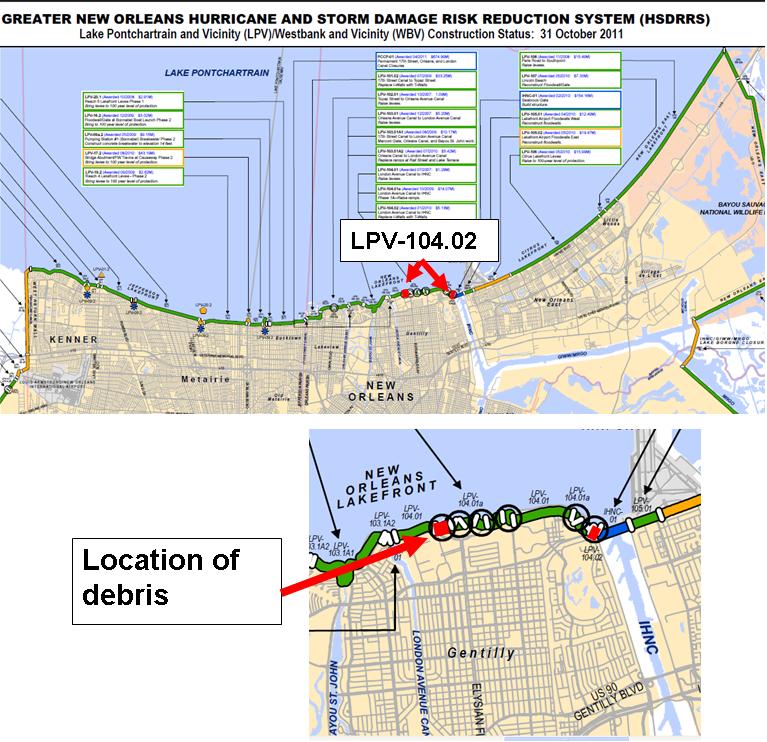
Let's start at project LPV-104.02 (LPV stands for Lake Pontchartrain and Vicinity, the official Corps name for all the levees on the east bank of the Mississippi). Here's the location of LPV-104.02:


LPV-104.02 is a catchall project involving a few small projects bundled together along the lakefront between the London Avenue canal and the Industrial Canal. One of those little projects was the installation of a vehicle ramp over the levee behind the main campus at UNO (University of New Orleans).

The lead contractor on LPV-104.02 is Quality Enterprises. They were placing the first "lift" of the ramp on the UNO side of the levee in May, 2010 (a "lift" is a layer of dirt, usually six to twelve inches thick). On May 13, 2010, the SLFPA-E inspector wrote the following about his inspection on the prior day:
"1st 6" lift was applied on protected side of the levee. Material from stock pile on LPV-104.01 [adjacent project - ed.] was used for this lift, and placed over the area that was cleared and grubbed 10" to 12" as stated by specifications. The material despite how much was cleared, was filled with small shells. These shells mixed with the material used for the first lift which caused it to have more than 5% debris in material. Material used was also considered to be too wet to pass moisture test, but will be cut up to dry out before next lift would be applied. Billy Rossignol [Corps resident engineer for the project - ed.] was asked to come and make a decision regarding the material being filled with the shells from the site. The decision was made that nothing can be done about this lift and to leave as is."

Isn't that nice? The bottom six inches of the earthwork are filled with shells (at 5 times the specified limit, no less), as shown in this picture from the same report:


But don't worry, they did something:
"Corrective measure will be done to prevent this from happening in the remaining lifts. Corrective action include not stockpiling material on the site, and scraping the surrounding area to move shelled material away from toe of ramp. (40ft offset to be exact)"

Note their "corrective" measures did not correct the actual problem by removing the debris. Their response to that was simply to leave it in place, which it is now.

Isolated incident of debris in the dirt? Not so much. Over at LPV-108 (contractor: Boh Brothers), a lakefront levee project at the exreme end of New Orleans East as shown on this map:


the SLFPA-E inspector wrote in his April 16, 2010 report:
"Corps inspector mentioned being unhappy with the size and amount of rock that is in the soil being used. Will follow up with this."

The follow-up came in the April 27th report:
"The dirt as mentioned in previous report is has not been filtered properly. It is filled with debris and material over the specified allowable size and over the specificed percentage of the material. The Contractor will be getting a formal letter requesting a correction plan from Billy Rossignol."

The inspector included this photo:


along with a caption informing us the material had been placed in the levee, debris and all:
"An example of the size of rocks that have been pulled from the surface of the material. This is a very small amount compared to what is on the surface of the entire project. Also if this is what is on the surface, what is located through the entire soil subsurface[?]"

That's a damn good question. Based on what we've seen at the west bank projects, the answer is probably that the LPV-108 levee had debris inside it.

A couple of weeks later, the May 13th report read,
"Corrective action has been done regarding soil conditions. Boh Bros was asked to remove a 5' wide by 6" deep section of material along the entire wall. Perform compaction and moisture tests on the area. Replace with stock pile material from pit, compact, and test to specifications."

Anyone who thinks the debris only went 6" down, raise their hands.

Just the Corps folks and their contractors? Okay, moving on...

Throughout the spring of 2010, debris was found at three other lakefront projects. At project LPV-103.1A1 (contractor: Aquaterra-CAYO), a levee project located in Orleans Parish between the Orleans Avenue and London Avenue canals...


...SLFPA-E inspectors reported the following:
"Starting to clean out dirt on the west side. The embankment material is full of large rocks and debris which is unacceptable for final use. Process will continue till the material is to specification." (April 20, 2010 report)

"Working on filtering out unwanted material in the back fill that is onsite." (April 30, 2010)

"Continue to remove debris in material on west side of Bayou St. John." (June 17, 2010)

Unfortunately, this is all the information we have from the reports. However, the events at two other projects were described more fully.

At LPV-19.2 (contractor: Phylway), a Jefferson Parish lakefront levee enlargement placement project located on either side of the Causeway:


this got reported on May 5, 2010:
"Found unsuitable material on F/S of levee at stations 409+00 and 419+50. It appears to be an old ramp that was covered up. Once contractor has provided enough material on site to fill the area they will start to do exploratory excavation to see exactly how much material will be removed."

Those locations are just 1000 feet apart, yet the Corps appears to have not dealt with anything in between them, viewing them as isolated instances. Pictures from the report give some more perspective, albeit only on the easternmost debris site at station 419+50, right next to the Causeway:


Te black stuff in the lower photo appears to be about a foot thick section of asphalt.

It is unclear if Phylway covered up the debris-laden area during prior work placing a berm at the base of the levee, or if they were excavating it in anticipation of normal work. Whatever the choronology, it is interesting to see their name on yet another project involving debris.

However, unlike the west bank projects Phylway worked on, in this east bank case, the Corps decided to excise the debris from the existing levee. Subsequent inspection reports tell us Phylway started moving in replacement material very quickly (5/6/10: "Began stockpiling material for areas where they are to remove unsuitable material."), and the removal of the bad dirt started around a week later (5/14/10: "Dug out unsuitable material area near Sta. 419+50. Unsuitable area around Sta. 409+00 still to be dug out."). Photos from the May 14, 2010 report show the excavation:


The dig out of the debris-laden material continued for about a week. The May 20, 2010 report said Phylway had moved to the second area: "Unsuitable material was removed from the F/S of the levee at Sta. 409+00. The area was approx. 150' wide." Photos also show that removal effort:


The Corps had a walkthrough on May 24, 2010 to determine whether Phylway had gotten everything. A third area was actually found with debris, according to the May 25, 2010 report: "Area at Sta. 407+00 near the Severn ramp where unsuitable material was found was dug out some more to remove a little excess that was found during inspection on Monday 5/24/10. Area was reinserted and approved for contractor to begin placing material and bring levee section back up to grade." Here's a picture:


But they declared victory on the other two areas and started backfilling them at the same time. Here's a photo of that backfilling in the May 27, 2010 report:


About a week later, the backfilling was nearly done, according to the June 2, 2010 report: "Work at this reach is almost done with the two sites that had material removed almost rebuilder [sic]."

Other than a single mention buried on page 21 of a SLFPA-E set of board meeting minutes from May, 2010 (minutes which were not published until two months later), none of this activity at LPV-19.2 was ever revealed to the press or the public by anyone. Given how close these events were happening to the beginning of the 2010 hurricane season, that's understandable from a public relations viewpoint. From a "complete disclosure," "partnership," or "protection of citizens" viewpoint though, I can't think of a justifiation.

But there were even more debris-related problems out at the lakefront besides all these. In April, 2010, debris was found in at LPV-20.1 (contractor: L&S/CKS Joint Venture), the project to enlarge the Jefferson Parish lakefront levee from Bonnabel over to the 17th Street canal. Here's the location of that project:


The first mention was in the April 13th report. It was just one sentence: "Special report filed unsuitable material in Levee." The "special report" was not included with the regular report.

The following day the SLFPA-E inspector reported "follow up" at the site, but gave no details. Reports over the following two days revealed the location (a ramp in front of the Coast Guard station) and the fact that more debris had been found.

On April 19th, it was revealed the Corps held a walkthrough to decide whether enough debris had been excised to allow the ramp to be rebuilt. This report (by a different inspector) also included much more detail:
"The USACE held a final walk through to approve the removal of unsuitable material in the Ramp and Levee. After a second check of levee the levee was deemed to be clean. The material that was removed will be stockpiled at Williams Blvd. Boat Launch. The plan is to use the material in foreshore protection. The USACE is still waiting on redesign of ramp."

This report also included photos, which show how extensive the dig out was. The photos are shot looking east toward the 17th Street canal, progressing from the protected (land) side of the levee to the flood (lake) side:


It's that last photo - showing the LPV-20.1 debris removal effort was not confined strictly to a protected side ramp, but also involved the flood side facing the lake - which is the most disturbing by virtue of the caption: "Flood side of levee any remaining large chumks [sic] of concrete will be removed."

"Large chunks of concrete?" Yikes.

Like the debris problems at LPV-19.2, this also got a single mention in the SLFPA-E board minutes, in this case on page 16 of the April, 2010 minutes. There was nothing else.

That's five different projects across two parishes with debris problems in the spring of 2010, almost none of which was revealed to the public. In the next part we'll discuss even more projects where debris was found as recently as last spring, after the Corps declared the system 100-year ready.

Labels:

Friday, December 16, 2011

Seriously?

Times-Picayune, October 26, 2011:
"Mark J. Titus, 48, pleaded guilty to conspiracy to commit mail fraud for bilking $1.2 million from a construction firm in a scheme allegedly aided by his brother-in-law Dominick Fazzio, River Birch's chief financial officer.

Fazzio, 58, of Slidell, used two construction companies he owns to send seven fraudulent invoices from June 2008 through March to Garner Services, a New Orleans construction management firm, according to a five-page "factual basis" for Titus' guilty plea."

FedBizOpps.gov, December 9, 2011:
Y--West Bank and Vicinity, New Orleans, LA HSDRRS, Lake Cataouatche Levee Enlargement, Phase 2, First Lift, Jefferson Parish, LA ED 11-203Solicitation Number: WBV15A-12-S-0001
Agency: Department of the Army
Office: U.S. Army Corps of Engineers
Location: USACE District, New Orleans


"This is a combined synopsis/solicitation for commercial items prepared in accordance with the format in Subpart 12.6, as supplemented with additional information included in this notice. This announcement constitutes the only solicitation; proposals are being requested and a written solicitation will not be issued.

THIS IS BEING POSTED FOR SUBCONTRACTING OPPORUNITIES ONLY. PROPOSALS WILL ONLY BE ACCEPTED FROM MATOC HOLDERS AS FOLLOWS:
[...]
W912P8-10-D-0009
Garner Services, LLC
348 S Diamond St
New Orleans, LA 70130-3808

POC: Mark Titus
Email: mtitus@garnersvc.com
Office: 504-566-1192
Fax: 504-566-1173"
[...]
SYNOPSIS:

The work consists of clearing and grubbing; removal of steel sheet pile; Contractor furnished borrow pit preparation and excavation; placement of earthen material, the earthen material shall be graded and compacted; placement of stone armor; fertilizing, seeding and mulching all disturbed areas and all other incidental work.

What exactly does it take for the Corps to cut ties with companies? This is a solicitation for new business, not an existing contract, but they are insisting on allowing Garner to bid on it. At the very least, don't they read the papers?

Update, February 1, 2012:
This job was awarded to Conquistador Dorado Joint Venture out of Sanford, Florida on January 24, 2012 for $2,609,737.50.

Thursday, October 27, 2011

Plus or minus two projects

Update, 8/18/12: This post wil be updated, now that new information on the production of the 2009 Cost Report to Congress has been acquired (see here). For now, the raw data below remains valid, but the conclusion that the Corps inflated the estimates given to Congress fromthose produced by Black and Veatch is incorrect. The B and V estimates were without contingency and escalation. Those two items are what made up the difference between the estimates given to Congress and the B and V numbers. However, it appears the Corps manipulated the Option 1 number when it came in higher than the appropriation, effectively lying to Congress.

After more than 500 days, the Corps finally released the documents I had been asking for in the permanent pumps saga. It is obvious why they held them back.

In March, 2009 the Corps delivered a report to Congress on the releative costs of Option 1 (keep the existing outfall canal walls, levees, and pump stations, while adding a pump station at the end of each canal) and Option 2 (line the canals with concrete, get rid of the walls and levees, demolish the existing pump stations, and have new lakefront pump stations to handle all drainage). There's also an Option 2a, which adds a diversion of drainage from the Hoey's Basin section of Jefferson and Orleans Parishes. That stormwater would be routed to the Mississippi River.

The report presented these as the costs:


Over $3.4 billion dollars for Option 2. That's certainly an eye-popping number and makes Option 2 look inconceivably expensive compared to the $797 million for Option 1. The Corps, unlike everyone else - including the people protected by this project - wanted Option 1.

There's one problem: it appears those cost numbers are not the truth, according to these new documents.

In a December, 2008 internal cost estimate prepared by Corps consultants Black & Veatch as part of the effort to write the Report to Congress, Option 2's engineering and construction costs were estimated at about $1.8 billion, not the $3 billion+ number.

Let's make sure we're comparing apples to apples here. The internal estimate is strictly for the engineering and construction of the facilities. It leaves out stuff like land acquisition, relocations, and construction management. The line items from the Report to Congress for just the Option 2 pump stations, canal revisions, and engineering were these:


The sum of the highlighted items is $3.219 billion.

There's one further clarification: the internal estimate (a document titled, "Basis of the Cost Estimate Developed by Black & Veatch to Support the 2008 Report to Congress" - the mention of 2008 indicates the original deadline of the report, which was busted by the Corps) calls out a couple of different flavors for Option 2, one with breakwaters in front of the 17th Street canal and Orleans Avenue canal stations, one without. However, that's a minor distinction, because both are about $1.8 billion:


The estimate for the same items as reported to Congress is $1.6 billion more - 77% greater - than what the Corps' internal numbers showed.

Put another way, that's a difference of about double the Congressional appropriation of $804 million for the entire project.

But wait there's more.

The Report to Congress called out the total price for Option 1 as $797 million, conveniently just below the appropriated amount. I wrote quite a bit in 2009 about how the Corps likely slashed their Option 1 estimate to make it fit the appropriation, moving the costs to Option 2. The slashing is confirmed explicitly by the new documents, in a part when Black & Veatch is describing the process of updating their cost estimates from an earlier round performed in 2006:
"Material Costs Update. The 2006 estimate was then updated to current (October 2008) costs. There were significant upward cost revisions in many areas, the greatest being in the fabrication costs for the pumps and drivers. When these costs were added, the Option 1 cost estimate appeared to be very close to, perhaps over, the appropriated amount. This cost estimate was termed the “Robust Adaptable Option 1”. HPO leadership asked B&V to find ways to reduce costs, and an aggressive review of all costs was undertaken.

Base Adaptable Pump Station. Careful examination of the design concepts incorporated in the “Robust” design resulted in significant cost savings, and the development of a new design called the “Base Adaptable Option 1”. This concept and the estimate developed from it, became the basis of the “Base to Go”, the cost of Option 1 for the Report to Congress."

So the "Base Adaptable Pump Station" is the flavor of Option 1 that became the basis for the estimate in the Report to Congress. So what was the internal estimate for the Option 1 Base Adapatable flavor?


$480 million.

Just to make sure we're doing apple to apples, here's what the Report to Congress called out for just the pump station, small revisions to the canals, and engineering:


That total - released in March, 2009 - is $752 million. That's an inflation of 56% from the internal estimate published in December, 2008.

I'm sure there's lots of people out in the field who know loads more about Corps estimating than I do, and would very much like to poke holes in what I'm saying here. However, I believe such criticisms will likely amount to nibbling around the edges of what appears to be a massive overestimation of the costs of the project likely designed to perform two Corps objectives:

1) Make Option 2 look so costly as to be impossible to construct.
2) Make Option 1 look to fit perfectly within the Congressional appropriation.

The public suspected objective 1 was going on. After all, Orleans and Jefferson Parishes commissioned a study showing the actual costs of Option 2 were over a billion dollars less than what the Corps was reporting. However, objective number two, while speculation on my part, appears to be new news. It comes out of the very surprising result that the Corps was radically inflating the Option 1 estimate as well. To what end were they doing this? Perhaps to avoid having the appropriation slashed by Congress. If Congress knew the Corps believed Option 1 could be built for half what had been appropriated, there likely would have been pressure to cut the funds.

What this appears to come down to is that the Corps may have, let's say, "stretched the truth" in reporting the costs of the permanent pumping project to Congress and the public. A $1.6 billion difference in internal and external cost estimates for Option 2 is very tough to explain away, as is the 56% increase in Option 1 costs. But I look forward to the Corps attempting to do so.

Friday, October 07, 2011

5701 Pratt

This is very odd.

A demolition permit for a privately owned house along the London Avenue canal was given to the contractor on the London Avenue canal remediation contract, Integrated Pro Services, on October 4, 2011.

Permit 11BLD-06904 authorizes IPS to demolish 5701 Pratt.

This property falls within an area the Corps said they would use as a staging area during the remediation repairs; it is not behind any of the areas actually remediated. Supposedly all the substantial work on the London Avenue canal is done. So what is going on here?

[UPDATE: More than likely, this is just for the removal of the contractor's construction trailer at this site (see the last page of the Corps' monthly remediation updates - such as this one from the end of April, 2011 - for confirmation of the location), and the New Orleans Safety & Permits department incorrectly typed in the permit as a private home. So it's probably not odd at all.]

[UPPERDATE: I have been told this demolition is actualy for flood protection purposes, and that the house was to be purchased by the Orleans Levee District, though the assessor's record doesn't reflect such a sale. According to a comment by the owner on an unrelated nola.com article last year, the purpose of the sale was to allow better access to the London Avenue canal levee.]

Tuesday, September 06, 2011

500 days

Since I filed a FOIA request with the Corps of Engineers' New Orleans District for the following documents:
"1) The Comparative Cost Analysis generated by Black & Veatch under task order CZ05 of contract W912BV-07-D-1002 (original and modification attached). This report is described as a deliverable on page 7 of the original task order and is described on on page 4:

"Cost Differential Analysis. Review and analyze the cost differential and methodology between the 2006 Conceptual Design Report and the 2008 90-day study and report to congress."

2) The Basis of Cost Estimates generated by Black & Veatch under task order CZ05 of contract W912BV-07-D-1002 (original and modification attached). This report is described as a deliverable on page 7 of the original task order."

These are the reports the Corps has never released which show in detail why they chose the cheaper, technically inferior Option 1 (canal depths stay where they are, pumping stations at each end of each canal which must be coordinated every time lakefront gates are closed, New Orleans taxpayers must pay extra $10 million in annual property taxes upon completion of construction to pay for maintenance of three extra pump stations) over the favored-by-everyone-except-the-Corps Option 2 (canals depths dug to ground level and lined with concrete, single pump station at each canal mouth, no property tax increase).

But 500 days isn't the oldest FOIA request I have into the Corps. That goes to this one:
"1) Any and all emails, memoranda, and other documents related to the operation, maintenance, design, or any other matter relating to the pumps, gates, and all other associated equipment at the interim closure structures (17th Street, Orleans Avenue, London Avenue) sent or received by the following individuals between 12:01 AM November 5, 2009 and 11:59 PM November 14, 2009, as well as between 12:01 AM, December 6, 2009 and 11:59 PM December 16, 2009:

a) Colonel Alvin B Lee
b) Karen Durham-Aguilera
c) Christopher Accardo
d) Carl Robinson
e) Michael Stack Jr
f) Nancy Powell
g) Raymond Newman
h) Donald Constantine
i) Dan Bradley

Responsive documents should include all attachments to the emails, as well as the emails themselves.
2) After action reports for Corps New Orleans District activities undertaken in preparation for and during Hurricane Ida and the December 11-13 rainstorms."

The Corps doesn't want the curtain pulled back on exactly how they operate the gates (in the case of the Hurricane Ida event) or how they don't (in the case of the December event, when water repeatedly rose to dangerous levels in the outfall canals and the gates were never closed, at the same time it appears there was a systemwide 6-day-long failure of their SCADA system.

That FOIA request has been pending for 538 days. That places it and the other one in rarefied company. According to the latest DoD FOIA Annual Report , from fiscal year 2010, only 1.1% of all simplified or complex requests to the Army are answered in 400+ days. The average is supposed to be fewer than 50 days.

I'm not interested in setting a record. I wish they would just turn this stuff over.

Saturday, September 03, 2011

Drip, drip, drip

When we last looked in on the rusty lakefront pumps, two pumps had been pulled out after the start of the 2011 hurricane season due to oil leaks. Both were at 17th Street (W8 and W9). I know W8 went back in the water, and I'm assuming W9 is also back in.

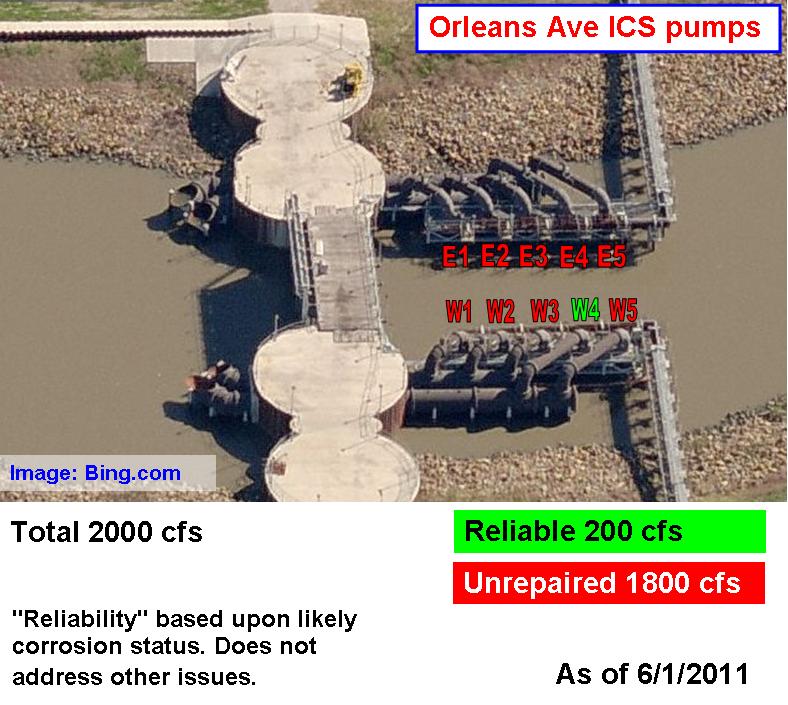
But that still leaves 15 of the 40 large size (60") hydraulic pumps rusting away in the brackish Lake Pontchartrain waters. 9 of those 15 are at the Orleans Avenue site:


There's one at the London Avenue site:


And, with the assumed return of pump W9, five at 17th Street:


With 9 of the 15 rusty pumps at the Orleans Avenue site, the chances were much greater of an Orleans Ave. pump being the next one to spill oil. That's exactly what happened on August 10, 2011, according to this spill report from the National Response Center (the Corps seems to be improving their spill reporting):
Location: "ORLEANS AVE INTERIM CANAL STRUCTURE PUMPING STATION"

Description: "CALLER STATED THERE IS A LEAK FROM A PUMP AT THE PUMPING STATION. CALLER STATED THERE MAY BE A CORROSIVE ELEMENT THAT IS CAUSING THE SPILL. THE SPILL IS WITHIN THE STRUCTURE OF THE FACILITY. CALLER STATED THERE IS NO SPILL TO LAKE PONTCHARTRAIN."

Released material: HYDRAULIC OIL"

Let's parse that. First, the only corrosive element causing the spill was salt water.

Secondly, there was most definitely a spill to Lake Pontchartrain. The waters within the canals aren't somehow separated from the lake with some invisible barrier - it's all the same thing: navigable waters of the United States. Under the law, if there's an oil spill of any amount into those waters, it must be reported to the National Response Center.

Anyhow, the Corps initially claimed the spill was 20 gallons and that their spill response contractor - QRI - had been summoned. Activities like this always portend a removal of a pump.

Indeed, a pump was pulled out from the Orleans Avenue site: E3. Here's pictures of E3 out:


Steve Beatty tells me the pump remains out while New Orleans gets rain from Tropical Storm Lee on September 2. If it came out sometime around August 10th, it should be back in around September 10th.

However, that still will leave 80% of the Orleans Avenue pumps dangerously close to failure should they be needed during this hurricane season. The Corps could have issued multiple repair contracts for these pump repairs and had them finished a long time ago. Instead they stuck with a solitary small business vendor (Healtheon, with Conhagen doing all the actual repair work) for the last two years. Combine that with the sections of the Orleans Avenue canal levees possessing Safe Water Elevations of zero feet which were left unremediated this spring, and the Orleans Avenue canal is not looking so well prepared.

Steve Beatty of The Lens contributed to this report.

Labels:

Tuesday, August 30, 2011

Debris Part 9

Part 1
Part 2
Part 3
Part 4
Part 5
Part 6
Part 7
Part 8
Part 10
Part 11
Part 12
Part 13
Part 14

Good news on the project at the center of the debris problems on the west bank: WBV-14c.2. That project has had serious problems with concrete, wood, steel, and other flotsam in its dirt supply.

As I've posted in the past, the debris laden dirt was coming out of a borrow pit owned by the River Birch organization, a landfill firm currently at the center of a large federal investigation of Jefferson Parish politics.

This month, the Corps finally (after nearly a year) told the WBV-14c.2 contractor (Phylway) to stop using the cruddy River Birch pit and to switch to the much cleaner Willow Bend pit near Donaldsonville. It was announced as part of an inspection of the site on August 9, 2011:
"USACE recently instructed contractor (via email) to change borrow pit and start hauling in material from the Willow Bend Pit for the remainder of the borrow material for the site. A modification to the contract will be issued in the incoming days.

Approximately 30,000 cubic yards are left to be hauled in."

That same day, the inspectors were told about a rather large chunk of concrete that had been dug out of the existing levee. Remember that this project involves using the existing levee to build up a new, taller levee behind it:


When one looks a picture of the concrete, it doesn't look so bad:


Then when one sees the size of it compared to a truck, it's clear how huge it is:


That was sitting in the levee for years before Katrina struck.

Labels:

Go to older posts Go to newer posts