Fix the pumps

Friday, September 15, 2006

Good luck for the next 495 days, Plaquemines Parish

The Corps is moving to finally fix the Plaquemines Parish pumping stations, over a year after Katrina trashed the entire system. They put this solicitation synopsis out today. The solicitation and Technical Data Package will probably go out tomorrow. This work is based on the Plaquemines Parish pumping station PIR, approved January 15, 2006.

This is a good thing, albeit extremely late in coming.

Among the details:

-There will be work on 15 of the 16 stations in the parish.
-Response date for the solicitation from bidders isn't until October 30th.
-And the best part (this is a direct quote): "Estimated time of completion for this project is 450 calendar days after notice to proceed is issued"

That puts the repairs on schedule for completion - assuming issuance of a contract on November 8, 2006, which is very optimistic - some time in early February, 2008. So much for the supposed emergency we in southeast Louisiana are still under.

Now, Plaquemines has managed to restore much of its drainage capacity, but it did so with toothpicks, spit, and duct tape. And it did it on its own, with very little help from the Feds. Now they are being told to wait over a year for complete restoration. This is unconscionable. These repairs shold have been taking place a year ago. By the time the Corps' contractors are done, Plaquemines will have been without a fully functioning drainage system for almost 2-1/2 years.

At the very least, I think the tens of thousands of people who have decided to return to Plaquemines - as well as the many personnel who work at the refineries and the Belle Chasse Naval Air Station-Joint Reserve Base - deserve a little more than a brief mention on a very obscure Corps webpage. Shouldn't there at least be a press release with a schedule of work for each station, so people can tell when their neighborhood will get their drainage back to pre-Katrina levels permanently?

To all of you out in America who assume that the government will take help repair your essential services after a disaster rips away your ability to do so, take this as fair warning - you are expendable.

How? Why? Part 1

Each time I've given a presentation or talked to people about the lack of repairs, the questions of how and why we got to this point come up.

I can answer part of the how, but the why still remains a mystery.

Here's a basic chronology of the actions (or lack thereof) leading us to the current situation. Page numbers refer to the numbers in Adobe Acrobat Reader, not within the document itself. You can see all this in my presentation as well.

September 15, 2005: Corps sends out Notice to Public Sponsors, "notifying them that the application period to request Rehabilitation Assistance for Flood Damaged Flood Control Projects expires on October 15, 2005." In English, this was a letter (with some blanks to fill in) to the drainage departments or boards of Jefferson, Orleans, St. Bernard, and Plaquemines Parishes saying the Corps would help out in repairs if they sent back the letter by October 15. [Orleans Parish pump station PIR, page 8]

October 7, 2006: In the wake of Katrina, Corps approves one-time deviations to their own poicies to, among other things, "…for non-federal flood damage reduction projects, including pumps and pump stations, not active in the RIP, at full federal expense use FCCE funds to … undertake permanent rehabilitation to pre-storm condition." [Plaquemines Parish pump station PIR, page 93]

Note: The RIP, which is sort for Rehabilitation and Inspection Program, is a Corps list of federally funded flood control works. Almost the entire S&WB drainage system is not on the RIP. FCCE stands for Flood Control and Coastal Emergency, which is a Corps pot of money designated for repair of structures on the RIP list after a disaster. It comes out of a law called P.L. 84-99.

October 15, 2005: New Orleans Sewerage & Water Board (S&WB) responds to Corps Notice to Public Sponsors, requesting total federal funding of repair to drainage pumps and pump stations. [Orleans Parish pump station PIR, pages 38-42]

Note: In a particularly cruel twist of the knife, in its 9/15/05 Notice to Public Sponsors, the Corps included the following "complete the sentence"-type question to the public sponsor:

"It is in the national interest to provide permanent rehabilitation of the above described projects for the following reasons:"

It is heartbreaking to imagine Parish officials trying to think of a reason why the nation should care about helping them, especially considering all those parishes were still under water on September 15th. How could someone at the Corps seriously put that question on the form? Did they not watch the news?!? Here's what Plaquemines wrote:

"This area is the gateway to America for shipping and the oil & gas industry. We also have critical infrastructure such as oil and gas refineries, gas plants, and the Joint Reserve Military Base." [Plaquemines Parish pump station PIR, page 41]

Here's St. Bernard's response:

"Home to approx. 70,000 people, commercial marine and fish landings such as: oysters, shrimp, crabs, fish, etc., Port of St. Bernard Parish, oil and gas infrastructure including two major refineries and a natural gas plant, recreational fishing, and critical nesting habitat for a large portion of the U.S. waterfowl that migrate through annually." [St. Bernard Parish pump station PIR, page 29]

And New Orleans' response (yes, New Orleans had to justify its continued existence just 17 days after Katrina):

"New Orleans is one of the largest ports in the world, and the largest in the nation, at the base of the largest river system in the nation serving as a major economic gateway for industry and commerce to the nation and the world including the export market for the nation's grain to the world. There are three petroleum refineries producing fuel at a critical juncture in our nation's energy plan and serving natural gas pipelines serving major portions of the Northeastern United States. The Sewerage and Water Board of New Orleans provides water and sewerage services, and drainage to many of the aforementioned businesses and many residents who are employed in the aforementioned industries and business [sic]. Additionally, the Sewerage and Water Board of New Orleans drains 2200 acres of the adjacent parish, Jefferson Parish." [Orleans Parish pump station PIR, page 39]

You get the idea. Pure cruelty to put local officials through that.

Anyway…

October 17, 2005: Office of Management and Budget (OMB) affirms Corps' one-time deviations from policies, supposedly freeing up funds for permanent pump station repairs. It is unclear what this money is spent on besides damage assessments. It would be nearly seven months before the issuance of pump station permanent repair contracts in Orleans Parish. [Plaquemines Parish pump station PIR, page 29]

December 15, 2005: A relatively heavy rainstorm exposes in dramatic fashion the effects of the Corps' inaction toward repairing the pumps. Pump motors which had been inundated (nearly two dozen of them) were cleaned and dried by the S&WB immediately after the storm, but were not "rewound." Considering the age of the copper windings and insulation on those motors (90 years in some cases), they should have been rewound in a staggered fashion as soon as they were put back into service.

On December 15th, the motor on pump "A" in station 1 caught fire after just a short time in service. We know this because it was in the damage assessments compiled by the Corps (see February 15 below), and was used as justification for future rewinding by the Corps in the May PIR. [Orleans Parish pump station PIR, page 49]

December 30, 2005: Third Katrina Supplemental is signed into law. This bill contains more money for repairs, including cash for pump station repairs. It is very unclear as to what happened between October 17 and December 30, especially considering the urgent need to repair the stations. It would seem the Corps simply ignored the need for repairs to the pumps, concentrating instead on other priorities like levee repairs and floodgates.

Stuff from 2006 to follow. Keep in mind that as of 12/30/05, the S&WB had already been repairing pumps and pump stations for nearly four months, and the Corps had not issued a single pump station permanent repair contract.

Other roofs in need of repair

Lets take a look at the extent of the problem with the unrepaired roofs at the S&WB pumping stations. The Corps agreed to make these repairs back in October, 2005 under emergency authorizations from their headquarters, and then agreed again to do so with money from the Third Katrina Supplemental. They have yet to be repaired.


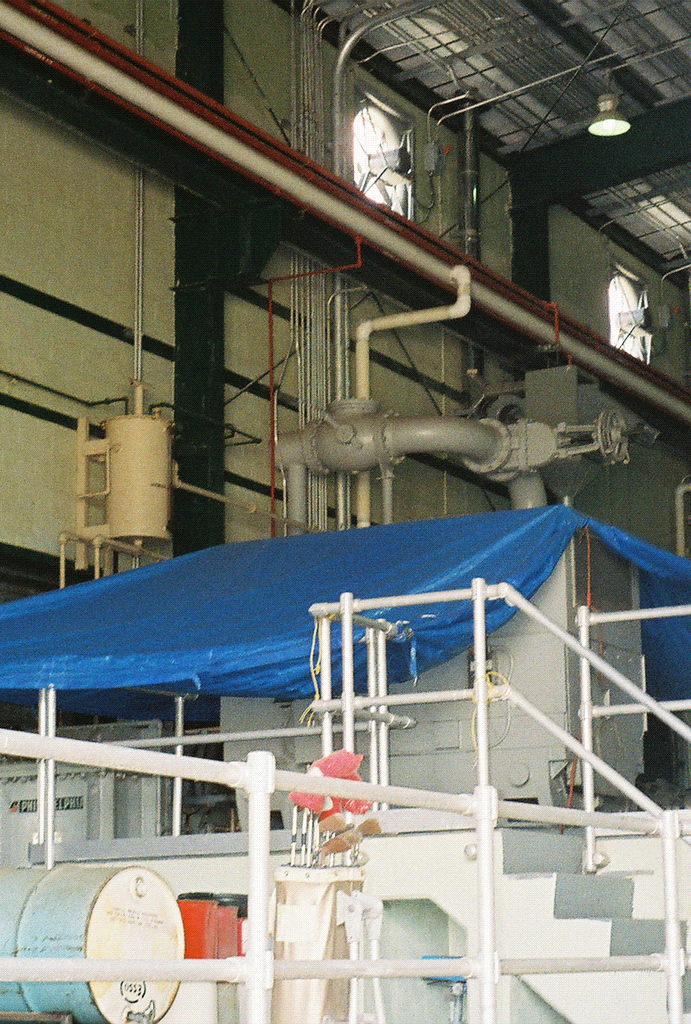
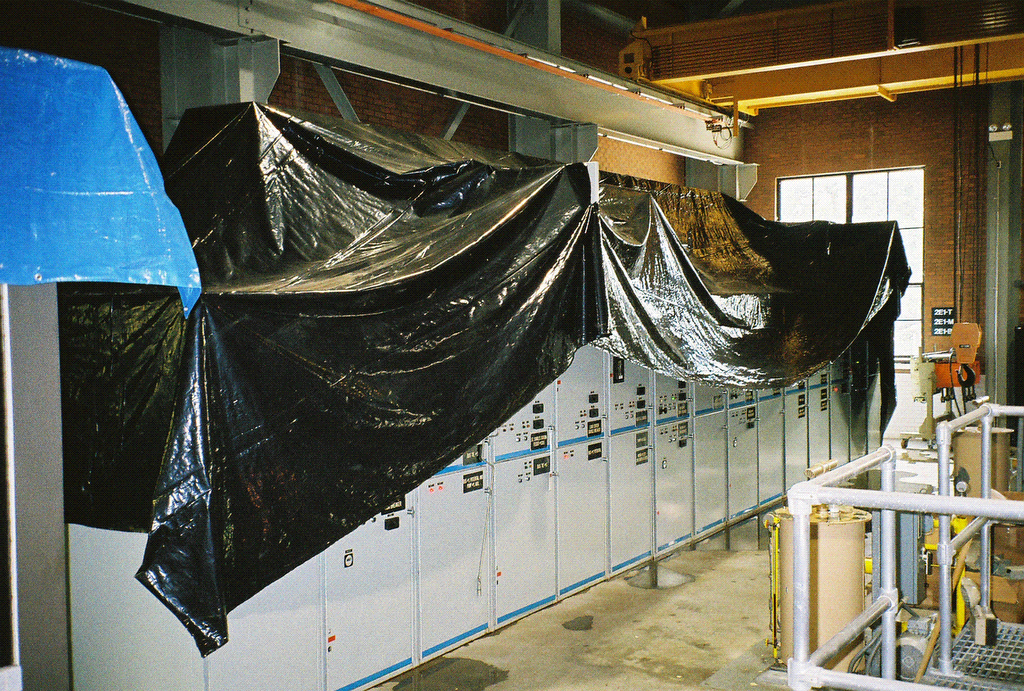
Station 11, on Orleans' west bank. This station drains English Turn and Lower Coast Algiers. Nearly every piece of control equipment and many of the pump motors inside the station have plastic tarps over them.


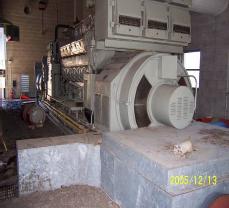
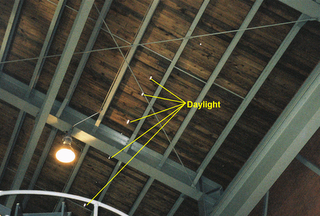
Station 13, also on Orleans' west bank. This large station drains much of New Orleans' west bank. I drew the red and green line. Red indicates where there is no copper sheathing, green indicates sheathing. Every pump motor and control box inside the station has tarps over it. Constant Duty pump CD4 actually has a picnic umbrella protecting it from the roof leaks. Here is one of the pump motors inside Station 13:


Station 5, in the Lower Ninth Ward. The building on the right, which is the main pump house, is the one with the roof damage. That is temporary tarp or something along all the peaks. Much of it has blown away since it was installed just after the storm. A generator set used to get the pumps started inside the pump house has a tarp over it. For reference, the building on the left is the control room, which also flooded, but did not lose its roof.

If only the national media crawling all over that neighborhood during the one-year anniversary a couple of weeks back had just trained their cameras on the northern edge...


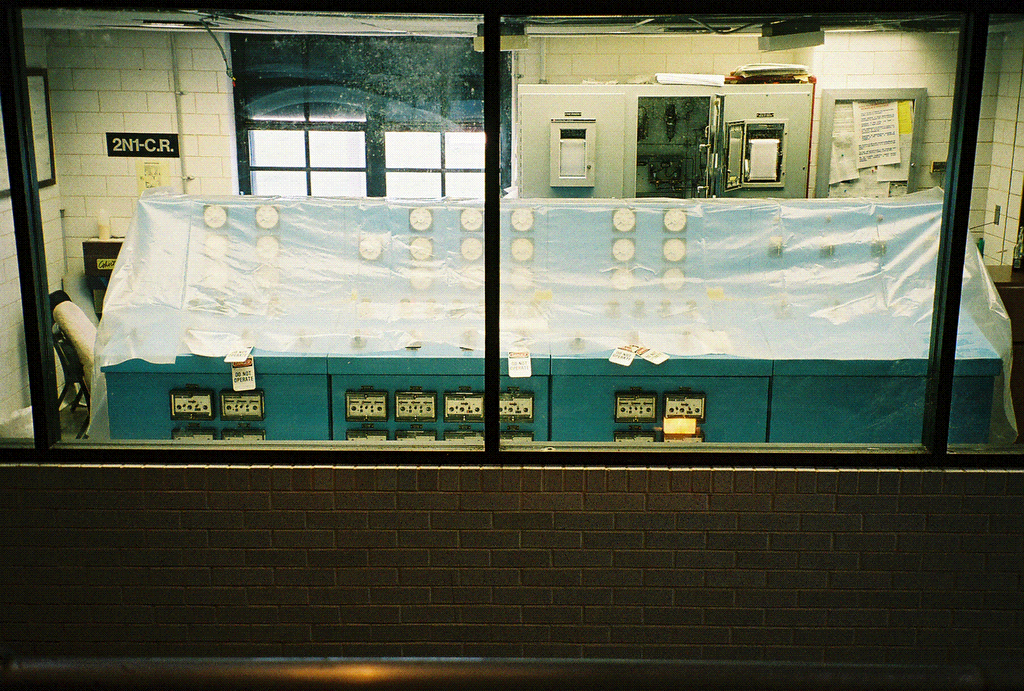
And finally, another shot inside Station 10, in New Orleans East. This is the control room. Would you feel safe running these controls during a rainstorm?

Keep in mind the irony of this happening at Station 10, which was built in 1989. The control room and all the electrical equipment that is now getting wet is elevated about 25 feet above the ground to keep them from getting wet during flooding.

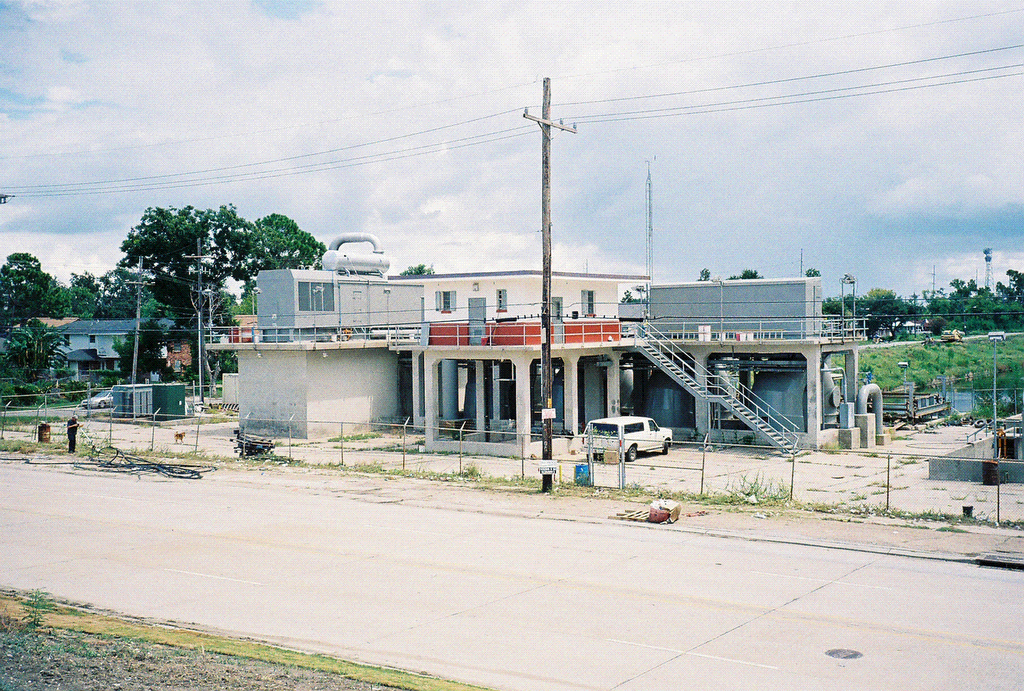
How widespread is the problem? Here's the Sewerage & Water Board's assessment of the status of their pumping stations, as of June 21 (this document came out of the City Council hearing on June 22). The column on the very left indicates which stations the S&WB considers in need of roof repair, and how critical that need is. 14 of 23 stations are on that list. Four of them are considered a "1" (highest priority): 10, 11, 13, and 14. You've seen the condition of stations 10, 11, and 13 above. I think anyone would agree with the S&WB on the criticality of the repairs at those stations. For your reference, Station 14 is also in New Orleans East. Here's a picture:


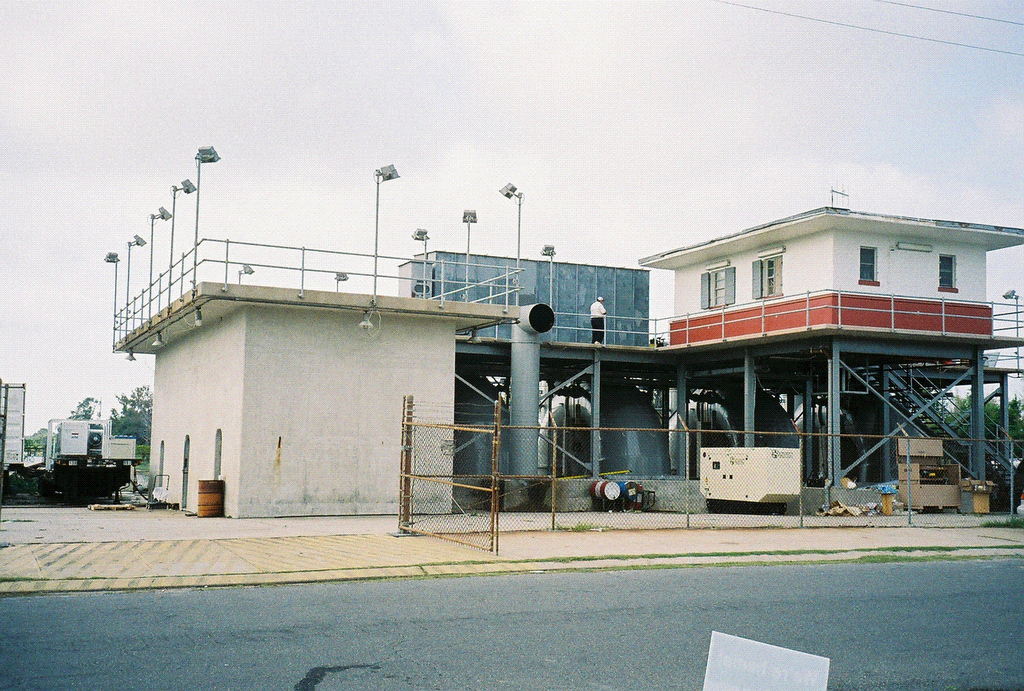
The red and white building in the center is the control house that, I assume, has the unrepaired roof damage. Unfortunately, I couldn't get high enough to see the roof and I wasn't able to get into station 14 the day I took this picture in August. I don't know if the roof has been repaired here, but I doubt it. However the picture is instructive because it gives an idea of the elevation of the equipment inside Station 10 just down the road on Hayne Blvd. The S&WB was very, very smart in the construction of these stations west of the Industrial Canal (there's a twin to 14, Station 16, over by Lakefront Airport), installing permanent generators and elevating nearly everything. Here's Station 16 (the generator has been moved off its platform on the left side for repair or replacement):


Station 20, over by the old Macfrugals, also has its critical equipment elevated. But it also has roof leaks. One of the control panels inside its elevated control rooms is covered in plastic sheeting. There's actualy pieces of the roof all over the site at 20. And the generator at 20, which is in its own building and at ground level, is completely smashed. Here's a picture of that generator from the Orleans Parish pump station PIR. As of a couple of weeks ago, nothing has changed. There's still mud in that building, which you can see in the lower left of the photo.

I don't know if both pumps at 20 are working. Last I heard, one of them had a bad shaft, but that was months ago. Sorry, but the pictures of 20 are still on my camera (yes, I am a Luddite still using film).

To see the Corps' assessments of the roofs, just page through Appendix D in the Orleans Parish Pumping Station PIR. It has all the details. Just as an example, here's the assessment of station 13's roof:

"According to the operator, approximately 90% of the copper metal roof blew off. The estimated leaking part of the roof dimensions is approximately 200’ X 50’. Repair with a new metal roof is recommended."

Thursday, September 14, 2006

How to keep tabs on Corps contracts around town

I've got few links on the right hand column of this site. One of them goes to the Corps' New Orleans District Contracting website.

This site shows all the contracts out for bidding currently, and many of the ones whose bidding preiods have passed. Click on the link with "Today" in it to see that day's activities. Other links show you activities in past days. The typical progression is issuance of a "Synopsis," which is available publicly. Usually a day later the actual bid solicitation will be issued, along with a Technical Data Package (TDP) if necessary. The Solicitation and TDP, along with any amendments which might be issued, are not available publicly, since they are behind a firewall called FedTeDS.

FedTeDS is a contracting application that is only available to companies which have registered with the government. To register, you must have a Dunn and Bradstreet number and a bunch of other information proving you're a company and not some pesky citizen. This was changed for the New Orleans District and the Mississippi Valley District (which is above New Orleans in the Corps command chain) just this past February 15 (as seen here), right in the middle of the biggest contracting bonanza since the Reagan Administration. It is all part of the Bush administration's broad-based effort to control information to keep it from falling into the hands of terrorists, though I have a hard time understanding what the terrorists would do with a bid solicitation for dirt.

Before February 15, everything was available to the public, which is how it should be. How in the world are we supposed to trust an organization with our tax dollars if it doesnt let us know how they are being spent?

Another wrinkle is the archiving of solicitations after a certain period. When they're archived, they're gone. But not really. You can go to http://www.fbodaily.com and find solicitations dating back years. The archive interface is a little clunky, but I've pulled stuff out of fbodaily that has been long gone from the Corps' own website.

If you're really interested, you can poke around both of these sites to get a flavor for all the post-Katrina work.

Finally, there is this file that I came across a couple of weeks ago. It seems to have disappeared since then, and I can't find where I got it. In any case, it is an Excel file listing of all the Corps contracts issued for Katrina, Rita, and Wilma through August 24 of this year. It shows over $3 billion spent by the Corps on Katrina alone, some of it a little suspect. I recommend checking out rows 1035, 1048, and 1259 on the Katrina sheet.

In any case, sometimes it's possible to get a peek at a bid solicitation. Here's the one for the rewinding of the pump motors in six stations in Orleans Parish. I got it through a FOIA request. This is the type of document that is essential to understanding how the Corps operates. It shows the exact schedule of rewindings and also the timescale expected of the contractor. This is information that should be available to all citizens.

For reference, rewinding is complete at stations 1, 6, and 7, and remains underway at stations 2, 3, and 5.

How long has the Corps known about the floodgate pump vibration problems?

The Times-Picayune has done yeoman work covering the construction and operation of the floodgates and pumps out at the lakefront. The latest article, from this past Tuesday, talked about continuing vibration problems on all the pumps:

"But serious vibration problems were discovered in the pumps soon after they were tested last month. The motors in 10 pumps at the Orleans canal and 12 pumps each at the London and 17th Street canals have all been rebuilt since then.
"And although some progress has occurred with the six pumps on the west side of the 17th, the results of weekend tests at London and Orleans 'weren't satisfactory,' [Corps Project Manager Jim] St. Germain said. Some pumps pulse less than others, but overall improvement is needed, he said.
"Still, he wouldn't rule out pressing most or all of the pumps into service if the canals are closed against storm surge. The faster the water leaves the canals, the faster the rainwater can drain from surrounding neighborhoods, so he said the corps would make every effort to use as many pumps as possible."

A few weeks ago, when the Corps released their totally useless initial inundation maps the Friday afternoon before the July 4th weekend - the ones with no depths shown - rainfall was dismissed as inconsequential. Here's a quote from a Corps spokesman:

"While the maps do not specify depths, a Corps spokesman said they show areas that would see inches of water and not the several feet that could result from a levee failure. 'This is a lower amount of water that's not going to be standing there for weeks like we had in Katrina,' said Todd Hornback, a Corps spokesman based in New Orleans. While the gates at the canal mouths on Lake Pontchartrain might block a devastating surge from getting in, the complication is that they will also stop some rainwater from draining. But Washington-based Corps spokesman Gene Pawlik argued that rainwater flooding is a lesser evil than flooding from another catastrophic levee rupture. 'A surge from Lake Pontchartrain is a bigger risk overall than rainfall inundation,' Pawlik said."

Now that we have inundation maps with depths that show certain areas receiving over five feet of water from rainfall backing up behind closed gates, we know the earlier reassurances to be untrue. And while it took a while, it appears the Corps is finally coming around to the common sense point of view that flooding is flooding, whether the water stays for a day or a week. That's good thing, and I applaud the Corps for coming over to the good side.

Thus the importance of the pumps at the lake. And my concern that the Corps has known about these vibration problems for months but possibly ignored them.

When the pump vibration problems were first announced four weeks ago on WLAE's "Road to Recovery," Colonel Wagenaar said the Corps was not completely surprised by them. It struck me as odd he would say something like that, because vibration problems on a new system are usually unexpected and surprising.

So I thought about why he would say such a thing. Why would they have been expecting vibration problems? The only answer I could come up with is that they had experienced them already, before the August tests. So I looked at a June 1 Times-Picayune article about pump testing. Read the article carefully. It was a little vague about what exact problems were initially encountered during a round of testing of six pumps at Orleans Avenue in mid-May, but I did learn from other sources that pumps were cavitating (sucking air and water) and generally not performing up to snuff.

I believe they were also vibrating, though perhaps not to the degree as those at 17th Street and London Ave. described by the Corps in August. Vibration would be a normal offshoot of cavitation. When combined with information I got later that seven of the ten pumps at Orleans were not working due to vibrations in recent pre-motor-replacement tests (which would definitely include at least some of those six tested in May), I think there's enough smoke to make everyone wonder about how long this fire has really been out there, and whether it was truly fully investigated.

One more post about documents

There is one more document that was not easily obtained, but which every citizen in New Orleans who lives west of the Industrial Canal should read. It is the Operating Manual for the Floodgates. It includes all the criteria for closure - and opening - of the gates, as well as technical details on the entire system.

It is not an easy document to read. It is filled with jargon, has very few paragraph or page breaks, and is sometimes contradictory. It only has a single diagram and no pictures. It also makes mention of another document meant as a companion - the Water Control Plan. The Water Control Plan apparently lays out the exact timing and scope of shutdown and startup of permanent pumps in Jefferson and Orleans Parishes. I have made a Freedom Of Information Act (FOIA) request for the Water Control Plan, which I know is complete, but the Corps did not respond within twenty days, as their regulations say they must. So I added that request to the pile that is currently included in my Federal FOIA lawsuit against the Corps.

Despite all that, the Operating Manual is key to understanding what to do if a tropical storm approaches. By reading the Manual, you will understand the Corps' thinking. And when considered in light of the inundation maps released by the Corps July 26th, which show the effects of gate closure on the neighborhoods of New Orleans and Metairie, you can plan accordingly. If you have web access as the storm approaches, you can watch the 17th Street floodgates and the London Avenue floodgates on WWL-TV's website. Unfortunately, there is no camera for Orleans Avenue.

More about documents

There is also a PIR for the floodgates at the mouths of the three outfall canals - 17th Street, London Ave, and Orleans Ave. It was issued in January, even before the Corps officially received the money to complete the projects described inside it (the Orleans Parish Pump Stations PIR was issued four months after passage and signing of the Third Katrina Supplemental). It lays out a scope of work that - among other things - includes $29 million for "bank stabilization" contracts along all three canals. This work was never mentioned again, despite what would seem to be a rather urgent need from the verbiage in the document. For example, this is what that report said about London Avenue:

"London Avenue Canal The length of paralllel protection in need of repair is 18,300 linear feet. Seepage analyses indicate a need for relief wells and/or seepage berms from a distance 3,700 feet north of Pumping Station No. 3 to the Robert E. Lee Bridge on the west side of the canal and to the Leon C. Simon Bridge on the east side of the canal. Above the Leon C. Simon Bridge seepage analyses indicated the need for a slurry trench with clay cap tie-in for the existing levee. Not included in the above numbers are the repairs at the two breaches and the repair of the translated wall on the east side of the canal south of the Robert E. Lee Bridge."

This is of interest because of what the Corps is now saying about the London Avenue canal:

"The appropriate water level at London Avenue Canal is still being re-evaluated, but it could drop a bit below its current 5-foot mark, said Walter Baumy, the corps' chief engineer in New Orleans. "'We've done a lot of additional borings and independent analyses, and we suspect that it could go lower. We'll make a decision by the time it has to be made,' he said. 'And if it does go lower, we're looking at how to mitigate that.'"Although most public attention since Katrina has focused on the 17th Street Canal, Baumy said protecting the London canal from surge is more problematic because sand layers are closer to the surface there and seepage -- with potentially catastrophic results -- is a threat."

On WLAE's Road to Recovery last Thursday, Col. Wagenaar, head of the Corps' New Orleans District, said those mitigation measures could include reinforcement of the walls or covering the entire inside of the earthen canal with concrete.

Documents

When conducting an investigation, it is very important to obtain paper documents, since they are permanent and are far tougher to refute than oral statements. During my investigations over the past few months, I have collected a wealth of documents - some publicly available, some not - pertaining to drainage in New Orleans post-Katrina. I'll be posting links to these documents over the coming days. This will allow you to come to your own conclusions, and give some insight as to how I came to my own findings.

I look to the 9/11 Commission as the exemplar of how to conduct an investigation. They kept the public in the loop every step of the way, conducting public hearings and issuing interim reports. This had two effects. It kept pressure on their targets constantly throughout the investigation, rather than just in the short period after the issuance of a final report. It also allowed the public to absorb important parts of the story without being overwhelmed by the detail of a large, final report. One other thing the 9/11 commission did was to communicate in plain English, only slipping into jargon when it was absolutely necessary. That was a large reason the 9/11 Report was a national best seller and was also only the second government report nominated for a National Book Award.

The most important document regarding the Corps repairs to the New Orleans pump stations is the Orleans Parish Pumping Station Project Information Report (PIR)

This report, issued on April 28th and approved by the Mississippi Valley Division on May 1 (four months after passage of the third Katrina supplemental, which supposedly funded the repairs), lays out the entire scope of work for the Corps in New Orleans' pump stations. The document was approved just four days after the Times-Picayune exposed the dangerous lack of rewinding repairs to motors which had been inundated on the front page. Corps projects cannot proceed without an approved PIR.

There are similar documents for Jefferson Parish, St. Bernard Parish, and Plaquemines Parishes. As far as I know, no contracts have been issued for the last two, and only a single roofing contract has gone out in Jefferson.

All four pump station PIR's can also be found on the IPET website, in the "Post-Katrina" section. IPET is the Interagency Performance Evaluation Task Force, which is the official name for the Corps' Katrina investigative team.

The second document the Corps requires to proceed with a project is called a Cooperative Agreement, or "CA." Sometimes it is referred to as a PCA, where P stands for Project.

In the case of the Orleans Parish pump stations, the Corps drafted two CA's. One covers work in facilities which have had previous federal funding directed toward them (pump stations 1 and Pritchard, which got SELA dollars). The other covers work in all the rest of the stations, which are referred to as "non-federal." The agreements are essentially the same, except for which stations to which they apply.

How hard is it to fix a roof?

Here's an example of the lack of repairs at the pumping stations:


That's the roof on station 10, on Hayne Blvd. in New Orleans East. And here's the result:

Those are the starter breaker cabinets. There's at least 2000 volts flowing through those things. Notice the puddles.

What's really notable, though, is that the above picture is taken on a platform that's about 25 feet above the ground. This station was built to keep all the vital equipment from getting wet due to flooding, but it's still getting wet because the Corps has waited a year to fix the roof. Would you like to walk around that equipment when it's running and there's puddles forming?

Here's the outside of the station just a couple of weeks ago. As you can see, the roof is shredded:

Download the presentation

If you want to see the presentation about the lack of repairs to the Orleans Parish pumping stations that I gave on September 6th, you can download it here

Or, you can go to http://www.box.net

Click on "Login" and enter the following:

Username: pumps
Password: password

Go to newer posts