Debris, Part 5
Part 1
Part 2
Part 3
Part 4
Part 6
Part 7
Part 8
Part 9
Part 10
Part 11
Part 12
Part 13
Part 14
The record in dealng with debris has been mixed throughout the Corps' projects. Let's look through the system, courtesy of the inspection reports prepared for the Southeast Louisiana Flood Protection Authority - West.
WBV-12

Some projects appear to have moved past the problem. Earlier, we noted WBV-12 (a project titularly awarded as task order to the much larger West Closure Complex contract. The WCC prime contractor is Gulf Intracoastal Constructors, which is actually Traylor Brothers and Kiewit. However, WBV-12 was actually immediately subcontracted to Phylway, who we will find out is behind many of the debris-laden projects.) having debris problems dating back to the beginning of the project last fall all the way through March of this year. From the April 4th report on March 28, 2011 inspection:
The debriefing summary also noted:
Subsequent inspection reports have better news:
May 3, 2011 report of April 25, 2011 inspection:
And the May 23, 2011 report of the May 16, 2011 inspection:
That's good. But the question asked in the report on the March 28th inspection is still hanging out there:
Moving along, we find other projects are still dealing with debris.
WBV-14a.2
WBV-14a.2 is a 3 mile long hundred year levee project on the west bank of the Harvey Canal:

The lead contractor is Purnell Construction, though a company named Hill Brothers also claims it. It's likely Hill Brothers is subcontracted to Purnell.
Before moving on to the debris problems, I must admit to some confusion regarding the scope of this project. Why is the Corps building a 100-year project behind the West Closure Complex (WCC), when they claim that the WCC is supposed to take all these floodwalls and levees out of the line of fire of a hundred year storm? In fact, there are two other 100-year projects immediately to the north and south of WBV-14a.2 (WBV-38.2 and WBV-23), both of which also lie behind the WCC. This seems like money that could have been better spent elsewhere, using the Corps' reasoning. After all, many of the other projects behind the WCC - including the projects just across the Harvey Canal from these - are not up to the 100 year standard, so why do these three get that treatment?
Anyway...
WBV-14a.2 has had reports of debris problems through May. During a May 5th inspection documented in the May 9, 2011 report, there was this:
This is followed by 3 pages of debris pictures:

The report also notes:
So debris was getting buried. That's very bad. Also, a two man crew is too small for such work.
The above comment was followed by another 7 pages of debris pictures:

From the pictures, it is clear the debris is not just organic, but also includes rocks or some other inorganic material.
Understandably, SLFPA-W came back just about a week later. On May 13th (documented in the May 16, 2011 report), this is what they found:
As I said, a two man crew was too small.
Also note that a River Birch pit is mentioned again. We heard about debris coming out of one of the River Birch pits on WBV-14c.2 as well.
The report continues:
Let's stop right here and read between the lines. The report starts with the Corps inspector's rather glowing description of the contractor's (that's Purnell or Hill Brothers) efforts at debris removal. Then it moves on to the reality that shows those efforts aren't worth very much.
If SLFPA-W inspectors are finding all this during weekly inspections, what exactly are the Corps folks doing when the SLFPA-W isn't there, especially during the months when SLFPA-W wasn't devoting its limited resources to stepped-up scrutiny of such projects? We've got dozens of reports of SLFPA-W inspectors finding large bunches of debris through many projects and over many months. How is this possible? Isn't the Corps paying its contractors and its Quality Assurance/Quality Control folks to keep tabs on this? Are the Corps folks and the contractors really acting on behalf of the public, or strictly on behalf of the contractor?
The SLFPA-W has similar concerns, as the report notes:
Translation: SLFPA-W believes this entire new levee may be shot through with debris, and it is the fault of the contractor and the Corps. The SLFPA-W inspector includes 6 pages of debris pictures to make his point.
That brings us to the most recent inspection of WBV-14a.2, which took place May 23, 2011 and was documented in the May 30, 2011 report:
So they went from two men, to seven men, to nine men. What were they doing for the months before the SLFPA-W started zeroing in on them? Likely nothing.
Continuing with the report:
The SLFPA-W wraps it up with this:
I seriously doubt they will get such verification without tearing the levee apart.
Here's a sample of the debris SLFPA-W found on May 23rd:

By the way, this project doesn't look anywhere near complete, despite the Corps saying it was 100-year ready.
WBV-14b.2
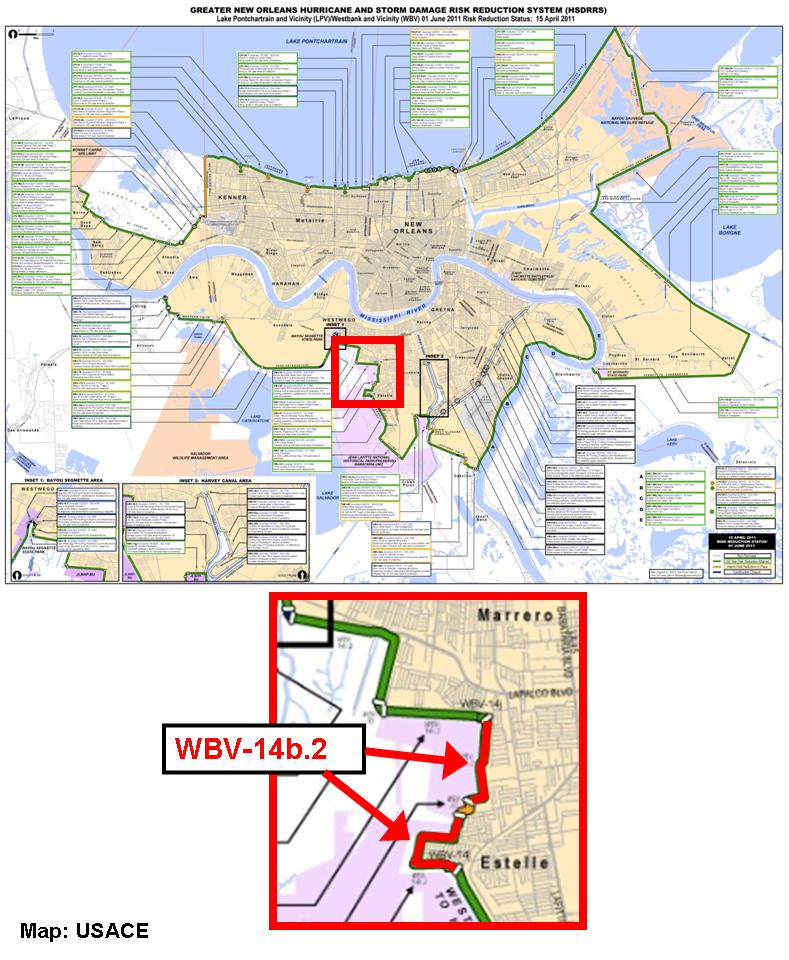
WBV-14b.2 is a 3 mile long stretch of levee between an area near Lapalco Blvd to a point near where Highway 45 runs alongside the west bank levees. Here's the exact location:

It's a zig-zag section of levee. The project involved mostly shifting the centerline of the new levee toward the protected (land) side from the existing levee. Some sections of the new levee would simply be built directly over the existing levee. The new levee would be built with dirt from both borrow pits the existing levee, the same as adjacent project WBV-14c.2.
The borrow apparently came from one of the River Birch pits. The SLFPA-W inspector noted in the January 18, 2010 report on his January 13, 2010 inspection:
This report was long before SLFPA-W became concerned about debris. However, about a year later the situation would be far different. With the SLFPA-W noticing copious amounts of debris on projects all over the west bank, they arrived at the WBV-14b.2 worksite on December 9, 2010 to find this:
That's about as bad as it gets. The report contains 26 pages of debris photos like these:

We don't know if the debris came from the existing levee or from the River Birch pits. Either way it's not good.
The report also contains pictures of the contractor burying the debris, as described above. The debris appears to be large sheets of rusty steel:

Considering the contractor (Creek Services) was willing to do this in full sight of the inspectors, it's a good bet this had been going on the entire year the project was under construction up to that time. It's too bad SLFPA-W only concentrated on the debris problem in December, though, because the project was nearly done at that point.
Subsequent reports as the project wound down noted some progress, albeit mixed. The December 28th report of the December 21, 2010 inspection said:
After reading as many of these reports as I have, I have learned to be very skeptical when I see the words "Corps inspector" and "assured" in proximity. And as expected, an inspection on February 23, 2011 of the mostly finished levees turned up debris in the final product:
There was still debris during another inspection on March 29, 2011 and April 1, 2011, but it was minimal:
It's probably too little, too late.
WBV-15a.2

Debris problems on this 3.75 mile long levee project (contractor: Phylway) near Lake Cataouatche date back months, and possibly longer. In October of last year, SLFPA-W inspectors noticed rocks and other debris in completed sections of the levee. During an October 19, 2010 inspection, they noted:

SLFPA-W inspectors continued to find debris during the October 25, 2010, November 4, 2010, and November 8, 2010.
On December 21 and 22, 2010, things seem to get more serious. The inspection report for this two day visit indicates it was the first time SLFPA-W inspector David Roark had come to the site. His inspection report notes the debris problem in much more complete terms:
The Corps inspector and the contractor were concerned. Right. More like finally confronted. Here's the photo of the back of the Corps inspector's truck, filled with junk pulled out of the levee:

I'm not exactly sure of the workflow on a levee project. However, I believe dirt is initially delivered to piles in a "stock yard" on the site. Then I think it is taken to a flat area where it is laid out and "processed" before it is placed on the levee. Theoretically, the "processing" step should get the debris out, but it really shouldn't be in there in the first place.
This report includes pictures of the stock yard in a section noted as an "Issue." Specifically, the report says, "Unsuitable material in dirt needs to be picked out after dirt is spread," implying the debris in these photos is destined for the levee. Take a look at all the junk in this material:

If this is what is coming out of the borrow pits, and if the contractor and Corps inspectors are as slack about removing debris as the SLFPA-W inspectors lead us to believe they are, it's no wonder junk is making it into the levees. These stockpiles almost look like more rock than dirt.
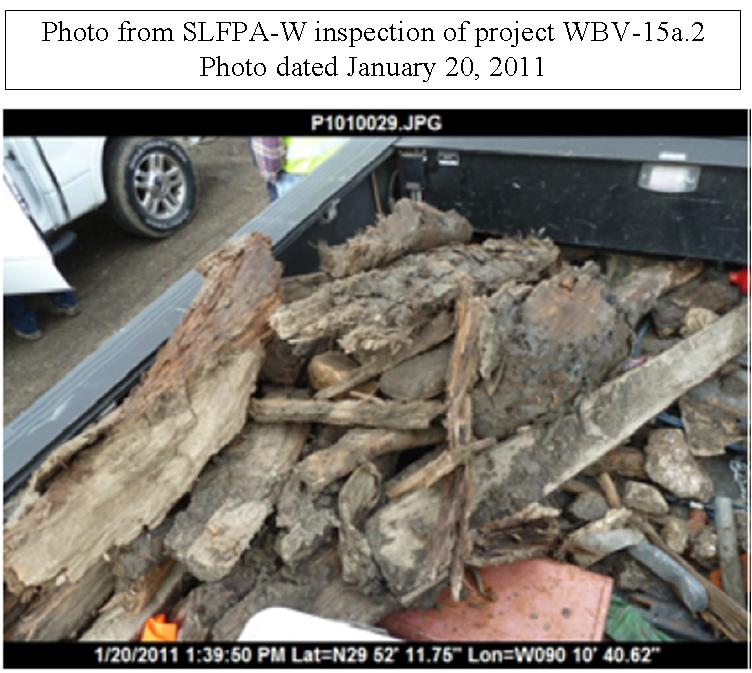
Back to the inspections. Debris was again found during the January 4, 2011 inspection. That seemed to have been the final straw, because the next inspection - on January 20, 2011, the SLFPA-W sent three SLFPA-W inspectors and the Corps sent a Major. The very throrough inspection generated another truck bed full of stuff:

Afterwards, everyone seemed to think things would be okay:
But - as with so many other projects - the debris kept showing up. From the February 21, 2011 inspection:
More assurances that debris would be removed. After a while, they just don't wash.
So what was reported during the April 6, 2011 inspection should not come as a surprise:
And the SLFPA-W inspector's view should also be no surprise:
How many times do the contractor and the Corps inspectors have to agree that debris is a problem, and then have more debris pointed out during the very next inspection, before something serious is done?
Unfortunately, this is the last report we have from this project. However, I think you get the point.
River Birch pits (+ Phylway?) = debris
Something starts to emerge from these reports: the River Birch pits appear very, very bad. We've seen the possibility of it in the WBV-14b.2 reports above, we've seen it mentioned definitely in the WBV-14a.2 reports - also above - and we've seen it mentioned in the WBV-14c.2 reports earlier. Now it shows up in the most recent inspection report from project WBV-14e.2.
WBV-14e.2 is a levee project across from the West Closure Complex, on the Gulf Intracoastal Waterway:

In the May 27th report on the May 26, 2011 inspection of WBV-14e.2, we read this:
The contractor is Phylway, the same one as on WBV-14c.2.
What exactly is happening here? We know River Birch has some sort of hold on certain members of the Jefferson Parish political establishment, but do they also have a similar influence on the Corps and their contractors? And what would make the contractor switch from a pit which is known to be clean to one that is known to be debris-laden? After all, the SLFPA-W reports have repeatedly commended the Willow Bend pit as quite acceptable. In their May 23, 2011 report on a May 18, 2011 inspection to WBV-14e.2, they specifically noted:
A possible connection is the contractor Phylway. Their name, along with River Birch's, keeps popping up on projects where debris is a problem. They are the contractor on what appears to be the worst project, WBV-14c.2, as well as three other projects with reported debris problems: WBV-12 (covered in Part 3), WBV-14e.2 (covered above), and WBV-15a.2 (also covered above).
I should also note that WBV-14e.2 is yet another project that was not actually at the 100 year level of protection at the end of May, despite the Corps saying it was. From the May 27th report on the May 26, 2011 inspection of WBV-14e.2:
How many projects are there like this?
WBV-18.2

We looked at the March 23, 2011 inspection of WBV-18.2 (contractor: Circle Construction) in part 3 of this series. At that time, there were debris problems. Since there, there's been two more inspections. An April 4, 2011 inspection revealed:
We get a hint of why the material looks cleaner in the report for the May 10, 2011 inspection:
So this contractor (Circle Construction) stopped using a pit that was putting out debris. It's unfortunate the pit is not identified, but it does lend more credence to a theory that certain pits are contaminating levees all over the west bank with debris. However, I should note that this project was using borrow from pits located on the site, so it's not clear if the inspector was referring to those pits, or pits elsewhere. Nevertheless, the debris problem was there.
WBV-17b.2

We also looked at this project (contractor: Healtheon) in an earlier post. It too was having debris problems. And like so many others, they have continued.
Except there is one difference. The SLFPA-W have explicitly linked the debris issue to the Corps' drive to build stuff before June 1, 2011. This is shocking stuff to read.
From the May 16th report on the May 10, 2011 inspection report of WBV-17b.2:
So not only is there debris through this supposedly finished levee, it's also not really finished.
But here's the gauntlet being laid down:
Wow. That's really, truly laying it on the line. They (David Roark representing the SLFPA-W and David St. Marie representing the state of Louisiana) follow up with 8 pages of debris photos, and even include direct quotes about debris from the specifications. It is as close to an out-and-out argument as you will see in such a document.
The next inspection (May 23, 2011) shows the Corps inspector - Larry Pryor - pushing to finish the levee in advance of the June 1 deadline, and the SLFPA-W (represented by David Roark) insisting (rightly) that it's not acceptable.
Who exactly is Mr. Pryor working for here? Along with debris photos, the SLFPA-W inspection report includes page after page of photos of depressions and debris in the levee, but the Corps wants to say it's done? Here's the best picture (among many) of the rather obvious high and low areas along the top of the WBV-17b.2 levee:

There is something deeply wrong going on.
Conclusion
A few trends emerge from reading enough of these reports:
1) The debris problem is widespread
Here's a map showing the projects where SLFPA-W inspections have documented debris problems:

All those red lines represent eight levee projects covering 21.9 miles, 18.9 miles of it on the front lines of a hurricane. It looks like the majority of the 100-year hurricane protection levee system along the west bank, excepting the Mississippi River levees. This is not an isolated problem. This is a systemic threat to the integrity of the storm protection around New Orleans.
2) The Corps does not like the SLFPA-W
SLFPA-W inspectors do not appear to be welcome on the project sites by Corps inspectors. Some Corps inspectors explicitly ignore them, while others insist projects are acceptable when they clearly, obviously are not. As a result, levees appear to be getting built improperly, despite SLFPA-W objections.
3) Some borrow pits are debris-laden
Numerous SLFPA-W inspection reports point to borrow pits owned by River Birch as the culprit in the excessive amounts of debris being placed into miles of new levees around the west bank. Certain projects' contractors and Corps inspectors (and higher Corps officials) are well aware of this, yet continued - and continue - to use these pits, sometimes even switching to them from cleaner pits (this happened the last week of May on one project). This is a serious, systematic problem that screams out for investigation, especially in light of the ongoing federal investigation into River Birch and their dealings with Jefferson Parish politicos.
4) The Corps' race to June 1st has materially affected the levee work, resulting in unacceptable work.
The SLFPA-W says it explicitly and implicitly throughout their reports: the Corps' hurrying has damaged their levee work. Guess who eventually pays? The people living behind those levees.
5) The Corps lied about projects being 100-year ready on June 1, 2011
SLFPA-W photos and inspection reports from the last week of May document numerous projects still well below 100-year elevations, despite Corps public pronoucements claiming the opposite. This appears to be lying by the Corps.
In the next part, the debris problem breaks through to the print media.
Part 2
Part 3
Part 4
Part 6
Part 7
Part 8
Part 9
Part 10
Part 11
Part 12
Part 13
Part 14
The record in dealng with debris has been mixed throughout the Corps' projects. Let's look through the system, courtesy of the inspection reports prepared for the Southeast Louisiana Flood Protection Authority - West.
WBV-12

Some projects appear to have moved past the problem. Earlier, we noted WBV-12 (a project titularly awarded as task order to the much larger West Closure Complex contract. The WCC prime contractor is Gulf Intracoastal Constructors, which is actually Traylor Brothers and Kiewit. However, WBV-12 was actually immediately subcontracted to Phylway, who we will find out is behind many of the debris-laden projects.) having debris problems dating back to the beginning of the project last fall all the way through March of this year. From the April 4th report on March 28, 2011 inspection:
"Debris was noted in several areas between the sheet pile driving operation and the first location of embankment work. As debris was found the USACE inspector placed debris in the back of his pickup truck. Between approximate stations 170+00 and 175+00 SLFPA-W noted debris in surface being covered by current lift and in material being placed, no personnel was monitoring area for debris. SLFPA-W continued to approximate station 138+00 were the second location of embankment work is ongoing. Debris was noted in the surface being covered by current lift as at the previous area of embankment work. The truck spotter did remove debris as SLFPA-W began taking pictures.
Overall I believe that since the current lifts are being placed on a surface containing debris, then how much debris was not removed?"
The debriefing summary also noted:
"At the second location the truck spotter began picking up debris when SLFPA-W was photographing debris."
Subsequent inspection reports have better news:
May 3, 2011 report of April 25, 2011 inspection:
"The debris found today was excavated from the flood side along the slurry trench installed. This material is to be hauled off and replaced with compacted material. Overall debris issue has diminished to nil. Truck spotters still utilized to remove during dumping operation. USACE inspectors to insure that the current method of removing debris continues."
And the May 23, 2011 report of the May 16, 2011 inspection:
"Debriefing:
No issues at this time. Debris no longer an issue, minimum amount was found during today's visit."
That's good. But the question asked in the report on the March 28th inspection is still hanging out there:
Overall I believe that since the current lifts are being placed on a surface containing debris, then how much debris was not removed?"
Moving along, we find other projects are still dealing with debris.
WBV-14a.2
WBV-14a.2 is a 3 mile long hundred year levee project on the west bank of the Harvey Canal:

The lead contractor is Purnell Construction, though a company named Hill Brothers also claims it. It's likely Hill Brothers is subcontracted to Purnell.
Before moving on to the debris problems, I must admit to some confusion regarding the scope of this project. Why is the Corps building a 100-year project behind the West Closure Complex (WCC), when they claim that the WCC is supposed to take all these floodwalls and levees out of the line of fire of a hundred year storm? In fact, there are two other 100-year projects immediately to the north and south of WBV-14a.2 (WBV-38.2 and WBV-23), both of which also lie behind the WCC. This seems like money that could have been better spent elsewhere, using the Corps' reasoning. After all, many of the other projects behind the WCC - including the projects just across the Harvey Canal from these - are not up to the 100 year standard, so why do these three get that treatment?
Anyway...
WBV-14a.2 has had reports of debris problems through May. During a May 5th inspection documented in the May 9, 2011 report, there was this:
"Debris in current material being placed"
This is followed by 3 pages of debris pictures:

The report also notes:
"Debris in material previously placed and being topped by current lift. SLFPA-W noted two man crew picking up debris."
So debris was getting buried. That's very bad. Also, a two man crew is too small for such work.
The above comment was followed by another 7 pages of debris pictures:

From the pictures, it is clear the debris is not just organic, but also includes rocks or some other inorganic material.
Understandably, SLFPA-W came back just about a week later. On May 13th (documented in the May 16, 2011 report), this is what they found:
Overall review of site visit:
USACE inspector [Wade Lucas] expressed that the contractor has stepped up debris removal from a two man crew to a seven man crew along with a crew removing debris at the pit (River Birch). Once the material is on site the material is picked through three times before the next lift is installed, first time during dumping and spreading operation, second time during the disking process and compaction and the third time during disking before placing the next lift."
As I said, a two man crew was too small.
Also note that a River Birch pit is mentioned again. We heard about debris coming out of one of the River Birch pits on WBV-14c.2 as well.
The report continues:
"Reviewed area between approximate stations 959+00 and 972+50; 6th lift has been placed. The amount of debris is considerably less in the 6th lift than noted previously during the placement of the 5th lift.
Reviewed area between approximate stations 935+00 and 951+00; 1st lift has been placed. Debris crew picking up debris in this area during visit. Several large pieces of wood was noted along with one large rock. Area also contains a considerable amount pieces of wood. The amount and size of debris found is substantial to warrant concerns that the contractor should put forth more effort in the removal of debris in this area."
Let's stop right here and read between the lines. The report starts with the Corps inspector's rather glowing description of the contractor's (that's Purnell or Hill Brothers) efforts at debris removal. Then it moves on to the reality that shows those efforts aren't worth very much.
If SLFPA-W inspectors are finding all this during weekly inspections, what exactly are the Corps folks doing when the SLFPA-W isn't there, especially during the months when SLFPA-W wasn't devoting its limited resources to stepped-up scrutiny of such projects? We've got dozens of reports of SLFPA-W inspectors finding large bunches of debris through many projects and over many months. How is this possible? Isn't the Corps paying its contractors and its Quality Assurance/Quality Control folks to keep tabs on this? Are the Corps folks and the contractors really acting on behalf of the public, or strictly on behalf of the contractor?
The SLFPA-W has similar concerns, as the report notes:
"Although the contractor appears to have stepped up debris removal operations, SLFPA-W has concerns with lifts 1 through 4 in area placed before the additional debris removal efforts were in place between approximate stations 959+00 and 972+50. A substantial amount of debris was noted in the 4th lift in the last report, which in may still exist.
SLFPA-W has concerns that with 250 plus trucks per day bringing in material and the amount noted today; the contractor needs to put forth a greater effort in monitoring and removing of debris."
Translation: SLFPA-W believes this entire new levee may be shot through with debris, and it is the fault of the contractor and the Corps. The SLFPA-W inspector includes 6 pages of debris pictures to make his point.
That brings us to the most recent inspection of WBV-14a.2, which took place May 23, 2011 and was documented in the May 30, 2011 report:
"SLFPA-W observed during today's visit that the contractor's nine man crew with supervision removing debris from material on site. The crew was working ahead of the material being placed and appeared to be removing all of the debris. SLFPA-W and USACE reviewed area between the picking crew and the material being placed and found it free of debris."
So they went from two men, to seven men, to nine men. What were they doing for the months before the SLFPA-W started zeroing in on them? Likely nothing.
Continuing with the report:
"Reviewed area between approximate stations 959+00 and 972+50; lift 7 has been placed to an elevation 1.0'. SLFPA-W and USACE reviewed approximately 600' of this area and found large pieces of wood debris. Later the contractor informed SLFPAW that the area has been disked but the debris in this area has not been removed.
Reviewed area between approximate stations 935+00 and 951+00; the 3rd lift was being placed and disked between approximate stations 935+00 and 941+00. This is in the area that the debris crew was observed picking up debris. The current material appeared to contain less debris but several large pieces were noted and the contractor removed them immediately."
The SLFPA-W wraps it up with this:
"SLFPA-W reiterated has concerns between approximate stations 959+00 and 972+50 with lifts 1 through 4 that were placed before the additional debris removal efforts were in place. A substantial amount of debris was noted in the 4th lift during placement of the 5th lift in the 05-May-2011 report, SLFPA-W needs verification that this debris has been removed."
I seriously doubt they will get such verification without tearing the levee apart.
Here's a sample of the debris SLFPA-W found on May 23rd:

By the way, this project doesn't look anywhere near complete, despite the Corps saying it was 100-year ready.
WBV-14b.2
WBV-14b.2 is a 3 mile long stretch of levee between an area near Lapalco Blvd to a point near where Highway 45 runs alongside the west bank levees. Here's the exact location:
It's a zig-zag section of levee. The project involved mostly shifting the centerline of the new levee toward the protected (land) side from the existing levee. Some sections of the new levee would simply be built directly over the existing levee. The new levee would be built with dirt from both borrow pits the existing levee, the same as adjacent project WBV-14c.2.
The borrow apparently came from one of the River Birch pits. The SLFPA-W inspector noted in the January 18, 2010 report on his January 13, 2010 inspection:
"The contractor is using River Birch as their borrow source."
This report was long before SLFPA-W became concerned about debris. However, about a year later the situation would be far different. With the SLFPA-W noticing copious amounts of debris on projects all over the west bank, they arrived at the WBV-14b.2 worksite on December 9, 2010 to find this:
"Debris was found throughout the flood side of levee and heavy in the berm area. During inspection the contractor began pushing embankment material from the protected side over the levee to the flood side. SFLPA-W representative noticed that dozer working material to the flood side was burying debris, as noted in issue #8. The protected side contains some debris but not as heavy as the flood side. Contractor had no one picking up debris in "area of work".
That's about as bad as it gets. The report contains 26 pages of debris photos like these:

We don't know if the debris came from the existing levee or from the River Birch pits. Either way it's not good.
The report also contains pictures of the contractor burying the debris, as described above. The debris appears to be large sheets of rusty steel:

Considering the contractor (Creek Services) was willing to do this in full sight of the inspectors, it's a good bet this had been going on the entire year the project was under construction up to that time. It's too bad SLFPA-W only concentrated on the debris problem in December, though, because the project was nearly done at that point.
Subsequent reports as the project wound down noted some progress, albeit mixed. The December 28th report of the December 21, 2010 inspection said:
"Very little debris was found on flood side of levee from Sta.0+35 to Sta.20+35. A 3 man crew with a bobcat was walking the entire levee area and picking up unsuitable material. Corps inspector assured us that this type of action would be continued throughout entire job."
After reading as many of these reports as I have, I have learned to be very skeptical when I see the words "Corps inspector" and "assured" in proximity. And as expected, an inspection on February 23, 2011 of the mostly finished levees turned up debris in the final product:
"23-Feb-2011 - The first day of inspection between approximate stations 164+92 to 74+65 revealed debris, ruts and low areas. It was apparent that some of the ruts were caused by others.
Contractor called out a crew to begin picking up debris. Crew picked up debris that SLFPA‐W crew flagging; no other debris was picked up by crew. SLFPA‐W (Roark, Muscarello), USACE (Major Giles, Channing) picked up debris in areas of flags and placed at flags as depicted in pictures."
There was still debris during another inspection on March 29, 2011 and April 1, 2011, but it was minimal:
"Overall debris found was within limits of specifications. Only one piece of wood was found of a substantial size and a minimal amount (1/2 dozen) of small concrete pieces were found, contractor removed all debris immediately. During inspection SLFPA-W noted contractor was picking up debris that was less than size limits set in specifications."
It's probably too little, too late.
WBV-15a.2

Debris problems on this 3.75 mile long levee project (contractor: Phylway) near Lake Cataouatche date back months, and possibly longer. In October of last year, SLFPA-W inspectors noticed rocks and other debris in completed sections of the levee. During an October 19, 2010 inspection, they noted:
"Issue: Unsuitable material found on levee from Sta.320+00 to Sta.330+0. Rocks are localized on floodside of levee."

SLFPA-W inspectors continued to find debris during the October 25, 2010, November 4, 2010, and November 8, 2010.
On December 21 and 22, 2010, things seem to get more serious. The inspection report for this two day visit indicates it was the first time SLFPA-W inspector David Roark had come to the site. His inspection report notes the debris problem in much more complete terms:
"21-Dec-2010 - SLFPA-W met Coe representative (Paul Williams) at the Coe site trailer. Reviewed project progress and both parties proceeded to site.
Overall review of inspection, some debris was found and Coe representative called contractor to site area of debris. Continuing with project inspection the contractor joined us; debris was immediately picked up as found during the inspection tour. Both the Coe representative and the contractor were concerned with the amount of debris found in area of finished grade berm (protected side) which basically filled the back of the Coe representative's truck (as depicted in photo P1000040)."
The Corps inspector and the contractor were concerned. Right. More like finally confronted. Here's the photo of the back of the Corps inspector's truck, filled with junk pulled out of the levee:

I'm not exactly sure of the workflow on a levee project. However, I believe dirt is initially delivered to piles in a "stock yard" on the site. Then I think it is taken to a flat area where it is laid out and "processed" before it is placed on the levee. Theoretically, the "processing" step should get the debris out, but it really shouldn't be in there in the first place.
This report includes pictures of the stock yard in a section noted as an "Issue." Specifically, the report says, "Unsuitable material in dirt needs to be picked out after dirt is spread," implying the debris in these photos is destined for the levee. Take a look at all the junk in this material:

If this is what is coming out of the borrow pits, and if the contractor and Corps inspectors are as slack about removing debris as the SLFPA-W inspectors lead us to believe they are, it's no wonder junk is making it into the levees. These stockpiles almost look like more rock than dirt.
Back to the inspections. Debris was again found during the January 4, 2011 inspection. That seemed to have been the final straw, because the next inspection - on January 20, 2011, the SLFPA-W sent three SLFPA-W inspectors and the Corps sent a Major. The very throrough inspection generated another truck bed full of stuff:
Afterwards, everyone seemed to think things would be okay:
"Debriefing: It was agreed that the debris concerns still exist, but the actions that the USACE and contractor have taken appear to be resolving the debris concerns.
Actions taken:
- Truck spotter is removing debris as trucks dump.
- Contractor's crew inspects for debris again, photos and removes any debris found.
- USACE inspects area again for any debris, debris found contractor removes."
But - as with so many other projects - the debris kept showing up. From the February 21, 2011 inspection:
"Reviewed areas of currently placed fill between approximate stations 465+00 and 468+00 along with section between stations 340+00 and 325+00. Some debris was found between stations 340+00 and 325+00 on the protected side as noted later in report by photos. Contractor stated lift was just placed and assured that the next step is to remove debris."
More assurances that debris would be removed. After a while, they just don't wash.
So what was reported during the April 6, 2011 inspection should not come as a surprise:
"Reviewed flood side of project between approximate stations 317+00 and 377+00. Debris was numerous through out this area in the berm. Most debris found was rocks and concrete; all of a considerable size."
And the SLFPA-W inspector's view should also be no surprise:
"Debriefing was held with USACE and the contractor. The amount of debris found along the flood side berm and haul road is still a considerable amount. During the past several site visits debris along the flood side berm has been located and removed. SLFPA-W believes the amount of debris found should have decreased in this amount of time and has requested that the contractor focus on debris removal before the next SLFPA-W site visit. Contractor agreed and is also attempting to schedule to begin seeding operation at the end of two weeks or the beginning of the third week from today. Seeding operation will cover the protected side berm along with both sides and top of the levee. Contractor to harrow areas before seeding and follow with a crew to remove any debris. USACE will notify SLFPA-W once harrowing begins."
How many times do the contractor and the Corps inspectors have to agree that debris is a problem, and then have more debris pointed out during the very next inspection, before something serious is done?
Unfortunately, this is the last report we have from this project. However, I think you get the point.
River Birch pits (+ Phylway?) = debris
Something starts to emerge from these reports: the River Birch pits appear very, very bad. We've seen the possibility of it in the WBV-14b.2 reports above, we've seen it mentioned definitely in the WBV-14a.2 reports - also above - and we've seen it mentioned in the WBV-14c.2 reports earlier. Now it shows up in the most recent inspection report from project WBV-14e.2.
WBV-14e.2 is a levee project across from the West Closure Complex, on the Gulf Intracoastal Waterway:

In the May 27th report on the May 26, 2011 inspection of WBV-14e.2, we read this:
"- Reach 3C (approximate stations 768+50 to 799+35), existing levee has been capped to elevation 11.0'. Contractor was placing embankment on protected side berm at approximate Sta.787+50. Contractor began hauling in material from the River Birch pit on Thursday 5/25/11.
Debriefing:
- SLFPAW reps expressed their concerns about the contractor changing from the Willowbend to RiverBirch pits."
The contractor is Phylway, the same one as on WBV-14c.2.
What exactly is happening here? We know River Birch has some sort of hold on certain members of the Jefferson Parish political establishment, but do they also have a similar influence on the Corps and their contractors? And what would make the contractor switch from a pit which is known to be clean to one that is known to be debris-laden? After all, the SLFPA-W reports have repeatedly commended the Willow Bend pit as quite acceptable. In their May 23, 2011 report on a May 18, 2011 inspection to WBV-14e.2, they specifically noted:
"No issues at this time. Material is hauled from the Willow bend pit and is very clean."
A possible connection is the contractor Phylway. Their name, along with River Birch's, keeps popping up on projects where debris is a problem. They are the contractor on what appears to be the worst project, WBV-14c.2, as well as three other projects with reported debris problems: WBV-12 (covered in Part 3), WBV-14e.2 (covered above), and WBV-15a.2 (also covered above).
I should also note that WBV-14e.2 is yet another project that was not actually at the 100 year level of protection at the end of May, despite the Corps saying it was. From the May 27th report on the May 26, 2011 inspection of WBV-14e.2:
"This project involves raising the elevation of approximately 3.5 miles of existing earthen levee to the 100-year level of protection varying between elevations +13.0 to +14.0."
"- Reach 1 (approximate Sta.649+54 to 661+50) has been constructed to elevation 12.5'. Final construction grade will be elevation 14.0'. No work was being done in this area during site visit.
- Reach 2 (approximate Sta.662+00 to 741+50), existing levee has been capped to elevation 11.0'.
- Reach 3A and 3B (approximate Sta.742+00 to 768+00) has been constructed to elevation 13.5' and has been seeded.
- Reach 3C (approximate stations 768+50 to 799+35), existing levee has been capped to elevation 11.0'. Contractor was placing embankment on protected side berm at approximate Sta.787+50. Contractor began hauling in material from the River Birch pit on Thursday 5/25/11."
How many projects are there like this?
WBV-18.2

We looked at the March 23, 2011 inspection of WBV-18.2 (contractor: Circle Construction) in part 3 of this series. At that time, there were debris problems. Since there, there's been two more inspections. An April 4, 2011 inspection revealed:
"Contractor placing only material to be processed and sealing in preparation of forecasted storm. Reviewed project from approximate station 245+00 to 160+00 along the protected side berm. Debris noted today was localized in the original berm area on the protected side between approximate stations 180+00 and 178+00. Overall material being placed for processing appears to be free of debris."
We get a hint of why the material looks cleaner in the report for the May 10, 2011 inspection:
"Contractor processing material; overall material placed for processing appears to be free of debris. Embankment material currently being placed on protected side berm at approximate station 211+00.
Very little debris was noted in review of levee and berm; debris found was removed and tossed to toe of levee (protected side) to be picked up by contractor later today.
Debriefing:
No issues, excavation was halted at pit were debris was coming from. Current material appears to be free of debris."
So this contractor (Circle Construction) stopped using a pit that was putting out debris. It's unfortunate the pit is not identified, but it does lend more credence to a theory that certain pits are contaminating levees all over the west bank with debris. However, I should note that this project was using borrow from pits located on the site, so it's not clear if the inspector was referring to those pits, or pits elsewhere. Nevertheless, the debris problem was there.
WBV-17b.2

We also looked at this project (contractor: Healtheon) in an earlier post. It too was having debris problems. And like so many others, they have continued.
Except there is one difference. The SLFPA-W have explicitly linked the debris issue to the Corps' drive to build stuff before June 1, 2011. This is shocking stuff to read.
From the May 16th report on the May 10, 2011 inspection report of WBV-17b.2:
"Overall review of site visit:
Levee is completed to construction elevation with the exception of two areas. The first at the east entrance levee crossing for WBV-72 and the second at the discharge pipe crossing for WBV-76.
The last lift placed atop the levee is compacted but not graded level; contains high and low areas (not sure which area is to grade). The sides of the levee where the last lift was placed appear not to have been graded or compacted. A considerable amount of debris was found through out the top and sides of the levee along with a small amount in the flood side berm."
So not only is there debris through this supposedly finished levee, it's also not really finished.
But here's the gauntlet being laid down:
"Debriefing:
The amount of debris found in the material placed in the levee is considered unacceptable. SLFPA-W noted no crew on site picking up debris today.
As reported in previous report; SLFPA-W has concerns that some debris may not have been removed due to the rate of 38 trucks per hour dumping material and no personnel was noted picking up debris.
Previous SLFPA-W concerns about the debris appear to have been disregarded to meet the June mandate."
Wow. That's really, truly laying it on the line. They (David Roark representing the SLFPA-W and David St. Marie representing the state of Louisiana) follow up with 8 pages of debris photos, and even include direct quotes about debris from the specifications. It is as close to an out-and-out argument as you will see in such a document.
The next inspection (May 23, 2011) shows the Corps inspector - Larry Pryor - pushing to finish the levee in advance of the June 1 deadline, and the SLFPA-W (represented by David Roark) insisting (rightly) that it's not acceptable.
"Overall review of site visit:
Levee is completed to construction elevation with the exception of two areas. The first at the east entrance levee construction crossing for WBV-72 and the second at the discharge pipe construction crossing for WBV-76.
USACE inspector expressed that the contractor believes the levee has been constructed to plans and specs and is ready for seeding; after reviewing the levee it appears to still have high and low areas along the top and sides of the levee. Also, debris was found along the top and sides of the levee.
Debriefing:
Before seeding, the levee needs to be graded, compacted and the debris removed (wood and concrete)."
Who exactly is Mr. Pryor working for here? Along with debris photos, the SLFPA-W inspection report includes page after page of photos of depressions and debris in the levee, but the Corps wants to say it's done? Here's the best picture (among many) of the rather obvious high and low areas along the top of the WBV-17b.2 levee:

There is something deeply wrong going on.
Conclusion
A few trends emerge from reading enough of these reports:
1) The debris problem is widespread
Here's a map showing the projects where SLFPA-W inspections have documented debris problems:

All those red lines represent eight levee projects covering 21.9 miles, 18.9 miles of it on the front lines of a hurricane. It looks like the majority of the 100-year hurricane protection levee system along the west bank, excepting the Mississippi River levees. This is not an isolated problem. This is a systemic threat to the integrity of the storm protection around New Orleans.
2) The Corps does not like the SLFPA-W
SLFPA-W inspectors do not appear to be welcome on the project sites by Corps inspectors. Some Corps inspectors explicitly ignore them, while others insist projects are acceptable when they clearly, obviously are not. As a result, levees appear to be getting built improperly, despite SLFPA-W objections.
3) Some borrow pits are debris-laden
Numerous SLFPA-W inspection reports point to borrow pits owned by River Birch as the culprit in the excessive amounts of debris being placed into miles of new levees around the west bank. Certain projects' contractors and Corps inspectors (and higher Corps officials) are well aware of this, yet continued - and continue - to use these pits, sometimes even switching to them from cleaner pits (this happened the last week of May on one project). This is a serious, systematic problem that screams out for investigation, especially in light of the ongoing federal investigation into River Birch and their dealings with Jefferson Parish politicos.
4) The Corps' race to June 1st has materially affected the levee work, resulting in unacceptable work.
The SLFPA-W says it explicitly and implicitly throughout their reports: the Corps' hurrying has damaged their levee work. Guess who eventually pays? The people living behind those levees.
5) The Corps lied about projects being 100-year ready on June 1, 2011
SLFPA-W photos and inspection reports from the last week of May document numerous projects still well below 100-year elevations, despite Corps public pronoucements claiming the opposite. This appears to be lying by the Corps.
In the next part, the debris problem breaks through to the print media.
Labels: Debris
posted by mcbrid35 at
11:05 AM
|
0 comments


