Fix the pumps

Monday, May 09, 2011

The 2011 pump rebuild scramble

This entry was updated July 14, 2011 to bring it in line with revisions made elsewhere on this blog. These revisions came about due to a large pump repair document release in June and July, 2011 in response to FOIA requests. As such, the tense is an odd mix of tone, mixing voices from both the original date of composition on May 9, 2011 and the later revision date of July 14, 2011.

Last spring, we looked at a flurry of hydraulic pump repair activity at the New Orleans lakefront gates. This spring, there seems to be another such push.

Third Healtheon contract, task order #1

At the end of the last update, we noted that two pumps at the London Avenue site - E1 and E5 - had been removed and taken to Conhagen's shop for rebuilding around March 22, 2011, based on an oil spill report from that day. Here's pictures of the empty E1 and E5 slots in early April:


As of late April, E1 and E5 were back in at London Avenue:


This work was performed under $598,101.68 task order #1 to Healtheon contract W912P8-11-D-0015, the third pump repair contract. As described in the previous post, that task order also called for the repair of 17th Street pumps W4 and W7:
CLIN 1001A - Remove, recondition and reinstall pump #4W and #7W at 17th Street Canal @ $262,376.76.
CLIN1001BC - Remove, recondition and reinstall pump #1E and #5E at London Avenue Canal @ $334,724.92. Contractor may opt to use 240-ton crane at this site in lieu of 500-tonn crane as stated in contract."

Modification 1 to task order #1, issued for $12,433.26 on June 8, 2010 - after the work had been completed - accounted for the bearing and seal work that has become standard on all these repairs:
"Add the following additional work for all four (4) pumps:

Repair Mechanical Seals at subcontractor shop (4 Each)
Remove Pump Shaft Bearings
Replace Radial bearings Impeller End (4 Each)
Replace Radial Bearings Motor End (4 Each)
Replace Thrust Bearings (4 Sets)
Replace bearing Spacers (4 Each)
Inspect Shafts and Housing
Mount New Bearings
Clean All Parts for Assembly
Reinstall Pump Shafts"

It also allowed for a smaller crane at the London Avenue site.

The Conhagen repair reports for these four pumps (London Avenue E1 and E5 report, 17th Street W4 and W7 report) include the now-usual photos of very, very, very rusty pumps. And they also help solve a mystery.

The pictures of London Avenue pump E1 include this shot:


Notice the multiple zinc anodes, and how they are fastened to the pump's suction bell. The original pump order included only a single pair of anodes for each pump, and they were fastened in a different manner. Here's pictures of the pumps in 2006, with their original anodes:


And here's one of the 2009 Conhagen-repaired pumps going back in the water:


All this indicates this pump had previously been removed and partially repaired. This helps explain the May 22, 2009 spill report I noted over a year ago in Corps of oil, Part 3:

May 22, 2009 at London Avenue
Quantity released: 40 gallons (from QRI task order)
NRC report: No
LDEQ report: No
Description: From $5399.16 task order #4 to the second QRI contract: "Provide labor, material, and use of eqipment [sic] to clean up about 40 gallons of hydraulic fluid that spilled from pump 1E at London Avenue Canal."

At that time, I noted that E1 was not among the four pumps that had been pulled out at the London Avenue site before June, 2010. Indeed, I don't know of any contractual evidence of the repair of London pump E1, but it obviously happened.

It was probably repaired by the Corps themselves, before they started sending pumps to Conhagen through the first Healtheon contract. And since this happened so early on in the repairs (May, 2009), it also likely had the very limited scope of work involving just replacement of the carbon steel pipes inside the pump bore with stainless steel, and simple cleaning of the external piping and coolers followed by a new coat of paint.

Indeed, other pictures of E1 from the 2011 repair report back this up. The interior pipes are not rusted at all, indicating they're stainless:


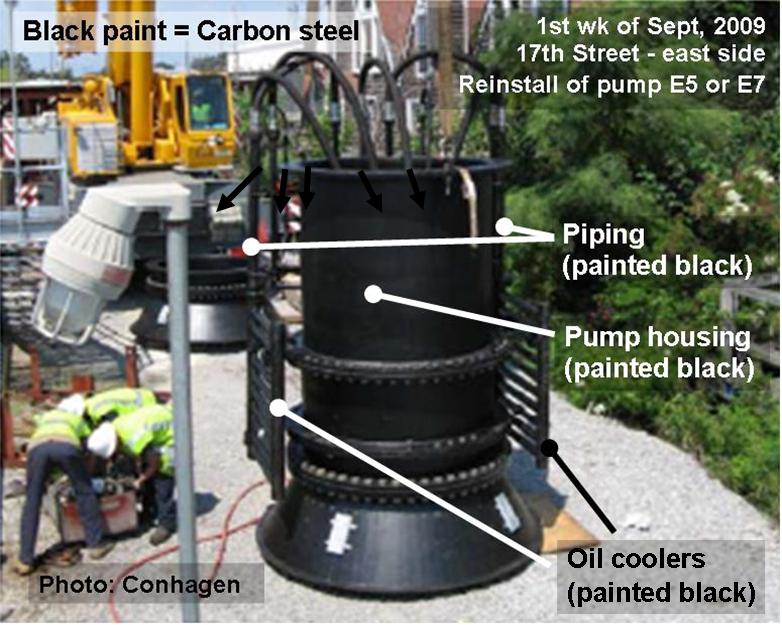
While the external piping and coolers look like they've taken some serious corrosion damage since the first round of repairs in June, 2009:


Five other 60" pumps - all at 17th Street - also received this misguidedly small set of repairs before the Corps realized they needed to do more.

This makes London Avenue pump E1 the first 60" pump to be pulled out twice, doubly compounding the errors in corrosion judgement made in 2006 and 2007. This is a massive waste of money. It is extremely likely this pattern will be repeated on the 17th Street pumps repaired in 2009 as well.

Anyhow, the other three pumps rebuilt under this task order had all the normal rust damage to their Rineer motors and attached piping:


And to their oil coolers and external piping:


Conhagen completed all the repairs (it's unclear whether they got new or refitted Rineer motors) in April, 2011. London Avenue pumps E1 and E5 went back in the water April 27, 2011. 17th Street pumps W4 and W7 were reinstalled three days later, on April 30, 2011.

Third Healtheon contract, task order #2

Work continued this spring at London Avenue, with pumps W5 and W6 coming out:


We can tell they're out because we can see the bottom flanges of the elbows unattached to any pumps below them. We also don't see the distinctive piping extensions added to the pumps in 2007, as we can on the adjacent pump W4.

This work likely took place on April 26th, since there was a spill report from London Avenue that day:
"CALLER IS REPORTING A DISCHARGE OF HYDRAULIC OIL FROM A HYDRAULIC PUMPS OVER THE WATER AT THE PUMPING STATION DUE TO MAINTENANCE ACTIVITY (MAINTAINING THE PUMPS)."

The Corps claimed 3 gallons for this spill. Again, like the last spill report in March, I find this implausibly tiny, and a likely underreporting. However, at least it was reported, unlike dozens of others over the last five years.

There is another possibility for the source of this spill. It could have resulted from the reinstallation of London Avenue pumps E1 and E5. The acceptance testing for those pumps occurred on April 27th, the day after this spill, but they could have been getting put back in on the 26th. Without more detail, it's unfortunately impossible to know.

Meanwhile, there was also work at 17th Street, with E4 coming out on May 2nd:


The corrosion on the outer pump housing and the oil coolers is obvious:


The corrosion damage to the innards of the pump, including the Rineer motor, is likely similarly severe.

E3 was also due to come out that day, as evidenced by the missing flange bolts on its elbow:


E3 and E4 were untouched before this latest activity.

All four of these pumps came out under $523,862.74 task order #2 to the third Healtheon/Conhagen contract, issued April 25, 2011. The text of that task order reads,
"CLIIN 1001A: Removal, reconditioning and reinstallation of pump #3E and #4E at 17th St. Canal Interim Closure Structure.

CLIN 1001BD: Removal, reconditioning and reinstallation of pump #5W and #6W at London Ave. Canal Interim Closure Structure.

All work shall be completed by 17 June 2011."

However, as the Corps' self-imposed June 1st deadline for the completion of the 100 year protection system around the New Orleans area approached, apparently someone wanted results faster. Modification 1 to task order #2, issued after the fact on June 8, 2011 did two things:

1) It moved the deadline for the work on these four pumps up to May 31, 2011.

2) It added the now standard suite of repairs to bearings and seals:
"The Scope of Work is also modified to add the following additional work for all four (4) pumps:

Repair Mechanical Seals at subcontractor shop (4 Each)
Remove Pump Shaft Bearings
Replace Radial bearings Impeller End (4 Each)
Replace Radial Bearings Motor End (4 Each)
Replace Thrust Bearings (4 Sets)
Replace bearing Spacers (4 Each)
Inspect Shafts and Housing
Mount New Bearings
Clean All Parts for Assembly
Reinstall Pump Shafts"

It didn't do these things cheap. It cost $139,913.16, bringing the total value of this task order to $663,775.90.

My FOIA request also produced the Conhagen repair reports for both pairs of pumps (repair report for 17th Street pumps E3 and E4 and repair report for London Avenue pumps W5 and W6)

As usual, these reports are full of troubling photos. Here's a before and after of the seal flange on London Avenue pump W6:


Here's the seal flange on 17th Street pump E3:


I'm assuming this photo was taken to show the oil that had gotten past the seal and had spread. When they removed some of the outer housing, presumably this is what they found. This is bad, because big oil leaks like this mean lubrication for the bearings is gone, potentially causing pump failure.

Anyhow, Conhagen accelerated the repairs (hopefully completing them properly in the process). The London Avenue pumps went back in the water May 21, 2011. Here they are in place on June 1, 2011:


The 17th Street pumps were back in May 24, 2011, beating the Corps' artificial deadline.

[I realize this information and the charts below include information that occurred after the date of this post, but that's because I'm writing it after I got information that was missing at the time I originally composed it. It's timey-wimey.]

Stepping back a bit, this means the Corps has pulled ten pumps in five pairs for planned repairs (the planned repairs always occur in pairs) since the 2010 hurricane season:

London Avenue pumps E2 and E6
London Avenue pumps E1 and E5 (second round of repairs for E1)
London Avenue pumps W5 and W6
17th Street pumps W4 and W7
17th Street pumps E3 and E4

With the receipt of all the documentation on these pumps, we can update the pump status for the London Avenue site:


We can also update the 17th Street site. It is important to realize that the five 60" pumps reworked in 2009 with an incomplete set of repairs are extremely liable to oil spills.


The Orleans Avenue site has had nearly zero attention paid to it, with only a single pump pulled out in the last two years, and even that was only in response to an oil spill, not as a planned repair:


So, even after all the pumps we believe have gone for repairs, there will still be twelve 60" pumps still untouched - including 9 of the 10 at the Orleans Avenue site:

17th Street: W2, W3
London Avenue: W2
Orleans Avenue: E1, E2, E3, E4, E5, W1, W2, W3, W5

and another five with incomplete repairs:

17th Street: E5, E7, W8, W9, W10

which are likely to break again very soon.

And it's taken two years to get to this point. Since the Corps only pulls pumps out during hurricane season if they break, it's either unlikely (in the Corps' view) or likely (in view of all the photos of broken pumps I've published over the last year) we'll see more activity before the end of the 2011 hurricane season.

Matt Davis and Steve Beatty of The Lens contributed to this report.

Labels:

Thursday, May 05, 2011

Debris, Part 3

Part 1
Part 2
Part 4
Part 5
Part 6
Part 7
Part 8
Part 9
Part 10
Part 11
Part 12
Part 13
Part 14

In the previous two entries (Part 1, Part 2), we've been looking at the problem of debris within the levees the Corps of Engineers is building around New Orleans. If there's too much debris, organic or otherwise, within a levee, its integrity could be undermined over time, reducing the level of protection for the people behind it.

We've looked at one project where debris was a problem for 3 months before a plan was put in place. At another project, debris has been a continuing issue for over six months, but the Corps refuses to shut the job down to fix the problem. The Southeast Louisiana Flood Protection Authority - West (SLFPA-W) has said in its inspection reports that these debris problems could lead to them not accepting the projects from the Corps upon completion.

But that's just two projects out of dozens. How widespread is the debris problem?

Let's look at three more levee projects where the SLFPA-W has reported debris concerns, WBV-17b.2, WBV-18.2, and WBV-12:


WBV-17b.2


WBV-17b.2 is a relatively short stretch (just 1 mile) of levee on the Jefferson side of the Jefferson-St Charles Parish line. The project was awarded last November. There are only five SLFPA-W inspection reports thus far. The first, an early report from December, 2010, notes the contractor - Healtheon - hadn't yet mobilized. But the four more recent inspections show SLFPA-W ramping up inspections because of debris concerns.

From the March 21, 2011 report of a March 17, 2011 inspection:
"Debriefing was held on site with USACE inspector; surface debris was not abundant but the current 1' lift being placed contained debris. Due to the current spreading operation burying debris; SLFPA-W request a work plan on removing the current debris and controlling future debris hauled to site in fill material. Spoke with USACE representative, John Yanguba; he assured that the debris issue would be taken care of and requested another site visit later this week."

Of course, there's pictures:


The next inspection took place five days later on the 22nd. It's recounted in the March 28th report, with a healthy dose of skepticism by the SLFPA-W:
"An email was received for previously requested work plan on debris issue stated; 'We will reinforce and follow up with Ktor ["Ktor" = contractor] to have people spotting and removing debris as well as continue our inspection regimen which assures debris like this does not end up in final product." Some debris was found today of a considerable size, SLFPA-W expressed that debris of this size should not be found after contractor has worked area. USACE will meet with contractor again on debris issue."

So more promises. How did that pan out?

The SLFPA-W came out about a two weeks later, on April 4th to find out. The SLFPA-W didn't like what they found, as they wrote in their April 11, 2011 report:
"Contractor currently placing lift along protected side and top of levee between approximate station 157+00 and 155+00. Some debris was noted in current dumping and spreading operation; contractor personnel spotting trucks but not reviewing material for debris. No contractor personnel noted removing debris during today's visit. SLFPA-W and USACE reviewed remaining project along the protected side berm; debris was still found and some removed by USACE personnel."

Pictures:


And in the debriefing meeting at the end of the inspection, it's clear they feel things are getting worse, not better:
"Contractor currently dumping approximately 38 trucks per hour with no full time crew removing debris. The USACE inspector expressed that the contractor has three personnel assigned to picking up debris once in the morning and again in the afternoon. Several small piles of debris were noted during but no personnel picking up debris with the exception of the USACE inspector. SLFPA-W has concerns that some debris may not have been removed due to the rate of 38 trucks per hour dumping material and no personnel was noted picking up debris during today's visit. The debris issue has not improved since the last visit noting the size of debris found in the berm area."

38 trucks an hour, and no one spotting debris. For weeks at a stretch.

Most recently, though, things may have improved. From the April 25, 2011 report of the April 20th inspection:
"Reviewed material currently being placed at approximate station 132+50 (protected side) and at approximate station 130+00 (flood side); found no debris. Contractor is very cautious about not hauling in material full of debris to site. Material is processed and debris removed at the pit before hauling to site.
Levee between stations 160+00 to 133+00 is within the final lift or grading of final grade. The protected side berm between the above stations is to final grade.
SLFPA-W and the USACE inspector reviewed the levee and the protected side berm between stations 160+00 and 130+00; very little debris was found during todays visit.
The USACE inspector removed the debris that was found.
The degraded flood side of the existing levee was reviewed; a minimal amount of debris was found and removed by the USACE inspector."

However, that only accounts for what has happened recently. What about those days and weeks when the SLFPA-W wasn't there? And what exactly are the Corps folks doing that problems like this are even appearing, let alone alone appearing so often?

WBV-18.2


At WBV-18.2 (contractor: Circle Construction), a 2.65 mile long levee project underway for nearly two years, debris problems cropped up in March of this year. WBV-18.2 is located adjacent to WBV-17b.2 and is a much longer stretch of levee. From the March 28th report on an inspection on March 23, 2011:
"SLFPA-W reviewed embankment placement along the protected side berm. Current placement was noted in two areas; the first between approximate stations 236+00 and 230+00 along the protected side of the levee and the second area between approximate stations 225+00 and 222+00. SLFPA-W found debris in fill that appeared to be placed for processing between approximate stations 245+00 and 244+00. Various areas between approximate stations 224+50 and 219+00. Debris appeared to be in embankment fill currently being placed. Areas of previously place embankment appeared clean. Called the USACE inspector at 11:58am to inform about debris found. USACE inspector called back for specific areas that the debris was found, he and the contractor went out to areas to review debris. Also spoke with contractor on the location of the debris and was informed that some of the fill material was coming from the pit which may have had debris. SLFPA-W did not see any personnel picking up debris during today's visit."

By now you know what the pictures of debris look like, so I will dispense with them.

WBV-12


Meanwhile, over at the 2.2 mile-long levee project WBV-12 (a project titularly awarded as part of the West Closure Complex contract to Gulf Intracoastal Constructors, which is actually Traylor Brothers and Kiewit. However, it was actually subcontracted to Phylway, who we will find out is behind many of the debris-laden projects.), the April 4th report on March 28, 2011 inspection had this to say:
"Debris was noted in several areas between the sheet pile driving operation and the first location of embankment work. As debris was found the USACE inspector placed debris in the back of his pickup truck. Between approximate stations 170+00 and 175+00 SLFPA-W noted debris in surface being covered by current lift and in material being placed, no personnel was monitoring area for debris. SLFPA-W continued to approximate station 138+00 were the second location of embankment work is ongoing. Debris was noted in the surface being covered by current lift as at the previous area of embankment work. The truck spotter did remove debris as SLFPA-W began taking pictures.
Overall I believe that since the current lifts are being placed on a surface containing debris, then how much debris was not removed?"

Again, I'll dispense with examples from the 8 pages of debris photos, and simply say that this passage from the debriefing summary says it all:
"At the second location the truck spotter began picking up debris when SLFPA-W was photographing debris."

Debris problems at WBV-12 appear to go back right to the beginning of the project. Before construction had started, when the only activity happening on site was the processing of dirt, the October 6, 2010 inspection report, reporting on the September 29, 2010 visit, noted:
"Unsuitable material found in dirt. [SLFPA-W inspector] Chris [Muscarello] talked to Corps inspector Mr. [Julian] Hayman and he said they were picking out unsuitables as they see them."

Here's the pictures:


The following month, when clay started getting placed, SLFPA-W inspectors started getting very concerned about the debris at WBV-12. In the October 13, 2010 report on their October 12, 2010 visit, they found material along the entire length of the project. 11 of the 13 pages of the report are pictures of the debris:


The next time out, on October 26, 2010, SLFPA-W inspectors noted there was coodinated debris removal happening:
"Met with Corp inspector (Julian Hayman) on site. Reviewed embankment placement and debris pick up operations. Overall embankment clean of debris. Both embankment operations have personnel picking up debris as embankment is being placed. Debris is piled along work in progress area and then picked up."

However, debris - including steel - was still seeping into the project:


Inspections were less frequent over the following months. The report of a December 8, 2010 inspection didn't mention any debris. And while the material being trucked in during the February 14, 2011 inspection seemed to be clean on first blush...
"During dumping operation several trucks were watched while dumping and very little debris was noticed. The truck spotter was removing the debris as the trucks were dumping and during the spreading of the material."

in fact there was stuff in there - concrete:
"Further reviewed of the placement area revealed several pieces of concrete debris which the contractor failed to remove this was brought to the inspectors’ attention."


Which brings us back to the March inspection we started with.

Summary

That's five projects with miles of levees that have who knows what in them besides dirt:


This is a systemwide problem that continues to be addressed in a half-hearted way by the Corps and their contractors. Right now, it looks like the SLFPA-W are the only folks that care. That makes sense, since they're the ones who will be stuck with these things after the Corps finshes with them.

This must be addressed, and if it takes the Corps missing their precious June 1st deadline, then so be it. They were never going to make it in the first place anyway.

Unfortunately, as the next two parts reveal, the Corps did practitcally nothing to fix this problem in May. It just kept getting worse and more widespread, and the SLFPA-W got more and more alarmed.

Labels:

Debris, Part 2

Part 1
Part 3
Part 4
Part 5
Part 6
Part 7
Part 8
Part 9
Part 10
Part 11
Part 12
Part 13
Part 14

In "Debris, Part 1" we looked at the serious problems at West Bank levee project WBV-14c.2. For months, the Corps and its contractor and subcontractors have been placing dirt with a lot of debris in it on the levee, all while representatives from the West Bank flood protection authority (the Southeast Louisiana Flood Protection Authority - West, or SLFPA-W) have been raising repeated and stern alarms.

We know about this from the voluminous and detailed reports filed by SLFPA-W inspectors. These inspectors are keeping track of dozens of projects and calling out problems when they see them. Right now, the problem of excessive debris in levee dirt is their number one concern.

Corps specifications call for no more than 1% organic debris by volume in their dirt. More than that could lead to holes in the levee forming as the organics break down over the years. SLFPA-W has already mentioned that they might not accept the Corps' work on WBV-14c.2 due to exceedance of this specification.

But the problem extends much further than this single project. In fact, it has struck at least 5 projects across the west bank, and likely more. It probably has quite a few folks freaking out. This post, like the last, will draw from the SLFPA-W inspection reports. These reports go back over two years and are meticulously detailed. They are also filled with pictures.

So let's start with WBV-72. That's a 2.8 mile long levee project on the west end of the WBV project, in St Charles Parish around Highway 90. The prime contractor is WRS Infrastructure. The official description of the project is (from the SLFPA-W inspection reports):

"Project consists of widening Highway 90, constructing two Waskey bridges, clearing and grubbing, dewatering, embankment of compacted and uncompacted fill, degrading sand cell levee embankment, Davis Pond Guide levee removal and opening, seeding and fertilizing, and all other incidental work thereto."

The exact location can be found on the Corps' April 15th construction progress map of 100 year projects:


We'll start with a passage from the December 13, 2010 WBV-72 report, documenting a visit on December 6, 2010:

"West end "Work in Progress": SFLPA-W representatives noticed several large pieces of wood at the west end of the project were the dozer was pushing fill. 12:28pm, walked to Coe [Corps of Engineers] representative (Larry Temple) sitting in truck and expressed that debris in area that dozer was pushing fill needed to be picked up before it was buried. Coe representative moved truck forward approximately 40ft, sat for a moment and drove off. SLFPA-W representatives watched, no one picked up debris and the dozer continued pushing fill."

Stay classy, Corps of Engineers!

It's too bad the inspectors didn't get pictures of this incident. However, they did get 33 pages of pictures of debris through the entire project. Here's just two of those pages:


Yes, that's a piece of pipe in the upper left of the second set of photos.

It wasn't like this problem appeared out of thin air. It had been going on for at least 3 months. The September 21, 2010 visit recapped in the September 24, 2010 WBV-72 report calls out debris:

"Issue: Unsuitbale [sic] material needs to be picked up."


And it came up again two weeks later during the October 5, 2010 inspection. From the October 8, 2010 WBV-72 report:

"Issue: Unsuitable material found in dirt. Chris tried to find CORPS inspector to tell him about this issue, but he was not found. Chris then told the contractor about this and the contractor assured us that they were going through and picking out unsuitable material in dirt."


And again on October 25th (from the 10/28/2010 WBV-72 report):

"Issue: Unsuitable material found in dirt at SM 100+00."


Once again on November 5th (from the 11/9/2010 WBV-72 report):

"Issue: Unsuitable material found in dirt at SM 100+00."


Yet again on November 8th (from 11/22/2010 WBV-72 report):

"Issue: Unsuitable material found in dirt."


And finally on November 23rd (from the November 30, 2010 report):
"Reviewed area of current material placement and noted several large pieces of debris in material, brought issues to Coe representatives attention. Coe rep expressed that material is being picked through at the borrow pit and on site. SLFPA-W noted a two man crew picking up debris as material was being dumped from trucks."

This pattern of inadequately sized crews for picking out debris, along with hollow reassurances from Corps representatives, is repeated throughout the SLFPA-W inspection reports for many, many projects. Fortunately, many of those reports include pages of debris pictures just like these:


This report includes 33 pages of debris photos. Clearly the two man crew and the debris pit folks (if they really existed) weren't doing their jobs.

Perhaps it was this November 23rd inspection that led to the Corps' Larry Temple's rudeness during the December 6, 2010 inspection described above. Let me just repeat that incident:
"West end "Work in Progress": SFLPA-W representatives noticed several large pieces of wood at the west end of the project were the dozer was pushing fill. 12:28pm, walked to Coe [Corps of Engineers] representative (Larry Temple) sitting in truck and expressed that debris in area that dozer was pushing fill needed to be picked up before it was buried. Coe representative moved truck forward approximately 40ft, sat for a moment and drove off. SLFPA-W representatives watched, no one picked up debris and the dozer continued pushing fill."

Let me also point out that after finding enough debris on November 23rd to fill 33 pages of their report with debris pictures, the SLFPA-W was able to duplicate the feat in reporting on the December 6th inspection, despite the Corps' assurances on November 23rd.

Perhaps after those embarassments, the Corps and the contractor eventually decided to do something about debris, though not for another couple of weeks after the incident with Mr. Temple.

First, though, there was the visit on December 13, 2010, documented in the December 14, 2010 WBV-72 report:

"Check-in: 9:33am, called Coe representatives, with no answer, left a message and continued with inspection. Coe representatives were then met out on jobsite at 12:08 pm. The issues of the previous reports were brought to their attention.
West end "Work in Progress": Trucks hauling in material and dozers working in material for levee lifts. Two men were on this end picking up debris but some was still found.
East end "Work in Progress": Very little debris was found in the material on this end. There was no active work going on at the time of this inspection."

They still only had two guys picking debris. So it is no surprise the SLFPA-W inspectors were able to get pictures like these:


There's 29 more pages of pictures like these.

The next week, the Corps and WRS finally seemed to have gotten the message. From the December 21, 2010 visit described in the December 28, 2010 WBV-72 report:

"Check-in: 8:48am, called Coe representative (David Trahan), met SLFPA-W onsite and was joined by second Coe representative and the contractor. Contractor expressed concern about correcting debris issue and proceeded explaining corrective messures:
1) A crew is assigned to the pit to remove debris from material before hauling to site.
2) A crew is designated to pick out debris as trucks dump material at site and dozer spreads.
3) As material is broken up and worked a crew will follow to remove any debris (everyone picked up debris yesterday till late in the afternoon).
4) Weekly a full labor crew will comb site for debris.
SLFPA-W representatives, COE representatives and WRS superindent continued on with site visit along with a crew to pick up any debris found.
Overall very little debris was found and debris found was immediately picked up, all parties assisted. Trucks were hauling in material at the west end of the project. SLFPA-W noted crew assigned to picking out debris from material being dumped and during dozer spreading operation. The main concern for this site visit was the debris issue and it appears the contractor is putting forth a plan to correct the debris issue. If this continues (according to debris found today) the debris issue should go away."

Of course, promises are easy to make. The contractor and the Corps made identical assurances back in October and November. Fortunately, at the SLFPA-W's next inspection on January 28, 2011, the stepped-up debris removal effort appeared to be working. From the January 31, 2011 WBV-72 report:
"Wet conditions has stopped hauling operations. Disking operation is ongoing trying to dry out material to allow hauling operations to resume. Contractor has two (2) crews removing debris on the west end, a total of ten (10) employees. Reviewed area that the crews are removing debris and found no significant amount or size of debris to note. Very little debris was found beyond were [sic] first crew was working (after the 3.5" of rain earlier in the week), contractor removing debris during visit. Noted to USACE and contractor that most of the debris was small, contractor stated that the employees were instructed to pick up all debris no matter what size. It appears that the contractor is still enforcing the corrective plan on the debris removal."

They had ten guys instead the meager two from before, which is interesting.

Here's further detail from the report:

"All parties agreed that the debris concerns continues to improve. During hauling operations the contractor still has a crew assigned to the pit to remove debris before loading and hauling. Once on site, during unloading and spreading operation, the contractor has a crew removing the debris. After the material has been spread it is disked and again the contractor removes any remaining debris. This operation is performed again after a rain."

There's been three more inspections since then. The SLFPA-W must feel everything is going well with this one, because they changed the frequency of inspection to monthly.

From the February 25, 2011 report on an inspection on February 22nd:

"Contractor and USCAE inspectors still enforcing debris plan set in motion. During hauling operations the contractor still has a crew assigned to the pit to remove debris before loading and hauling. During unloading and spreading operations the contractor has a crew removing the debris. After the material has been spread it is disked and again the contractor removes any remaining debris. Also, during and between the above sequences the USACE inspectors monitor the project for debris."

Yes, this is mostly copied and pasted from the January inspection report. That says the debris plan is continuing to work.

The April 4, 2011 report of the March 27, 2011 inspection said:

"Overall very little debris found. Contractor to set up labor force toward end of week (depending on weather) to concentrate on west end of project where degrading of existing levee is occurring and move eastward."


And the latest news, from the April 25, 2011 report about an inspection on April 21st:

"Overall very little debris found. Previous area of debris concern toward the west end at degrading of Dpeg levee has been cleaned of debris. The two large piles of grubbing and clearing debris at approximate station 149+50 is scheduled to be removed in May (weather will determine when in May)."

So things actually seem to be back to normal at WBV-72. However, we'll likely never know how much debris got put into the levee at times when the SLFPA-W wasn't looking over the Corps shoulder.

We'll take a look at more projects with reported debris problems in the next part.

Labels:

Friday, April 29, 2011

Debris, Part 1

Part 2
Part 3
Part 4
Part 5
Part 6
Part 7
Part 8
Part 9
Part 10
Part 11
Part 12
Part 13
Part 14

Over the next couple of months, the Corps of Engineers will be trumpeting the June 1, 2011 "completion" of their 100 year protection across the greater New Orleans area, made up of raised levees, big gate complexes, pump stations, and lots of federal dollars. But there's a problem lurking beneath the surface.

At Corps 100 year projects across West Bank of the Mississippi, the dirt being placed on levees is loaded with stuff that isn't dirt. Excessive organic debris and other flotsam and jetsam keeps coming out of the borrow pits with whom the Corps has contracted. And then when it's poured on the levees, it's not picked out by contractors. Also, it appears some Corps personnel are less than diligent about identifying it as well. If there's too much debris in the dirt, it can undermine the integrity of the levee. The Corps specifications for the soil say this:

"All fill materials shall be free from masses of organic matter, sticks, branches, roots, and other debris including hazardous and regulated solid wastes. As earth from the designated excavation areas may contain excessive amounts of wood, isolated pieces of wood will not be considered objectionable in the embankment provided their length does not exceed 1 foot, their cross-sectional area is less than 4 square inches, and they are distributed throughout the fill. Not more than 1 percent (by volume) of objectionable material shall be contained in the earth material placed in each cubic yard of the levee section. Pockets and/or zones of wood shall not be placed in the embankment."

It's the 1% number that is the problem. It looks like some projects might be exceeding it. This debris problem certainly has the attention of the West Bank flood protection authority (officially the Southeast Louisiana Flood Protection Authority - West, or SLFPA-W), which sends inspectors out to the various contruction sites in its jurisdiction nearly daily. Fortunately for the public, SLFPA-W posts the reports of those inspections nearly instantly, so we have a real-time history of this problem.

This post is made mostly of excerpts from the SLFPA-W inspection reports. There are mounds of such reports going back two years. They represent the best record of construction of the west bank portion of the new hurricane defenses the Corps is throwing up around New Orleans and environs.

One other thing: they are loaded with pictures.

We'll start at the center of concern right now, project WBV-14c.2. That's the Corps' project code. "WBV" stands for "West Bank & Vicinity," the official name given to the string of levees, floodwalls, gates and other defenses running from St Charles Parish all the way over to Plaquemines Parish south of New Orleans.

WBV-14c.2 is a levee project that goes for about 3.5 miles from the New Westwego Pump Station to a point about 1 mile east of the Westminster Pump Station, all in Jefferson Parish. The Corps is raising the levee height most of that length, and also installing sheet pile in some spots. Here's where it's located on the Corps' April 15, 2011 construction progress map of the entire hurricane protection system:


Raising the levee mostly involves putting dirt down. It's more complicated than that, but that's the basic idea. The dirt is drawn from borrow pits all over the metro area. These pits were supposed to put out quality material, but the one feeding this project obviously has not. WBV-14c.2 has had serious debris problems with the dirt pretty much right from the start, yet the Corps and their prime contractor - Phylway - just continue to put the bad dirt down.

Before I go any further, I should mention that this isn't exactly breaking news. The WBV-14c.2 inspection reports are online for anyone to read. Also, this particular project's debris problems have already been called out publicly by SLFPA-W's regional director, Giuseppe Miserendino. At the April 15, 2011 Tulane Engineer's Forum, attended by over 600 engineers and other professionals, Mr. Miserendino gave a presentation on the hurricane protection efforts occurring on the West Bank, and what the SLFPA-W views as successes and worries (h/t to Clay at Nola-dishu).

In a section of the presentation titled, "What's Not Working?" he devoted two slides to project WBV-14c.2, including explicit references to the debris problem:


So all this post does is fill in the details...

The first hints of problems came in the October 15, 2010 report:

"Issue: Unsuitable material needs to be picked up."


Then again in the October 29, 2010 report:

"Issue: Unsuitable material found on protected side of levee."


And once again about a week later, in the November 9, 2010 report:

"Issue: Unsuitable material found on protected side of levee."


These were small pieces of debris that hardly represented a systemic problem at the time. But it kept cropping up in every report - November 22, 2010; November 30, 2010.

Then in the December 13, 2010 report, the SLFPA-W inspectors noticed the debris coming in the dump trucks as they were pouring the dirt:

"Issue: 12/10/2010 - During site visit SLFPA-W representatives watched several tandem trucks unloading along approximate station 88+50 to 78+50 and noticed debris in one of the trucks. Inspected area as dozer was spreading material and found some debris."


Notice these are the pictures in one of Mr. Miserendino's slides from the April 15, 2011 TEF presentation:


Moving on, the inspectors also found debris in an area where dirt was being processed before getting poured:

"Issue: Debris found in processing area. Unsuitables need to be picked out of material."


The report notes that this area was later cleaned of most debris. But there was also unsuitable material all over the site:

"Issue: Unsuitable material found on protected side and flood side of levee from Sta.120+00 to Sta.182+15."


Yes, that's a tire. Sigh.

This sort of thing continued on through the December 28, 2010 report and the January 10, 2011 report.

Things finally broke with an inspection conducted January 19, 2011. We read in the January 21, 2011 report:

"Arrived on site at 7:12am and met with USACE representative (Audie Watson) discussed concerns on project.
- Debris on west end of project coming from the River Birch pit.
- Debris on east end of project from degrading the existing levee.
- USACE representative has previously marked debris with flags and paint.

SLFPA-W and USACE representatives agreed that debris localized in two areas along the flood side. First on the east [sic, should be "west"] end of the project between approximate C/L stations 0+44 and 56+75. The second area is along the degrading operation between approximate C/L stations 119+02 and 129+02 (1000 ft.).

Debris concerns are a high priority ranking. SLFPA-W request a detailed work plan on removal of existing debris within 48 hours or prior to additional lifts. Also, please provide a method to assure that future lifts are constructed without unsuitable materials."

That last paragraph is the line in the sand for the SLFPA-W. To put an exclamation mark on that, the report is filled with 14 pages of debris pictures. Unfortunately, after that, things seem to get worse.

About a week later, some extraordinary work took place. On January 27th, an exercise to determine how much debris existed within the existing levee was conducted. This levee had previously been worked on by the Corps after Katrina, and even further back than that as well. The exercise was to find out how much of the existing levee was debris filled. This was important because some of the dirt scraped, or "degraded," from this existing levee had quite a bit of debris in it. This degraded material was being used as fill on the new levee elsewhere on the project, per the specifications and drawings. For clarification, here's the what the project drawings call for in the area of concern:


In the January 27th exercise, trenches were dug from the top of the existing levee back down the protected side to the toe of the levee. The flood side wasn't excavated. They dug trenches every 500 feet along the levee until they stopped seeing debris. This diagram from the internal Corps report on this activity shows the locations of some of the trenches:


Here's the overview of the January 27th trenching from the January 31, 2011 SLFPA-W report:

"Excavating between stations 180+00 and 125+00. Debris was heavily localized between stations 180+00 and 170+00. After station 170+00 debris in the previously topped material greatly decrease at station 165+00 and debris in the core decreased at station 160+00. At station 125+00 some debris was found through out excavation but not above a manageable amount. All investigation excavation was performed along the protected side slope through the crown section of the existing levee. The flood side slope extending into the new levee slope was not investigated."

The resolution was:

"- Material unsuitable for fill between stations 180+00 and 170+00
- Contractor to remove unsuitable material placed that was degraded between stations 180+00 and 170+00. Material will be stock piled and later removed from site (contractor will wait on written directions from USACE)."

That is, 1000 feet (found by subtracting 170+00 from 180+00) of the existing levee, which had been sitting there for years, had been discovered to be too full of debris. The contractor had used the material degraded from that existing levee as fill on the new job, per the specifications. They would now have to scrape it back off and send it off site.

Curiously, the Corps' internal report on the January 27th activities doesn't recommend removing the debris-laden material at all. In fact, it's silent on what to do with that material. It only addresses what to do with the area of the degraded existing levee. They say to put 2 feet of fresh clay over the area. Frankly, the Corps report and the SLFPA-W report are so different, it's tough to reconcile them. For your convenience, here's the Corps report. The original report was in .docx format, so I resaved in .doc format. I didn't change it in any other way. The original is here.

The SLFPA-W January 27th report is filled with over 100 pictures of debris like this:


However, all this activity was nowhere near the end of the problems. The next report was about nothing but debris. This was a large contrast to the early reports from fall, 2010, when debris was confined to a single comment very far down in the text. Reading between the lines, one can sense the deep concern that this job was going off the rails. From the March 21, 2011 report, which documented a March 17th inspection and included mention of a meeting between the Corps and Phylway about "debris being hauled in fill material:"

"USACE inspector stated that the majority of the debris was localized at both ends of the project. SLFPA-W focused reviewed on the flood side of project, debris was noted as stated by the USACE inspector.
- Area between stations 0+40 to 55+00 contractor was disking to dry out material.
- Review began at station 0+40, amount of debris began heavy and lessened toward station 55+00.
- Area between stations 65+00 to 107+00 (flood side) has a small amount of debris.
- East of pump station crew was noted picking up debris at approximate station 138+00 and working toward station 124+00 (flood side).
SLFPA-W reviewed several areas between stations 124+00 to 175+00 and found wood, brick and concrete debris (reviewed focused on flood side)"

Reading that carefully, I get the impression that - while they agreed during the January 27th exercise the debris was localized on both ends - the SLFPA-W didn't buy it now, two months later. Indeed, the SLFPA-W found debris across the entire project this day. Here's a sample:


There's 75 more pictures like this, just in this report.

The resolution to this was:

"At the meeting between USACE and Phylway handling of debris issue was outlined as follows;
- Fill would not be compacted or tested before USACE representative inspected for debris.
- Contractor to step up debris removal at pit and on site, no testing to be performed until USACE inspector is confident that the contractor's efforts to remove debris are substantial."

Lord knows how much bad material had been placed between the previous inspection in late January and this one nearly two months later. Also, reading report after report filled with promises to address the debris problem while not seeing any progress leads one to believe Phylway and the Corps were perhaps not serious.

Perhaps with that thought in mind, the next inspection took place just a week later, kicking off weekly reinspections of WBV-14c.2 by SLFPA-W. The March 25th report documents a pair of visits on March 22nd and March 24th by SLFPA-W. It is exclusively about debris, and explicitly mentions the concerns about exceeding the 1% organic criterion in the soil specifications:

"Site visit was concentrated on the floodside of the levee from Sta.0+40 to Sta.55+00. Material is being added to the floodside of the levee from Sta.55+00 to Sta.45+00. The material being dumped in this area is filled with debris and will need to be picked out. An abundant amount of small wood chips (within spec size) are being found in the levee section from Sta.55+00 to Sta.25+00. SLFPAW representatives are concerned that the amount of wood chips in this area would be beyond the 1% of organics allowed in the material, but would like USACE Geotech to determine this."

"The material being dumped in this area is filled with debris" - so much for the contractor's promise to step up removal at the pit:


As for the small wood chips:


This would get worse. There would be no resolution of this particular problem for at least two weeks, during which presumably similar soil was being dumped.

The SLFPAW concerns were enough to convince the Corps to send someone to the borrow pit putting out this material:

"SLFPAW representatives met with Wade Wright (USACE) at the WBV-14e.2 site visit later that day. He informed SLFPAW that he will be making a visit to the WBV-14c.2 jobsite today (3/24/2011), and also to the River Birch pit to investigate the debris problem."

And yes, the "River Birch" mentioned here is the same River Birch landfill that is the center of a wide-ranging federal investigation into corruption within Jefferson Parish politics. That investigation has already led to the resignation of three top officials within Jefferson Parish, including the parish president, Aaron Broussard. The Corps is approved to get borrow material from four River Birch-owned pits on the west bank of Jefferson Parish. We don't know which one is supplying the dirt for this proect. What's odd is that earlier SLFPA-W inspections for this project say that the borrow was coming from the Willow Bend borrow pit in Donaldsonville, LA. It is unclear whether WBV-14c.2's contractor Phylway has switched borrow sources for this project, or if they are using two pits, or what.

Anyhow, here's how the SLFPA-W representatives stated their conclusions:

"SLFPAW representatives expressed their concerns about the debris in the material in the levee, and the material that is being hauled in to Jeremy George (USACE). The current lift is being placed on top of a questionable amount of debris before the problem has been resolved; this may raise concerns of acceptability."

That's a gentle way of the SLFPA-W saying, "We think this levee might be crap, and we probably won't accept it from the Corps until it's fixed." This is quite serious.

Just a few days later, SLFPA-W was out to WBV-14c.2 again. The April 1, 2011 report documents a visit on March 28, 2011. They noted there was still debris coming into the site:

"- Site visit was concentrated on the floodside of the levee from Sta 0+40 to Sta.55+00. Debris in the material that is being hauled in from Sta 55+00 to Sta.25+00. Area has not been picked yet but USACE assured SLFPAW representatives that this area would be picked before the next levee lift was placed."

And despite those reassurances, SLFPA-W reiterated their concerns, not just to the local Corps guy, but also to a Major who was on site (a sign of increased attention by the Corps):

"SLFPAW representatives expressed their concerns about the debris in the material in the levee, and the material that is being hauled in to Jeremy George (USACE) and Maj. Kim Giles (USACE). These areas are being picked before the next levee lifts are being placed."

Those pickers would have had to dig pretty hard, as the pictures from this report show the debris had been pressed into the dirt by bulldozers already:


I imagine there's also similar stuff below the surface.

The frequent visits to WBV-14c.2 have continued, with three four more inspections since March 28th. The April 7th visit documented in the April 8th report shows things continue to deteriorate, including a rather alarming expansion of the wood chip problem mentioned in the March 25th report:
"Site visit began on the floodside of the levee between Sta.0+44 to Sta 55+00. The material that is being hauled in contains a considerable amount of debris and is being picked out. Pickers were at approx. Sta.15+00 during site visit. Levee lifts are being placed on top of an abundant amount of small wood chips (within spec size) in this area. Phylway reps informed SLFPAW that USACE stopped hauling of material to this area until the problem is further investigated. Currently, material is being hauled to the south east end of the job for levee lifts."

There's lots of pictures of the areas with the "abundant amount of small wood chips:"


Frankly, it looks like more wood than dirt in some spots there. Who knows what that area looks like below the surface, especially after this problem had been identified two weeks earlier?

The following week SLFPA-W was out at WBV-14c.2 twice - on April 12th and April 13th, as documented in the April 18th report. Things were still bad:

"Site visit began on the east end of the job (Sta.119+00 to Sta.182+00). A considerable amount of large debris, stones, and smaller wood chips was found on the levee section in this area. Contractor informed SLFPAW reps that the area had been sealed due to expecting rains earlier in the week. This area needs to be picked before more material is placed."

Here's why it needs to be picked:


There's over two dozen more pictures just like this in the report.

The area with all the wood chips remained shut down:

"Work remains on hold from Sta.0+44 to Sta.55+00 to investigate problem with wood chips and smaller debris."

And SLFPA-W continued to make their concerns known:

"All issues and concerns were discussed at the progress meeting held that day. Sta.0+44 to Sta.55+00 remains on hold to investigate problem with smaller wood chips. Concerns with larger debris on the east end of the job (Sta.119+00 to Sta.182+00) were brought up to USACE and Phylway representatives."

That brings us to the latest next to latest inspection report we have, the one from April 21, 2011. It describes an effort to characterize the extensive debris problem during an April 20th inspection:

"On 4/20/2011 a geotech evaluation of unsuitable material by volume was held. Samples were taken from 6 areas ranging from the floodside berm to the crown of the levee. (3 from Westwego levee, 3 from Westminister East/West Levee) Results of the test will be available after 1 and a half weeks."

Here's pictures of that sampling:


But other sections of the job continue as if there's no problem, despite ample evidence to the contrary:

"On the east end of the job (Sta.119+00 to Sta.182+00) work continues on enlarging and filling in the protected side berm in accordance with the contract modification to eliminate seepage problems. A considerable amount of large debris, stones, and smaller wood chips was found in this area. Pickers were at approx. Sta.120+00 during the site visit, picking the levee and the flood side berm."


And so on. There's 7 pages of pictures like these, just in this report.

Finally, the most recent inspection report shows the Corps just keeps putting debris-laden material down, as if there's no problems. From the April 29th report of the April 28th inspection:

"Overall review of site visit:
- West end of job (Sta.0+44 to Sta.55+00). Material has been hauled in to this area earlier in the week. A considerable amount of large debris, stones, and smaller wood chips was found in this area. Pickers were at approx Sta.45+00 during site visit.
- At approx Sta.55+00, the levee is being degraded to elevation +3.0' where geotextile will be installed.
- A considerable amount of debris is being found from Sta.68+00 to Sta.112+00 (north/south levee). Material is being added to the protected side berm in this area at approx. Sta.110+00, debris is also being found in this material.
- All sheet piling on the west side of Westminister Pump Station has been driven. Hpiles are currently being driven at monolith F.
- On the east end of the job (Sta.119+00 to Sta.182+00) debris is being found within the levee section and on the protected side berm.

So there's still debris pretty much through the entire job.

After months of what is appears to be very poor quality dirt getting poured on this levee, as well SLFPA-W raising loud alarms over the same period, it still doesn't appear the Corps is doing the smart thing. The smart thing would be to shut the job down completely until the problem is totally characterized, eventually ensuring the levee is being built properly. Instead, they are just pushing ahead so they can meet their vaunted June 1st deadline. Thank goodness for the SLFPA-W inspectors.

It should probably come as no surprise that this is not the only project having these problems. In the next part, we'll start to see how widespread it is.

Labels:

Go to older posts Go to newer posts