Fix the pumps

Saturday, September 30, 2006

Problems at the floodgates - Part 4

Part 1
Part 2
Part 3

Part 4: Urgency is gone
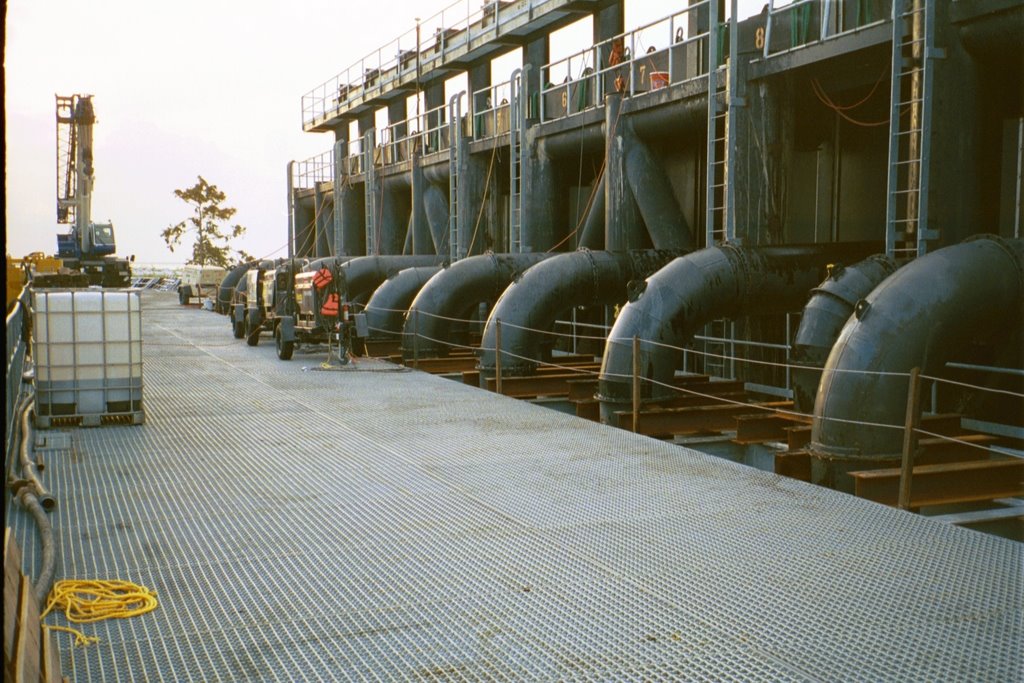
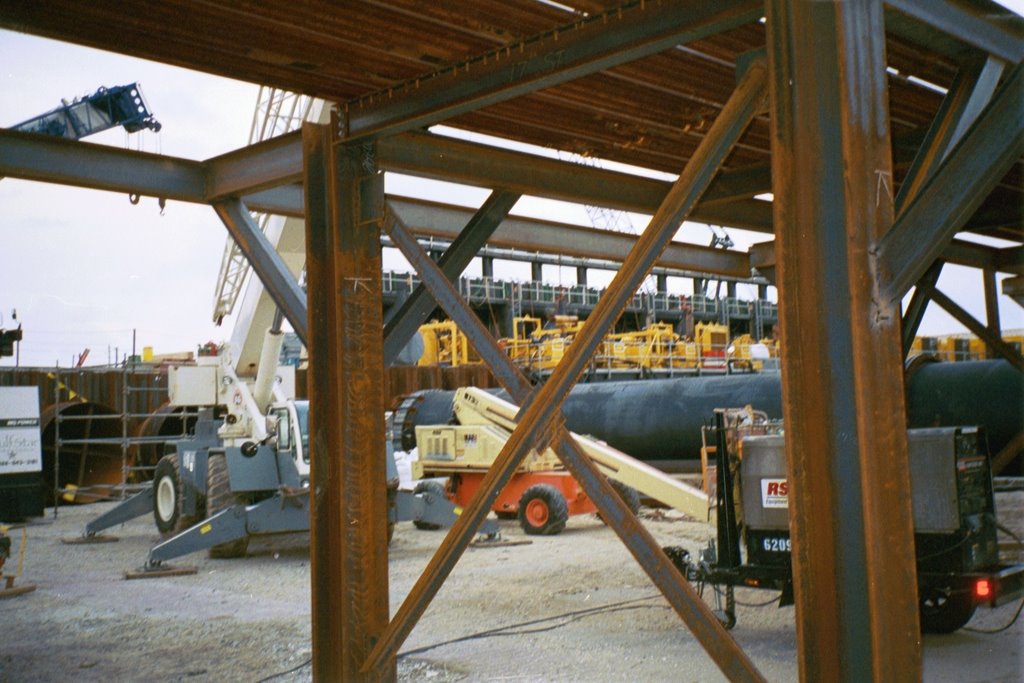
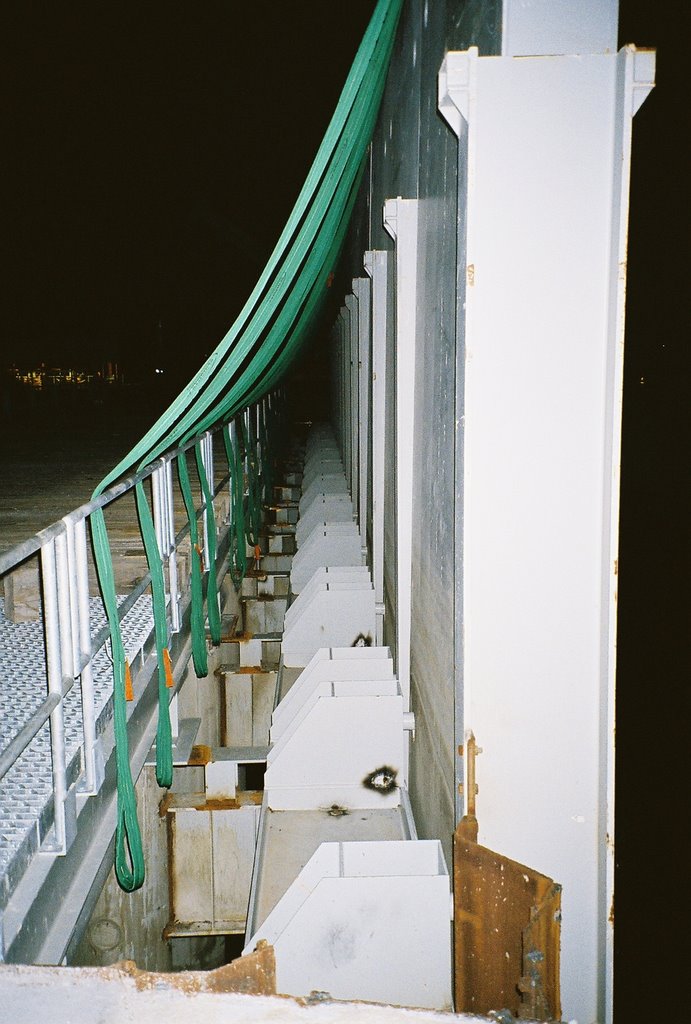
Deep Flood tells me that the 17th Street pictures were all taken between 6 and 7 PM. The London Avenue photos were taken after dark. As you can see, there's no one around in any of the photos, or else Deep Flood would have gotten shooed away. It's just more evidence that the Corps has gone back to business as usual.

There is no urgency left in the Corps' work at 17th Street, which is tragic, because there is still a critical need for more pumping. Do a Google search on "17th Street," "gates," and "around the clock," and you'll find articles as recently as May showing the site lit up like a movie set while work was going on. But, if you've been reading my blog regularly, you know from the Clock of Shame that the Corps hasn't been working nights for a while.

Was there ever any urgency around the pumps? First a little background info.

Before the storm, the capacity of the 17th Street canal was about 10,000 cubic feet per second (cfs). In January, the Corps decided to only purchase enough pumps to flow 2800 cfs around the gates when they close. Their eventual design calls for 7300 cfs by next June 1.

At London Ave., the prestorm capacity was about 8000 cfs. In January, the Corps decided to only purchase enough pumps to flow 2800 cfs around the gates when they close. Their eventual design calls for 4800 cfs by next June 1.

At Orleans Ave., the prestorm capacity was about 2550 cfs. In January, the Corps decided to only purchase enough pumps to flow 2200 cfs around the gates when they close. 2200 is the final amount caled for by the Corps.

So it's not like they don't know about the acute need for extra pumping capacity. They've known it right from the beginning in January, when they only ordered 12 pumps for 17th Street, 12 for London Ave., and 10 Orleans Ave. Here's the original pumping solicitation. The quantities are on pages 2 and 3. As I said above, all of those quantities result in capacities below the prestorm capacities. They also give no backup capacity in case pumps fail.

And they also knew they had to rectify the pumping shortfall immediately. Here's a drawing that has not been shown publicly before today. It shows a massive expansion of pumping at 17th Street along the Jefferson Parish side. Click on it to see it full size. If it's zoomed too big in your browser window, you can save it to your hard drive from the browser and open it with another program.


What is interesting is the date on the drawing:
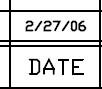
February 27th! They were planning for extra pumps all the way back in February. What happened? Absolutely nothing until June 9th, when they finally issued a solicitation for extra pumps. They planned on getting 16 extra pumps at 17th Street (about an extra 3600 cfs) and 7 more at London Ave (about an extra 1600 cfs). But they cancelled it June 21st for fear of getting sued by a bidder that was about to lose the contract.

What's interesting is the drawing of the layout for the extra pumps (click to enlarge). Again, if it's zoomed too big in your browser window, you can save it to your hard drive from the browser and open it with another program.


It's almost exactly like the February 27th drawing. For reference, here's the entire package of drawings that went out with the extra pumps solicitation in pdf form.

This is called "churn" in bureaucratic-ese. Churn is doing the same thing over and over without any actual results. Between February and June, when the need was absolutely the highest to buy extra pumps, the Corps churned. So much for urgency.

And since June? They've wisely given the pump ordering task to Boh Brothers. Why didn't they do this in the first place? Boh purchased six extra pumps (where the need went for the extra ten the Corps wanted in June is unclear, as is the need for the extra pumps at London, though I've heard those pumps are still coming), two for the Orleans side, four for the Jefferson side. You saw the locations in Part 1. The Orleans side extra pumps were supposed to be working as of today. They are not. The Jefferson side pumps are supposed to be working as of October 31. They won't be, because the platforms for them have only barely begun to be built. From what I can tell, those Jefferson side pumps and engines are not even delivered yet.

Is the Corps working hard to catch up and get those pumps installed according to their own, publicly announced schedule? No. They only work during the daytime. According to the plainly available evidence, there's no urgency.

However, they are diligently still snowing the national media with their phony "we're working 24/7" routine. Here's a quote from the August 31 Washington Post:
"So the thing to do is rebuild, but for rebuilding to make sense you also have to protect. That's why I spent an afternoon this week at the London Avenue Canal, listening as Col. Jeffrey Bedey of the Army Corps of Engineers described the additions and repairs to New Orleans's manifestly inadequate flood-control system that crews are working around the clock [my emphasis] to complete."

They're saying the same stuff to the local media as well. This past Wednesday, September 27 on WLAE's "Road to Recovery," Brigadier General Robert Crear, Commander of the Mississippi Valley Division (which is one step above the New Orleans District), in response to the question of what is the most important thing to the Corps in their repair and reconstruction efforts, said this:
"Whatever we do, we have to have a sense of urgency."

And the mendacity extends to Corps Headquarters in Washington as well. As recently as this month, Corps HQ is still putting forth the myth that work is going on around the clock. Here's a quote from the Public Affairs office at the Corps' headquarters:
"According to James St. Germain, project manager in the Hurricane Protection Office (HPO), crews are working 24/7 to get the interim pumping structures ready at the three outfall canals. Once completed, the interim floodgates and pumping system will maintain water levels within the canals and lower the risk of floodwall failure. 'This has been an unprecedented operation with activity around the clock," said St. Germain. 'Our contractors have been very good and have really stepped up the pace to get these structures operational.'"

According to the available evidence, there hasn't been activity on a 24/7 basis out there for weeks, possibly months. There seems to be a disconnect between what the Corps says - the supposed urgency, the promises of extra pumping capacity, the schedules - and what is plainly visible on the construction site from the road.

Why is this? Either Boh Brothers has decided that other projects are more important, or the Corps has just given up now that the media spotlight is off of them. Whatever the reason, New Orleanians who depend on the swift completion of the project have been hung out to dry by the very people we're depending upon to help us.

What gives with these people? Why should we be any less valuable in September than we were in June?

Tomorrow: Part 5 - What can you do? And a bonus addition to part 4!

Problems at the floodgates - Part 3

Part 1 is here.
Part 2 is here.

Part 3: Environmental
How are the Corps and its contractors treating the environment? Probably not well. It's hard to tell from pictures and from what Deep Flood has to say, but there indications of environmental degradation to the site.


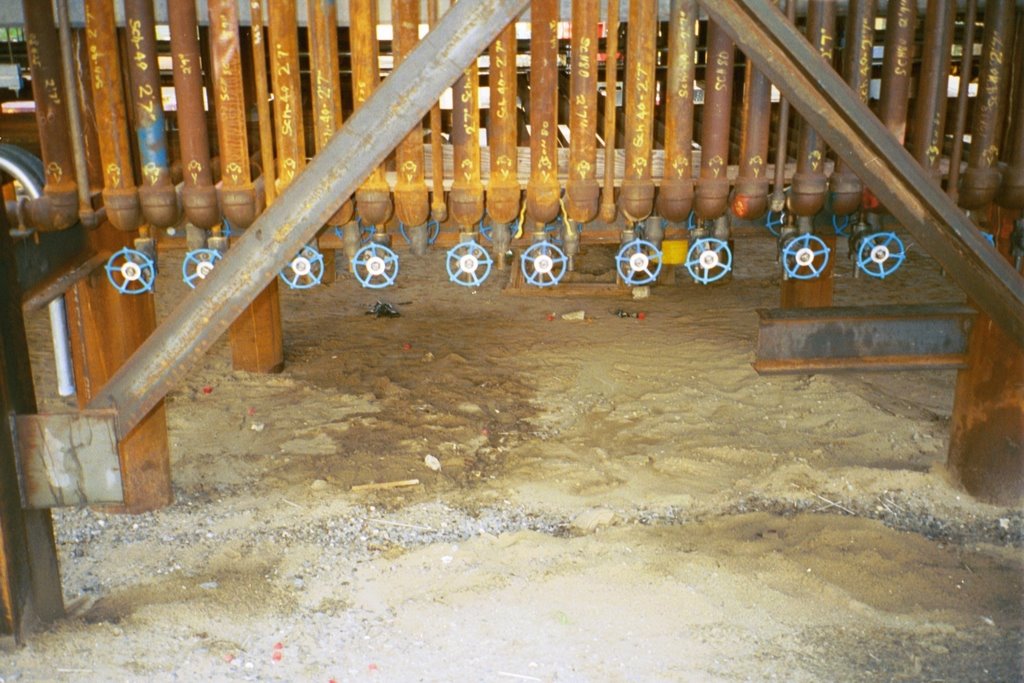
This is the grouping - called a manifold - of drain valves for the hydraulic fluid that powers the pumps. The pipes run between the diesel engines and the pumps. All of these valves open the lines to allow hydraulic fluid to drain during maintenance. The question is: drain to where? Right now, it's the ground, and some of these valves, according to Deep Flood, are leaking right into the ground.

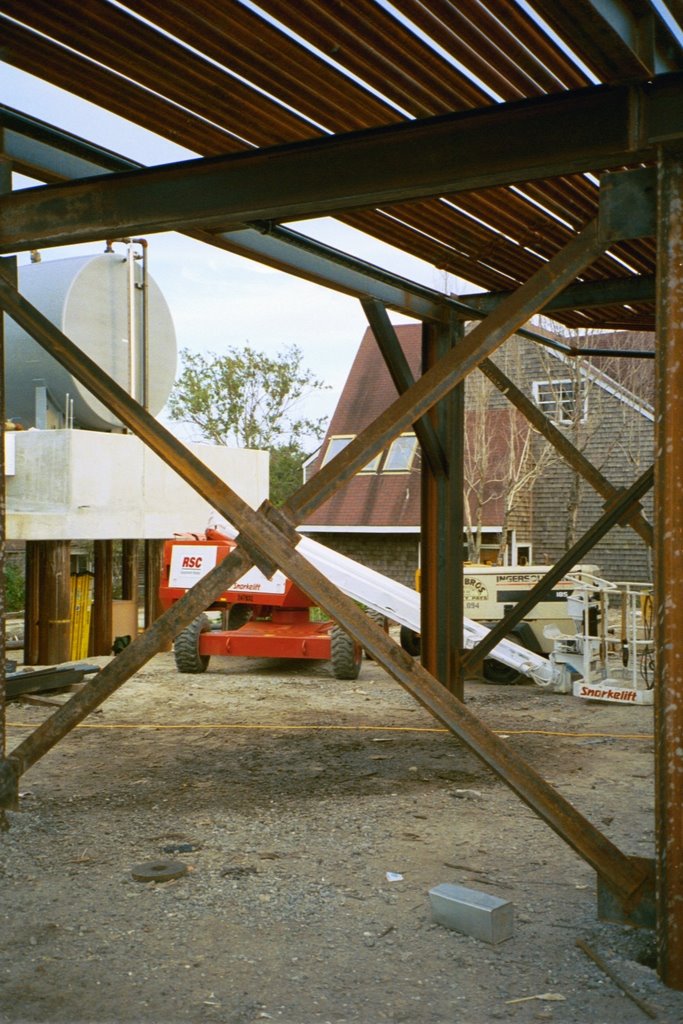
There are also some suspicious wet spots on the ground below the hydraulic lines, like here:


For my final example, I have to step off the enterprise reporting train for just a minute here and cite the reporting from the public pump tests the Corps recently ran at Orleans and London Avenues. Note the Corps is constantly testing the 17th Street canal pumps without public notice. One can tell by checking the WWL webcam. When gate sections are lowered on only one side or another of the structure, they are probably testing pumps. The sections are lowered to limit backflow to the pumps being tested. They only test pumps on one side of the canal at once.

For example, it appears they are doing testing at 17th St today (or were maybe doing it yesterday). I have annotated a WWLTV screenshot with the indications below.


One should note the fact that only one set of pumps is tested at a time, because, during actual operations (i.e. when the gates drop), all of the pumps on both sides will be running. No one knows if they'll actually work properly under storm conditions. The same goes for the gates themselves.

Anyway, buried at the end of the excellent article about the London Avenue canal testing was this:
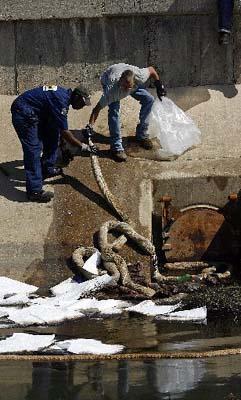
"A pipe joint began leaking during the tests on Friday, spilling a few gallons of hydraulic fluid into the canal, but officials said repairs would be finished within 24 hours. On Thursday, a leak in the Orleans Canal also spilled hydraulic fluid into that canal.
'We're using environmentally friendly hydraulic oil, and you don't want it to happen. But that's why we have booms set up every time to absorb (spills), just in case,' Bedey said.
'When you start up any mechanical system, you'll have fittings that fail and you replace them. That's part of doing business,' he said. 'In fact, you really never finish testing systems like this. It's part of ongoing maintenance and operation.'"

I first heard about this on TV, when Rob Masson on Fox 8 reported a spill of fifty gallons on the evening of the London Avenue test, Friday, September 15. Note that the Corps had also had the media out to Orleans Avenue the previous day - Thursday - when a spill occurred, but did not reveal that until Friday.

Secondly, if this guy - Colonel Jeffrey Bedey, the head of the Corps' local newly minted Hurricane Protection Office and a transplant from the Corps' St. Louis District - were working as a production or maintenance supervisor at a chemical plant, he would have been fired long ago for an attitude like that. There is no way that fittings fail any time you start up a mechanical system. Maybe that's true in the mechanical systems the Corps designs and installs, but certainly not in the ones in the private-sector.

To prevent leaks you have good mechanics and operators who double and triple check every joint and fitting before any pressure is put on them. And then you leak test those fittings by putting high pressure water through them. Only then do you do a preliminary start up of the system. If that preliminary startup shows problems, you shut down the system and remedy the problem.

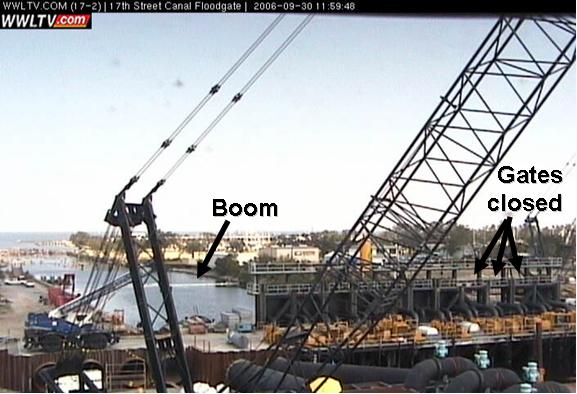
Finally, while I applaud the Corps for having booms to contain the spill (they were likely required by the Coast Guard), I find it odd that they are not mentioned anywhere in the Floodgates Operating Manual. Also notable is that the booms have stayed in place at London Avenue. Here's a screencap from WWL-TV's London Avenue camera:


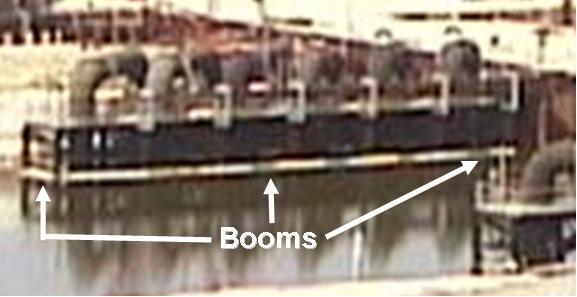
Here's a detail of the pumps on the west side. I have noted the booms.


Admittedly, I can't prove anything from pictures and citations from articles, but just the fact that the hydraulic lines are leaking to the ground at the valves is bad enough. Stuff like that is supposed to be contained. And when one considers all the other inattention to security and safety, it is not a long leap to guess at deeper environmental problems as well.

Next: Part 4 - Urgency is gone

Friday, September 29, 2006

Clock of shame - day 6


By the way, those lights are from Coconut Beach, the beach volleyball venue just to the northwest of the gates. There are no lights on at the gates.

Problems at the floodgates - Part 2

Part 1 can be found here.

Part 2: Workplace Safety
The security situation at the floodgates would be bad enough if it were the only problem. But - at least at 17th Street, which is the only site still under construction - apparently normal workplace safety measures required by OSHA don't apply. Just to ensure I'm on steady ground here, I looked at the contract solicitation for the 17th Street Canal. On page 81 (Adobe Acrobat page 112), it says (in part):

"...On contracts for construction or dismantling, demolition, or removal of improvements, the Contractor shall-
(1) Provide appropriate safety barricades, signs, and signal lights;

(2) Comply with the standards issued by the Secretary of Labor at 29 CFR Part 1926 and 29 CFR Part 1910; and

(3) Ensure that any additional measures the Contracting Officer determines to be reasonably necessary for the purposes are taken."

29CFR1926 is safety standards for a construction site. 29CFR1910 is general workplace safety standards for any workplace.


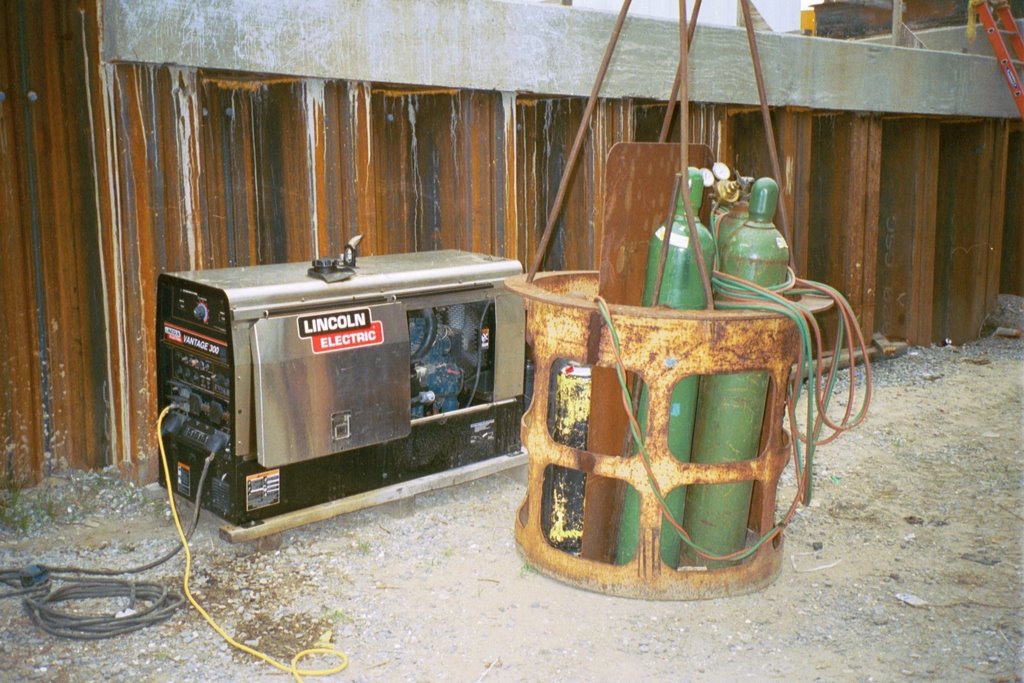
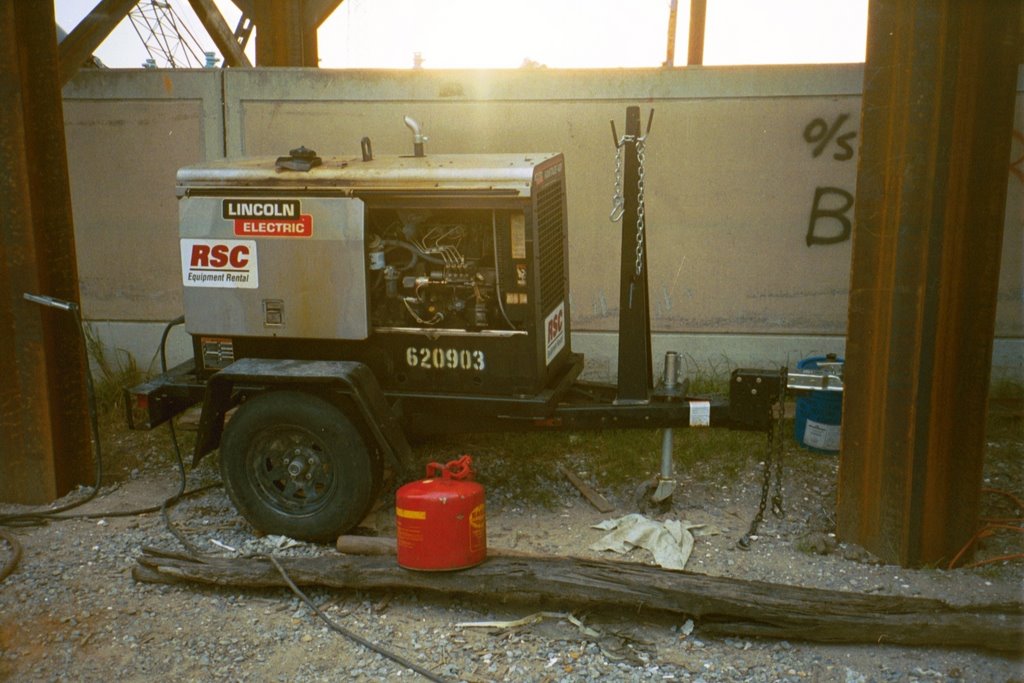
Does this look safe? Electric arc welders get very hot. Welding gas is (I believe) flammable. That's not a good mix. (Note: it has been pointed out since the original publication of this post that this might not be the usual position for the welding bottles - they might get moved elsewhere on the site for use.)


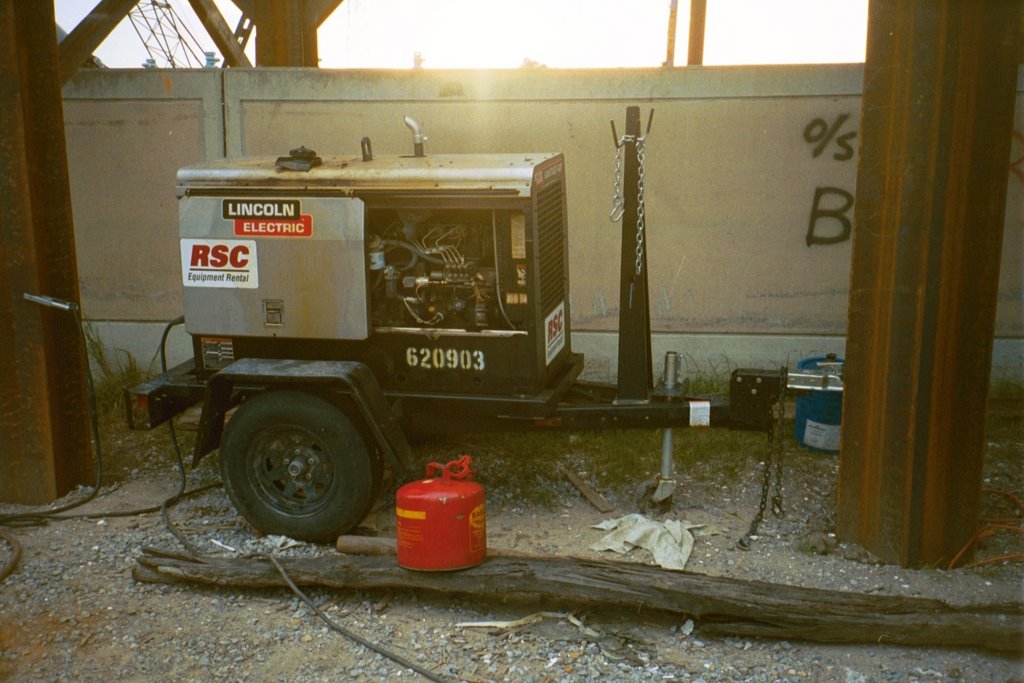
Gasoline is supposed to be stored remotely on a work site.


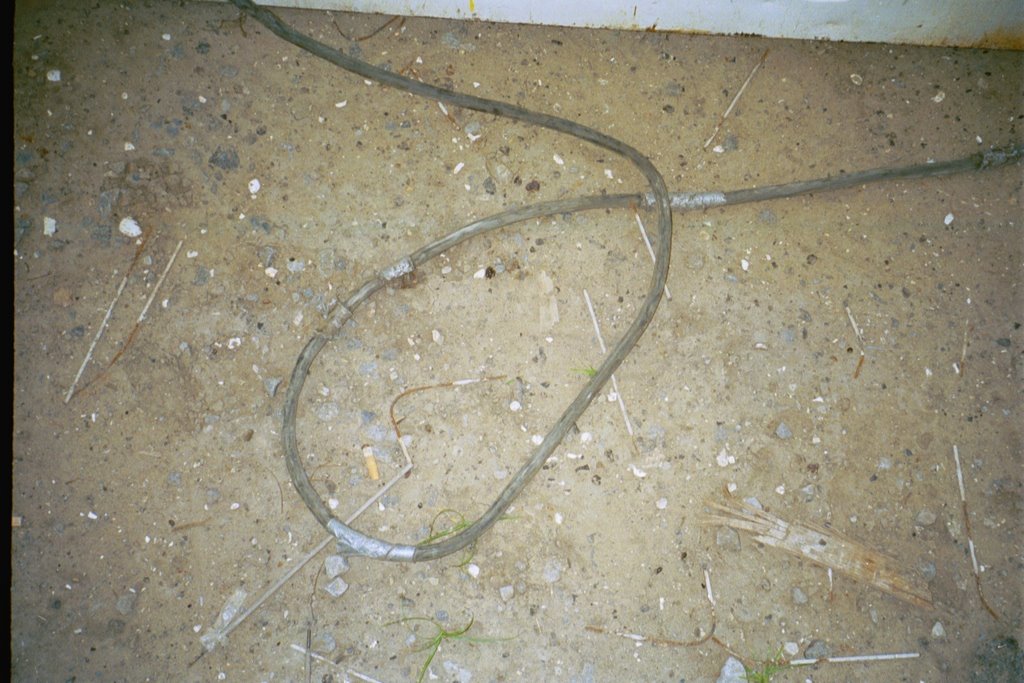
The electrical cords coming out of the generators are in terrible shape.

The first two situations appear to be in violation of OSHA regulations for storage and handling of hazardous substances on a construction site. The third is in violation of OSHA regs for safe use of electric cords on a construction site. Wires like that are supposed to be withdrawn from use.

As I mentioned briefly in Part 1, the Corps also has their own safety manual, which the contractor at 17th Street is also supposed to adhere to. The manual is EM 385-1-1. Chapter 11, which is the electrical section, has this to say about use of cables: "Patched, oil-soaked, worn, or frayed electric cords or cables shall not be used." (EM 385-1-1, paragraph 11.A.03.e). That cord (and most others on the site, according to Deep Flood) is definitely "patched."


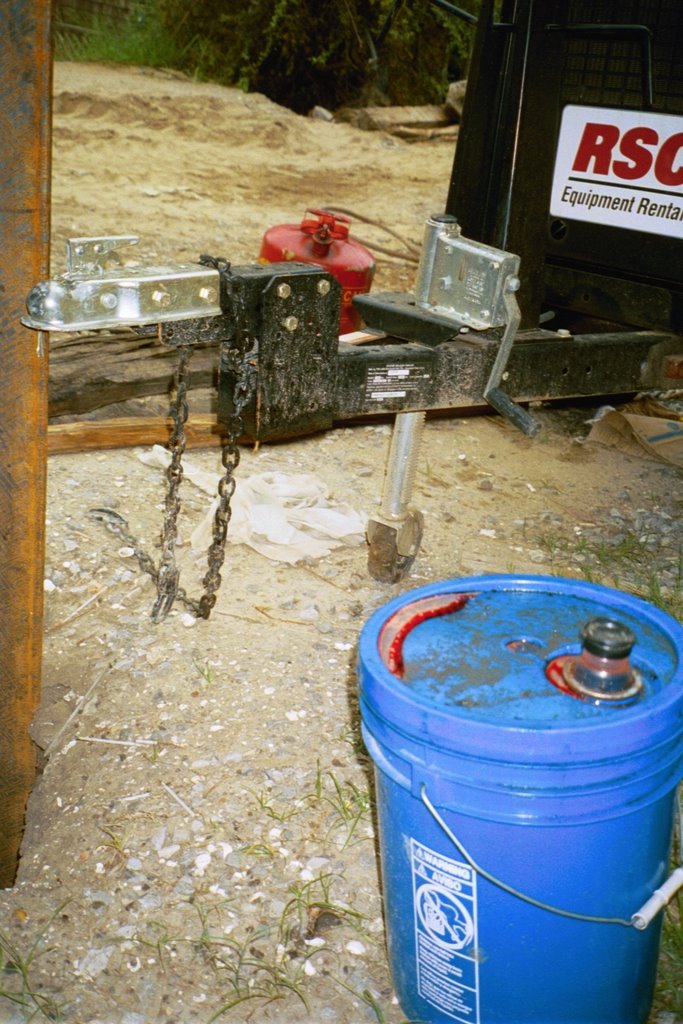
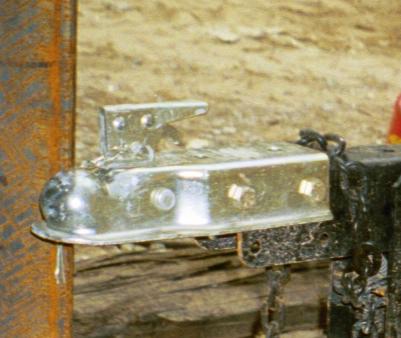
By the way, here's another look at the second electric arc welder. Look closely at the trailer hitch.

It's not locked. Anyone could drive their truck up and steal it.

There are design errors that were not caught on drawings before they were fabricated:


Workers cannot be required to clamber over handrail to get to a ladder. Especially about 15 feet over 18 foot deep water, which these are. This is a walking-working surface violation according to OSHA regs. Specifically, 29CFR1910.27(c)(1), which says,
"On fixed ladders, the perpendicular distance from the centerline of the rungs to the nearest permanent object on the climbing side of the ladder shall be ... 30 inches for a pitch of 90 degrees (fig. D-2 of this section)"

All of the ladders from the deck up to the upper level are like this.

Deep Flood tells me this is the only lifering on the gate structure.

OSHA regulations say it is supposed to have at least 90 feet of rope on it. It obviously doesn't. It also doesn't appear to be tied to anything sturdy. Finally, look at what one has to do to get the thing to someone in the water. You'd have to climb over the handrail even to get to it, which is hardly "readily available," as required in the OSHA standard. This is very poor water safety. I hope none of the workers fall in the canal (the water depth is about 18 feet).


Does this look safe to you?

The reason I'm bringing all this up is because the Corps and its contractors are ignoring the well-learned lessons of the "safety pyramid."

Here's an example of such a pyramid:


The safety pyramid is a tool for preventing injuries and fatalities at any workplace. The idea is that a certain number of "near misses" or minor incidents will inevitably lead to serious injuries and deaths on the job. It is only a matter of time. But if you can minimize the number of near misses and minor incidents (make the base of the pyramid smaller), you can drive the chances of death or injury to near zero. The way to do that is to take care of small violations before they become big incidents.

Considering what Deep Flood has seen, I would be surprised if there haven't been any injuries on the floodgate jobs. And from a purely financial point of view, that gets my goat, because any injury settlement comes out of the Corps' pocket. That's a pocket filled by the taxpayers, including me. On a more altruistic note, it means that many workers are being placed in harm's way unnecessarily by very poor project management.

Conclusion: the 17th Street canal floodgate site is not a safe place to work, and OSHA regulators should definitely pay the site a visit.

Next: Part 3 - the environment

Problems at the floodgates - Part 1

Readers coming here from http://b.rox.com, please realize there's much more to this site than just this one post. Please take time to look around. There's a link to the second part of this story at the bottom of this part. Or click the title above to see the whole blog. Now, on to the special report...

It's funny what happens when you start a blog. You find out how big the internet is. Lots of people who you didn't know before start contacting you.

One such person is someone I'll call "Deep Flood." Deep Flood is not associated with the Corps of Engineers or any of its contractors. Deep Flood sent me the pictures of the outfall floodgate sites you'll see below and in future postings. The pictures were taken within the last two weeks. They form the basis for a five part special series of reports starting today. The storylines they tell... well, they'll emerge as you read each part.

The problems these photos - and my text - will document over this series are not the ones you've heard about in the media, but in many respects they are just as serious. They are problems with security, with safety, with the environment, and with the Corps' sense of urgency. They make one ask big questions about the floodgates, like "How robust is the design?" and "Will they work at all?"

These are not problems the Corps would willingly admit to, so I'm giving them a push. At the end, I'll give you some suggestions on how to make your voice heard as well. Because all of New Orleans is depending on the Corps to do things right and to do things quickly at the floodgates. From what I've seen, they are doing neither.

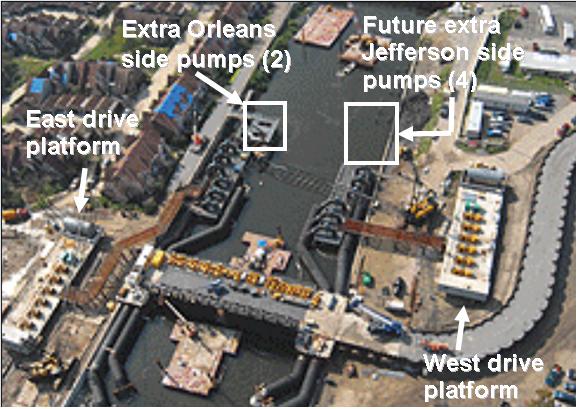
First, a little orientation. Here's a very recent overhead shot of the 17th Street canal floodgate site. It was taken from the Corps' own website, and according to the caption, dates from September 14, 2006.

This picture is looking from the lake back toward New Orleans. So the camera is facing roughly south (the canal is on an almost direct north-south line). The gates themselves are toward the middle bottom of the picture. You can see the pumps just to the south of the gates (remember, south is up in this picture) and their discharges on the north side. I've labeled the platforms that hold the diesel drive units for the pumps (the yellow things on each platform are the actual engines). There are a bunch more yellow engines across the deck of the gate structure. These power other pumps that are actually on the structure itself. I've also noted the locations of expansions of pumping capacity. Note that the Jefferson side is still waiting for a previously announced quartet of pumps. On the Orleans side, two extra are planned, but only one has been installed.

Many of the pictures below are in the vicinity of the east drive platform.

Today: Part One - Security

Part 1: Security
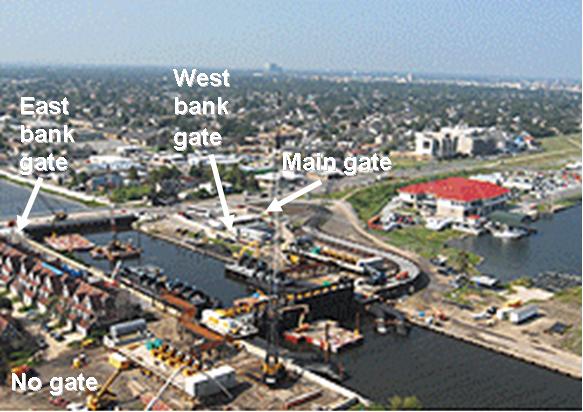
Let's first look at the massive lack of even basic security. It is apparent from the pictures below that anyone can go anywhere on these sites. At 17th Street, there are large gates at each of the three vehicular entrances fronting Old Hammond Highway. You can see the locations on a map here (the satellite photo is obviously pre-Katrina). I've called them "Main gate," "West bank gate," and "East bank gate." Here's a picture from the Corps of Engineers website dated September 14, 2006, on which I've annotated the gate locations.

The security gates look very impressive from the street. They're eight foot high chain link fence with a sturdy chain and padlock. The problem is that they are a Potemkin Village. Because when you go to the back of the site on the Orleans Parish side…

It's wide open. There are no gates or fences. One can walk anywhere…


…Up on the deck next to the gates themselves


…Or around the area at ground level on the Jefferson Parish side…

And it's not just the 17th Street canal site. The same situation exists at the London Avenue floodgates, which are complete. The fences, what there are of them, are wide open for anyone to tour the sites for themselves. There's no cameras, security guards, or even lights on the gate structures to deter someone from mischief.

You can walk up to the gates, which is bad enough.


But even worse, you can walk right up to the diesel engines. These are on the west side of the canal.


And take a battery for your truck if you wanted…

The battery on these diesel engines functions the same as on the engines in your car. Without a battery, the engine can't be started.

And of course, one has to walk past the control house to get to the engines. One would assume the control house would be locked. It's not


That’s the control panel for the pumps, totally unlocked. Click on the picture and you can zoom in to see the actual controls. Explanations of what you see are available in the Floodgates Operating Manual.

There are three rooms in each of the control houses (there are two control houses at each floodgate site. The houses are done at London and Orleans Avenues, but remain wholly incomplete at 17th Street). Here's another of the rooms:

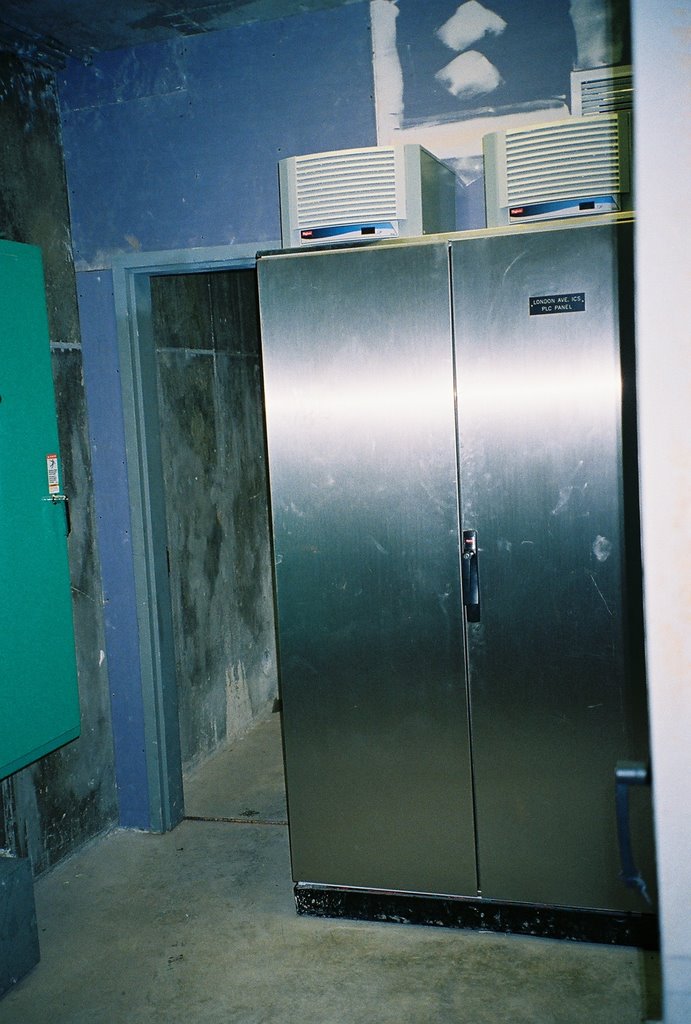
The silver cabinet is labeled as "London Ave. ICS, PLC Panel" There are tons of control wires and sensitive pieces of equipment inside that cabinet.

Disappointingly, the Corps knows they're supposed to be watching this stuff. It shows up in their own regulations. The Corps has their own safety manual, which the contractor at 17th Street is supposed to adhere to. The manual is EM 385-1-1. Chapter 11, which is the electrical section, has this to say about security around electrical equipment:


"Transformer banks and high voltage equipment shall be protected from unauthorized access; entrances not under constant observation shall be kept locked; metallic enclosures shall be grounded; and signs warning of high voltage and prohibiting unauthorized entrance shall be posted at entrances."

Clearly, none of this is happening.

The very fact that these pictures could even be taken by someone not associated with the jobs is scary enough. What if Deep Flood were some mischievious teenager, or a small child, or - worst of all - someone with more nefarious motives? How can the U.S. Army of all organizations ignore security? Especially when many of the senior military leadership in the New Orleans District and the Mississippi Valley Division have done tours of duty in Iraq, where everything is about security?

Conclusion: Even the most basic security measures have been neglected at the three most important construction sites in New Orleans, leaving vulnerable vital equipment that is meant to keep the city safe.

Please read the rest of the story! Or, take a look at the rest of the blog at http://fixthepumps.blogspot.com.

Next: Part 2 - Workplace Safety

Follow up on flappers vs. siphons

Here's some more information about flapgates, and why they're important. This follows up on my earlier post.

The Corps publishes all their engineering regulations, standards, and manuals online. These are what they use to design everything.

Theoretically, the one they shold be using for the construction of the floodgates and pumps is this one, EM 1110-2-3105, Engineering and Design - Mechanical and Electrical Design of Pumping Stations. Chapter 7, which is only 3 pages long, deals with how the discharges of pumps should be designed.

It talks about two possible configurations: over-the-levee, or through-the-protection. Since the common 9'-0" discharges of the pumps go through the protection (i.e. the gate structure), that's the one that applies.

Here's what the Corps says should happen with that type of discharge:
"In general, two means shall be provided to prevent backflow when the discharge is through the protection. Discharge lines through the protection should terminate with a flap gate to prevent back flow. In addition to the flap gate, provisions should be made for emergency shutoff valves, emergency gates, or individual stop log slots to place bulkheads in case of flap gate failure."

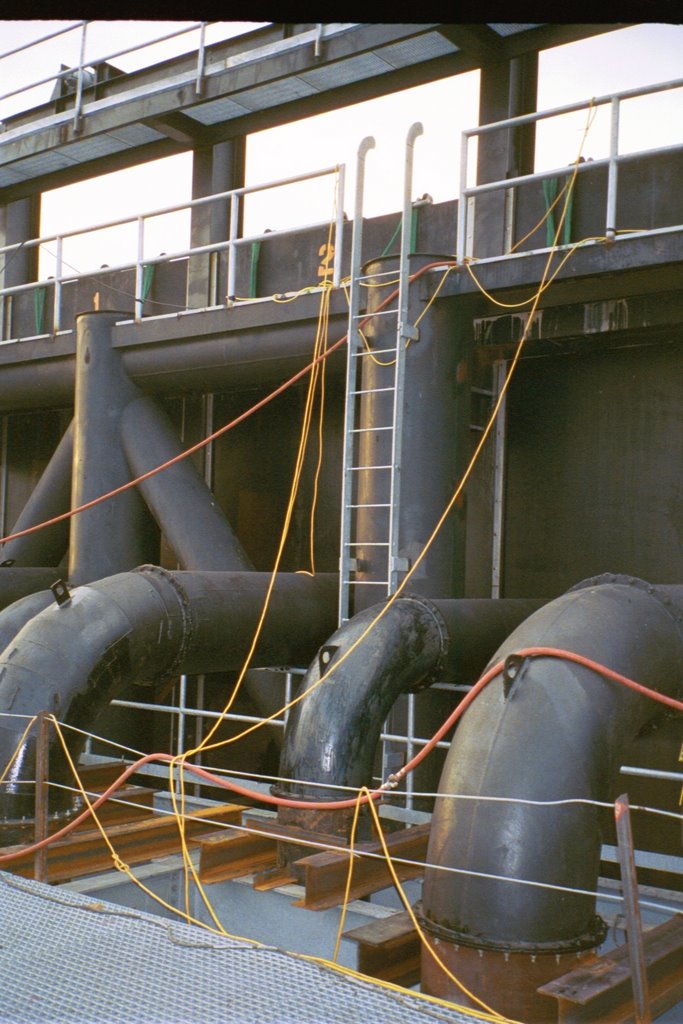
Neither of these were included in the designs for the pumping discharges at the gates. As a reminder, here is what the discharges look like:


Keep in mind that during storm surge conditions, the water level would be about two to four feet higher.

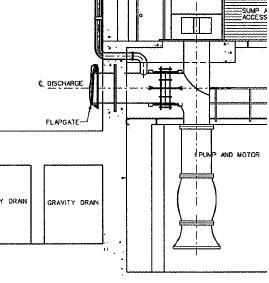
In any case, there is even a picture of a flap gate on page 6 of the chapter that has all the drawings in the manual. Here's the relevant detail from that picture:


Why can't the Corps follow their own manuals?

Thursday, September 28, 2006

Clock of shame - day 5


Tick, tick, tick...

Wednesday, September 27, 2006

Clock of shame - day 4


"Whatever we do, we have to have a sense of urgency" - Brigadier General Robert Crear, Commander of the Mississippi Valley Division, US Army Corps of Engineers, on 9/27/06 "Road to Recovery" on WLAE - channel 14

Tuesday, September 26, 2006

Clock of shame - Day 3

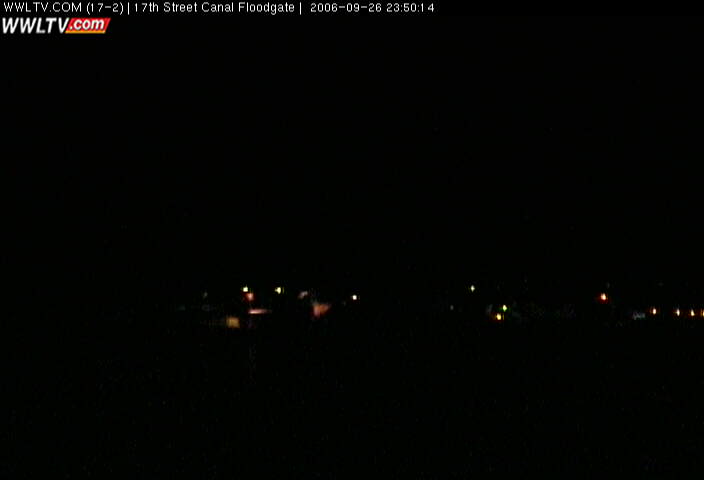
Following up on this post below, I'm going to start showing nighttime screencaps of the 17th Street Canal floodgate site (courtesy WWL-TV) every day until work returns to the 24-7 schedule the Corps promised. I'm starting the clock with this past Sunday, even though we all know it's been like this for weeks. Unfortunately, Sunday is the first day I started archiving the pictures.

Here's September 26th:

Sunday, September 24, 2006

17th Street canal no longer 24/7

Has anyone noticed how work at the 17th Street canal floodgates has turned from an around-the-clock affair to just another 9-5 construction job? I thought we were still in the height of storm season, but the Corps and Boh Brothers seemed to have lost the urgency they claimed to have earlier in the summer, when the press and the government were all over them.

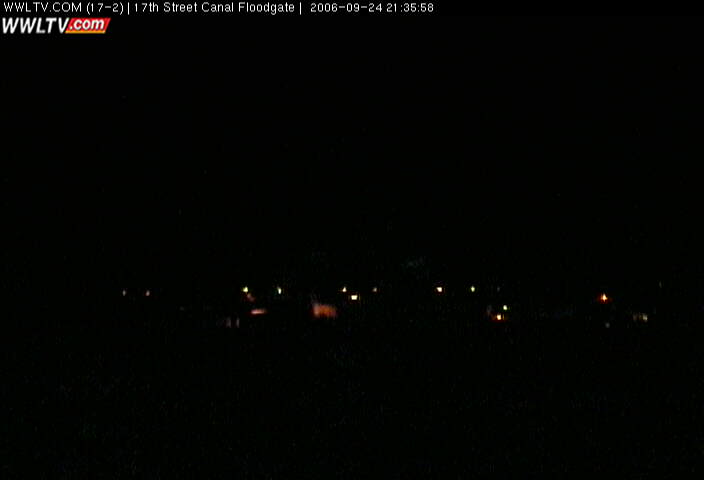
Below is what the site looked like last night. This is from WWL-TV's invaluable Eye On Floodgates web-camera. I check it often, and I can tell you it looks like this every night for about the last month. They shut down around 5:00 every day and everyone goes home. This despite the fact that there are still pumps uninstalled on both sides of the canal, pumps that could conceivably (well, maybe not, but still) keep neighborhoods from flooding if the gates were to drop. There's also tons of electrical and controls work left unfinished. Someone please tell me why this work is somehow less urgent now than earlier this year?

The work priorities have been kind of goofy as well. Despite the deep importance of installing extra pumps on the Orleans side (two pumps) and the Jefferson side (four pumps), the Corps and Boh have instead focused on putting in the hydraulic winches and their framework (you can see that framework and walkway sticking up across the very top of the gates in the picture below). These winches are designed to automatically lower and lift the gates. That's great, and I applaud then for getting them in. But the fact remains they can already do this with cranes, and they haven't even put in the platform for the extra pumps on the Jefferson side of the canal! And the work on the extra pumps on the Orleans side (just two of them, there) has been ridiculously slow as well. They're spent a whole bunch of time putting up access platforms and handrails, but they've only got one pump out of the two in, and it's not even hooked up. The schedule is screwed up. The Corps project managers need to be called on the carpet for this.

Conclusion: the Corps is back to business-as-usual. they've given up doing things quickly, even though they're not even done with the stuff they were supposed to finish on June 1.

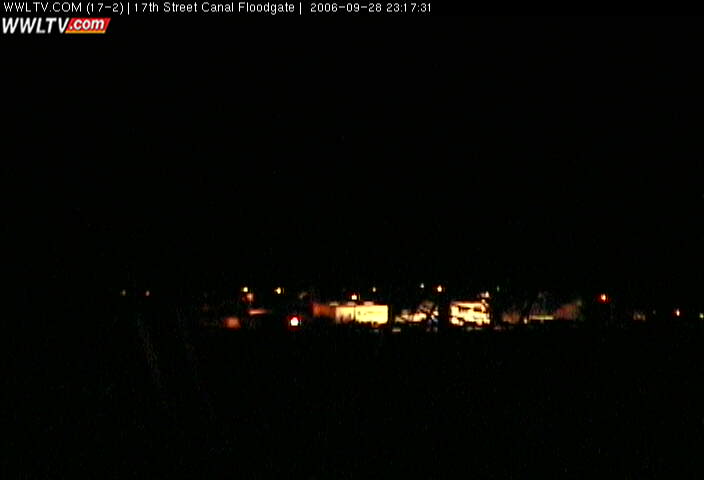
The site last night (most of those lights are actually streetlights on the land behind the gates, not on the structure itself):


And tonight:


For reference, this is what the camera sees during the daytime (from this morning):

Friday, September 22, 2006

Rewinding update

Here's the status of all the pump motors which were due to be rewound under these two contracts. The original solicitation is here. The Times-Picayune article that first talked about the problem of unrewound motors is here.

Note: all the station names below are weblinks that take you to Google Maps pages with the stations' locations

Station 1
Pump "B," 550 cfs, rewinding complete
Pump "C," 1000 cfs, rewinding complete
Pump "D," 1000 cfs, rewinding complete
Pump "E," 1000 cfs, rewinding complete

Note: Pump "A," 550 cfs, burned up Dec. 15th and was rewound by the S&WB.

Station 2
Pump "A," 550 cfs, rewinding complete
Pump "B," 550 cfs, rewinding in progress
Pump "C," 1000 cfs, rewinding not started
Pump "D," 1000 cfs, rewinding complete

Note: according to solicitation, pump "C" was to be rewound before pump "B"

Station 3
Pump "A," 550 cfs, rewinding
complete
Pump "B," 550 cfs, rewinding complete
Pump "C," 1000 cfs, rewinding complete
Pump "D," 1000 cfs, not on rewinding list, but it should be. This pump has a metal housing around its motor, but the housing has not been opened for inspection since Katrina.
Pump "E," 1000 cfs, rewinding complete

Station 5
Pump "A," 550 cfs, rewinding complete
Pump "B," 550 cfs, rewinding not started (I'm not absolutely sure about this, but I'm pretty sure)
Constant duty pumps CD1 & CD2, 80 cfs each, rewinding in progress
Note: Original bid solicitation said pump "B" was to be rewound before constant duty pumps. Also, an amendment to the bid specifications said that CD2 was eliminated from the scope of work.

Station 6
Pump "D," 1000 cfs, rewinding complete
Pump "E," 1000 cfs, rewinding complete
Pump "F," 1000 cfs, rewinding
complete

Note: Pumps "A," "B," and "C" were previously rewound under S&WB contracts

Station 7
Pump "A," 550 cfs, rewinding complete
Pump "C," 1000 cfs, rewinding complete

Thursday, September 21, 2006

Flappers vs. siphons

They say that if you put two engineers in a room, they'll come out with three opinions. Often, it is assumed that what the Corps says is the best way, or the only way, to do things. That's not true. Let me give you an example of what leads engineers to argue. Now keep in mind that the post below is just what's coming out of my head, so you're free to disagree. And I know that a lot of this was supposedly hashed out between the Corps, the S&WB, and both their contractors back in December and January when technical details of the pumps were being worked out. Nonetheless, I feel it's important to keep pulling the curtain back so that people have as much information as possible.

Background
Backflow prevention is what one calls a system for keeping a pump from turning the wrong way because of liquid flowing backwards. Backflow prevention became a huge issue during Katrina. When Jefferson Parish president Aaron Broussard made the career-killing decision to send his pump operators 100 miles out of town as Katrina approached - he didn't deem them essential personnel - he also prevented monitoring of the systems that kept Lake Pontchartrain's massive storm surge from backflowing through the pumps. When those systems (some of them gates, some of them a goofy compressed air system) failed, much of Jefferson Parish flooded. It didn't have to be that way. Not one pump in Jefferson Parish was damaged during Katrina, meaning much of the parish could have probably remained completely dry, if only the operators were there to run the pumps or check the backflow prevention systems.

Being a resident of New Orleans, I was curious about the backflow prevention measures for the new floodgate pumps. There are measures in place, but I wonder about their efficacy.

There are many ways to keep water from running backward through pumps. The easiest - and most reliable - way is to physically block the discharge pipe with something solid. This could be a sluice gate (a piece of metal that slides down across the pipe) or a flapper gate (a hinged metal door on the end of the pipe). The S&WB uses both on its drainage systems. On the three pump stations in New Orleans East that discharge directly into the Lake (10, 14, and 16), there are sluice gates. Along the Palmetto Canal in Gert Town and Hollygrove, there are numerous flapper gates to prevent backflow into the neighborhoods when water flows down the canal from station 1. Here's a picture of one of those gates:


Another way is a "siphon leg." This is an upsidedown-U stretch of pipe in the discharge. The idea is that if the peak of the "U" is tall enough, the water can't get over and into the pump. If that happened, a siphon (that is, a vacuum) would develop and water would flow backwards of its own accord. In fact, when the pumps are running normally, they take advantage of that siphon to keep water flowing away from the pump. The S&WB also uses siphon legs, but only in combination with sluice gates.

Just in case the sluice gates fail, and a pump breaks or is down for service, and a backwards flowing siphon does develop, there is a device called a "siphon breaker" at the peak of the siphon leg. The siphon breaker detects backward flow and opens a valve that introduces air into the leg, breaking the siphon, or vacuum.

What is notable about the siphon leg idea is that - by itself - there is no positive physical closure. If the pump stops and the siphon breaker fails there is nothing to stop the backflow. A gate closure is the nearest thing to a guarantee against backflow, as opposed to a siphon leg. That's why the S&WB installed sluice gates at stations such as station 14, shown below.


The pumps are the four gray things in the middle. In this picture, the water flows from the inlet canal at the right (just out of frame), up through the pumps and over the siphon leg horseshoes into an underground culvert. This culvert goes under Hayne Blvd. and the Lake levee to the left and out to Lake Pontchartrain. The sluice gates are mounted in the levee.

Note that the sluice gates, in order to be effective, must be present. The S&WB might want to look into a slight defect in that idea at station 16:


This is the outlet of the pumps at station 16 where it flows into the lake. There are no gates. They appear to have been stolen, removed, or otherwise misplaced. I hope the siphon breakers are in good working order at that station.

At the new floodgates
The Corps' new floodgate pumps use siphon legs, but no flapper gates. Here's the original drawing sent to pump vendors when the pumps were out for bid (jpeg version, click for bigger):

Here's a pdf of the same drawing. The pdf is about one tenth the size, if you want to save it to your harddrive

And here's a picture of the final installation:


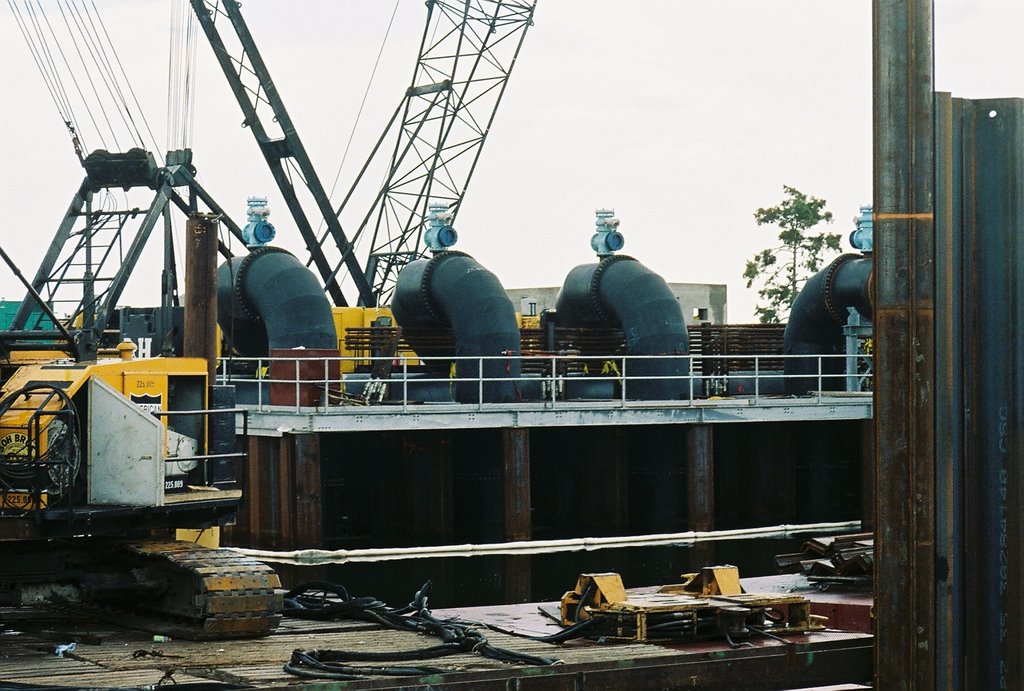
This picture shows the siphon legs for three pumps at the 17th Street Canal. The blue devices on top of the siphon legs are the siphon breakers. They are made by a company called Wm. P. Wilson & Sons. Three other links on that page give technical information. The breakers at 17th Street are 12" versions. Note that the siphon breakers appear to be undersized, if a flow equivalent to the pumps' capacities (about 250 cubic feet per second) were to backflow. This is because the maximum flow capacity for a 12" Wilson siphon breaker is apparently 225 cfs, as seen here. Could this lead to another backflow problem in case of pump failures at the outfall canals? Yes. And in light of recent troubles with the pumps, the possibility is particularly distinct.

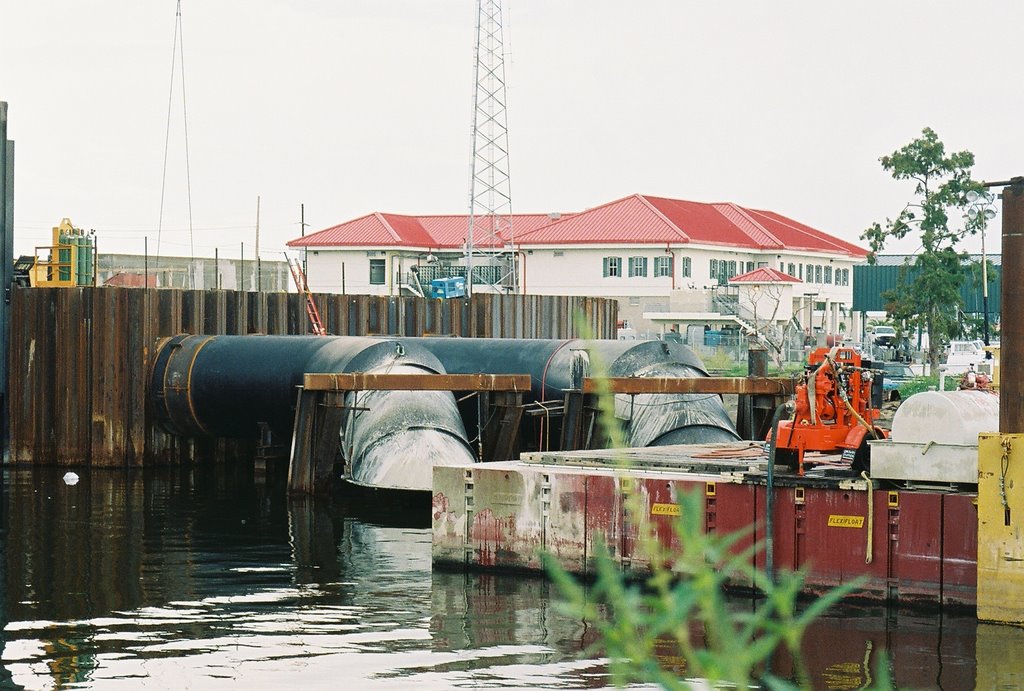
The Corps considered flappers, but removed them from the design upon the protest of the S&WB. Here is what the discharges of the floodgate pumps look like now:


Apparently, at some time in the past, the S&WB suffered a failure in one of those Palmetto Canal flapper gates I mentioned above. Something kept the gate open when water was flowing down the canal, and a section of Hollygrove flooded.

However, there is a fundamental difference in the situation that occurred on the Palmetto Canal and that which might occur at the floodgate pumps. Along the Palmetto Canal, the flapper gates were being pushed open by water flowing relatively slowly by gravity. Also, those gates are only 12" in diameter and are much more easily forced open by sticks, trash, and other debris. At the floodgates, the pumps would be (hopefully) running the entire time during the threat of backflow, i.e. during storm surge. Also, the flappers would be 108" in diameter, which is huge, heavy, and pretty much impossible to force open except by the flow of the water. They would be used much less and inspected far more often than the S&WB gates (simply because there are many more S&WB flappers), including right before they were used.

Note that the reason the S&WB has siphon legs on stations such as those in New Orleans East is not for backflow protection, though that is a side benefit of their design. The main reason for the siphon legs was to move the electrical equipment on the motors above the level of a major flood. They still wisely rely on the sluice gates for backflow protection.

Another disadvantage of siphon legs is that pumps must devote lots of extra energy to get started. This is because the pump must push the water up and over the leg. Without the siphon leg, the pump could simply push water through a relatively flat pipe to the outlet. It's equivalent to the difference between rolling a barbell across the floor as opposed to picking it up and carrying it across the room. In fact, at the floodgates, pumps must be started in pairs because of all the energy required to establish a siphon in the discharge pipe, as this excerpt buried on page 81 of the Floodgates Operating Manual describes (for reference, the "mainfold pipe" is the 108" pipe into which the 60" discharges of the pumps flow):


"Note that at least 2 pumps must run to establish a siphon in the manifold pipe and therefore the grouping of the 3 pumps in 2 stages was selected for pumps at the 17th St. Canal and London Ave. Canal. At the Orleans Ave. Canal the pumps are grouped with 3 pumps in the first stage and 2 pumps in the second stage."

What happens if one of the pumps in the second stage at Orleans Ave can't start? Well, that means that both the pumps in that pair can't start.

By the way, this is most likely why the Corps tested two pumps at Orleans Ave last week and three at London Ave., rather than doing individual tests of the pumps. It's because the individual pumps can't really be started very well by themselves.

One more question I have is this: What prevents backflow if the gates are lowered and the pumps aren't running? I mean, according to the Corps, it's very possible to have a big storm surge, but not a lot of rainfall. That's what they keep telling us in order to justify their wrongheaded decision not to place enough pumps at the floodgates. Well, if you take that argument to its logical conclusion, what if the storm surge precedes the rainfall by quite a while and they close the gates, but there's no need to run the pumps? Then the entire city is depending on those little siphon breakers to guard against a levee breach? That's pretty risky!

Flapper gates do work
As a postscript, it's not like there isn't precedent for installing what I'm describing, All one has to do is visit St. Bernard Parish - specifically the E.J. Gore pumping station:


E.J Gore uses pumps of the same manufacturer and type as the new ones at the floodgates. They are MWI hydraulically-powered axial flow pumps. These days, MWI calls them Hydraflo. Here's what the 60" Hydraflo's looked like this past July before they were put in place at the floodgates:

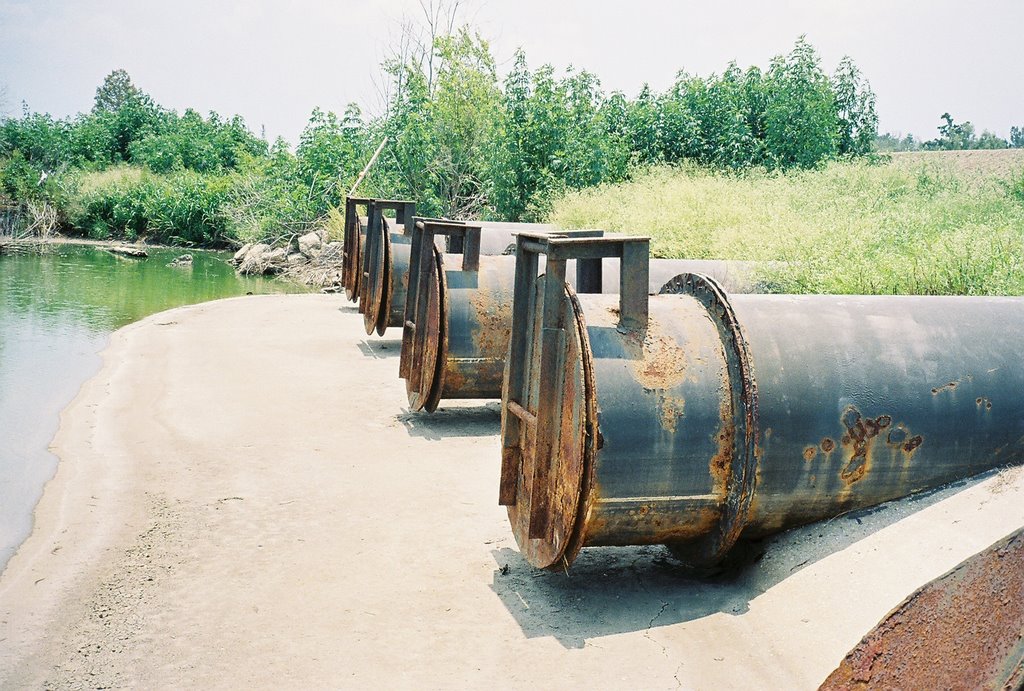
This was just off Marconi Drive near the Orleans Ave. floodgate site. The 60" (that's 5 feet!) I refer to is the diameter across the pump. The pump on the right is sitting with its bottom to the right of the photo. The pumps are turned up on end when they are installed at the gates.

The E.J. Gore pumps are the same as those at the floodgates, just a bit smaller. Actually they're 42" diameter pumps, and there's six of them:


The sixth pump is just out of frame to the left. They're all submerged in this picture.

What's interesting about the E.J. Gore station is that these MWI pumps have been in service for over 20 years without complaint. But there's an even more interesting part of the station. Look what's on the end of the pump discharge pipes:


Flapper gates! There are no siphon legs at E.J. Gore. I ask you, when considering your safety from backflow problems at the floodgates, would you feel more confident in what would undoubtedly be sturdier versions of the above (the pipe diameter in the picture is 42" - the pipe diameter for the manifold discharge at the gates is 108"), or 12" siphon breakers that - according to the manufacturer's own literature - appear to be installed outside their suggested operating range? Keep in mind that the consequences of backflow into this system are even more dire that those experienced by Jefferson Parish during Katrina, especially when one considers that:

a) The automated control and monitoring systems are not ready this storm season, meaning there is no way to remotely monitor or operate the pumps. According to the original bid solicitation, those systems were supposed to be installed 48 days after award of the contract, which was on April 14th. Obviously, the contractor, Prime Controls, is way behind the original schedule.
b) The Corps will pull its personnel out of the S&WB pump stations for anything over a category 3 storm, leaving the S&WB to fend for themselves. From page 9 of the Floodgates Operating Manual:

"Based on the predicted storm data from the EOC and the construction status at each structure, the Chief of Operations will determine if personnel will remain at the Outfall Canal Control Houses, be relocated to local safe locations or evacuated to remote safe locations. Until the control houses are complete, the Outfall Canal Teams shall report to the MVN reservation for a category 1 or 2 storm. For a category 3 or 4 storm, they will be stationed at the LADOTD building on Lakeshore Dr. For a category 5 storm they shall be evacuated to a remote location. Canal Captains shall be stationed at the S&WB Pump Stations for up to a Category 3 Storm [emphasis mine]. For a storm above Cat. 3, they will follow the plan for the Operations Teams."
For reference, the Control Houses are complete at London Ave. and Orleans Ave., but not at 17th Street.

If there is backflow through the pumps, the possibilties for craziness are legion. It would seem to be theoretically possible to get water flowing down the outfall canals once again! I wish the Corps had just gone with the flapper gates.

Tuesday, September 19, 2006

Mmmm, Powerpointy!

In my continuing effort to get as much information to the public as possible, I've uploaded a few PowerPoint presentations. To see them, you may need the free PowerPoint Viewer, which is available here.

My September 6 presentation. Keep in mind that the stuff about the roofs, while it was true on the 6th, is now out of date.

The other presentation given by my neighbor Joe Thompson on April 27th. This was given the same day as this article about the previous day's motor fires appeared above the fold on page 1 of the Times Picayune. Four days later the Orleans Parish pump stations PIR was approved. Five days later, the Corps issued the solicitation for rewinding of motors in six S&WB pump stations. Seven days later, the Cooperative Agreeements for Corps work in the stations were signed. On May 12, the contracts for rewinding were awarded.

A March 15 presentation given by Corps of Engineers pumping project manager Jim St. Germain to the S&WB at the regular Board meeting. Only the last two slides deal with pumps; the rest talks about levees. I find that curious considering the audience. This presentation was noted in the Times-Picayune the next day. This article included the first public admission that certain areas - including my neighborhood of Broadmoor - would flood when the gates closed. It also was the first public indication of what was going on with the pumping system, an aspect of the post-Katrina recovery that had been all but ignored by that point. I believe that article is one of the most important published by the T-P all year. The following Monday, March 20, I started my research and by Thursday was emailing the national media with findings of serious shortcomings in the floodgates.

Finally, last night I gave a brief presentation to my neighborhood group, the Broadmoor Improvement Association, to update the neighborhood on flood mitigation news. That's another hat I wear besides the drainage advocacy stuff. I wrote a goodly chunk of the flood mitigation portion of Broadmoor's redevelopment plan, which was unveiled in August and is already attracting private funding. Broadmoor has many concerns and proposals dealing with long term flood mitigation , and some of the proposals have already been enacted. I mentioned two of them - expansion of Broadmoor's National Register Historic District, and the city codification of the FEMA mitigation exception for historic properties - at last night's meeting.

I also mentioned the University of New Orleans (UNO) flood mitigation study that is proceeding within Broadmoor. Please bear with me as I go off the drainage advocacy ranch a bit here for the sake of my neighbors.

UNO, through their Center for Hazards Assessment Response and Technology (CHART) is conducting a FEMA-funded "area study" of flood mitigation in Broadmoor. It is part of CHART's work in characterizing and mitigating the repetitive loss problem in the greater New Orleans area. They have a rep loss website.

The Broadmoor is the only such study proceeding - or planned for that matter - in all of Orleans Parish right now. The study looks at a small subsection of the neighborhood (in our case, the area bounded by Napoleon Ave., S. Miro St., Upperline St., and S. Johnson St.) and examines in detail the flooding and rainfall history since 1978 (the first year of comprehensive flood claims data) of every property, including taking elevation surveys. The researchers also look at each home's history as far as mitigation measures the owners may have taken since 1978. They do this through mailed data sheets, which homeowners fill out. They crunch the numbers and then come up with conclusions for what mitigation measures best suit the neighborhood as a whole. This is a novel way of looking at things for FEMA, which usually considers flood mitigation on a house-by-house basis, without looking at underlying causes for flooding. For Broadmoor to be chosen for such a study is a big deal.

In addition, we hope that the study will show the effectiveness of the local SELA project installed four years ago, someting I talked about here a couple of days ago. The study is due to be released in draft form hopefully sometime in November. If you are a Broadmoor resident that lives in the study area, and you have not filled out your data sheet, please contact me at the email address listed on my profile to the immediate right of this post. I have extra sheets. It is very important that UNO get as many responses as possible. To see if your home is in the study, you can check your address against this list.

To get a feel for what the study will look like, here is a draft of another UNO area study. It was done for the Maplewood subdivision on the west bank of Jefferson Parish, and I think it's pretty cool. Of course, I'm kind of a nerd about flood mitigation stuff.

Sunday, September 17, 2006

Backup generators - we need them. NOW.

Most of the following is from an email I sent out earlier today. Let me get you up to speed so you can understand what the heck I'm talking about.

Almost all the drainage pumps in Orleans Parish run on electricity. Most older pumps (those installed before the 1950's or 1960's) run on 25 cycle (or hertz, abbreviated Hz) power, which is generated at the Sewerage & Water Board power plant on South Claiborne Ave at the Orleans-Jefferson parish line. Those pumps supply about 60% of the drainage capacity of the city. The 25 Hz power is conveyed on underground lines, away from the damaging effects of wind.

Almost all the rest of the pumps run on 60 Hz electricity supplied by bankrupt local utility Entergy New Orleans. That power is transmitted on overhead lines and is susceptible to the same likelihood of outages as the rest of us who depend upon it. There have been numerous Entergy power outages over the last few months. Some have struck pump stations while they were running 60 Hz pumps. 60 Hz electricity also supplies power to much of the support systems in the pump stations.

Currently, there are no backup generators for any 25 Hz pumps, and it is unlikely there ever will be. 25 Hz dropped out of favor in the U.S. decades ago, and very few people in this country are making equipment that is based on 25 Hz. 60 Hz has long been the standard for America, just like 50 Hz is the standard in Europe.

Now, with that introduction out of the way...

The Corps has been saying for months that rental generators for 60 cycle pumps in Orleans Parish are "not authorized." I think I may have found an argument that smashes that excuse to bits. And it comes from Plaquemines Parish.

With the issuance of the synopsis of the repair work to Plaquemines Parish's pump stations, I decided to take a look at the Project Information Report for that work. In general, the Plaquemines PIR has more revealing detail than the Orleans one. The detail I'm interested in comes on pages 8 and 9.

The report discusses all of the alternatives for Corps action in response to the destruction in Plaquemines' pump stations, ranging from "do nothing" all the way up to the "structural repair and elevating alternative." That last part - "elevating" - is what is intriguing.

In Plaquemines Parish, every pump but one is powered by diesel engines. At six stations, those diesel engines were built at or near ground level. During Katrina, all those engines were inundated and destroyed, requiring their replacement.

Here's the relevant quote from the report:

"ER 500-1-1 paragraph 5-2 b (1) allows for the improvements to design and equipment that are a result of state of the art technology, and are commonly incorporated into current designs in accordance with sound engineering principles. Elevating the equipment when the engine requires replacement is practical and sound engineering. Three pumping facilities sites, Gainard Woods, Sunrise, and Grand Liard/Triumph, each have multiple stations. The older stations Gainard Woods No. 1 (constructed 1960), Sunrise No. 1 (constructed 1960), and Triumph (constructed 1965) flooded approximately 7 to 8 feet above the equipment operating floor. The newer stations, Gainard Woods No. 2 (constructed 1986), Sunrise No. 2 (constructed 1981), and Grand Laird (constructed 1976), constructed adjacent to the older stations, received only minor flooding and do not require major engine overhaul or replacement because the operating floors are at higher elevations than the older stations.
"Similarly, Duvic and Bellevue Pump Stations did not flood because the operating floors are also elevated. Elevating stations to a height near the elevation of the hurricane protection level is common practice for new construction in Plaquemines Parish and is the current design standard for the parish."

They even give pictures of how the elevation is to be done!

I decided to take a closer look at Corps regulation ER 500-1-1, specifically Chapter 5. It is the regulation that governs the nitty gritty of the expenditure of funds by the Corps on repairs to damaged flood control works after a storm. Reading the PIR's, one can see the Corps followed regulations right down the line. The relevant paragraphs are these (linked here):

"5-2 (b) Rehabilitation Assistance Scope. Rehabilitation Assistance is limited to repair or restoration of an FCW to its pre-disaster condition and level of protection (e.g., the actual elevation of the levee, allowing for normal settlement.)
"5-2 (b) (1) Improvements to design and equipment (e.g., geomembranes) that are a result of state of the art technology, and are commonly incorporated into current designs in accordance with sound engineering principles, are permissible, and are not considered betterments."

If part of a project under this regulation is determined to be a "betterment," it has to be paid for by the locals, not the feds, and it can only be included if it fits within the scope of the repair project. In the case of raising the diesel engines at these six stations in Plaquemines, the Corps determined that placing them on platforms wasn't a betterment, but "state of the art technology." In their analysis of the various alternatives, they had this to say about raising the engines:

"The percent increase in cost to the overall project is 5 percent. The additional $389,000 to elevate the engines is a small increase to ensure that damages during future flood events will be minimized. Not only will the pump station damages be reduced, but damages to residential and commercial properties should also be reduced."

What is doubly interesting is that they said the exact same thing about elevating diesel engines at three pump stations in St. Bernard Parish. In that case, they were willing to accept a nearly 15% increase in project costs:

"The percent increase in cost to the overall project is 14.7 percent. The additional $1,371,000 to elevate the engines is a small increase to ensure that damages during future flood events will be minimized. Not only will the pump station damages be reduced, but damages to residential and commercial properties should also be reduced."

So, here we have a case of the Corps, in TWO parishes, going beyind simply repairing stations, but actually doing some improvements to make them more resistant to future storms of Katrina's magnitude. And keep in mind that this work is theoretically separate from the "stormproofing" to be done in the future.

So let's move a little west to Orleans Parish. Unlike Plaquemines, in Orleans almost all the pumps run on electricity. Recognizing the potentiality of flooding, in the 1950's the Sewerage & Water Board began installing backup generators at its newer stations, all of which run on 60 Hz, Entergy-supplied power. Almost every station built since the 1950's has 60 Hz generators. Those stations include 11, 13, 14, 15, 16, 19, 20, I-10, and the brand new Pritchard station in Hollygrove. And it's not like the Corps doesn't know this - they built Pritchard just two years ago under the SELA project. It has generators and its operating equipment is elevated above the top of the nearby levee. You can see a picture of station 14 in all its elevated, generator-having glory at this post below. There's also a picture of its twin, station 16.

Thus, I would say that, in the language of ER 500-1-1, backup generators are "state of the art technology, and are commonly incorporated into current designs in accordance with sound engineering principles." In this case, the sound engineering principle would be the fairly basic idea of keeping the pumps running when their main power source - Entergy power - is lost. That possibility is greatly increased now that Entergy's local power distibution system is severely damaged in the wake of Katrina (the reason they're asking for CBDG money and massive rate increases).

In addition, rental of equipment is expressly permitted by Corps regulations. In fact, it's permitted on the same page as the "state of the art" passage: "Contracts for repair of damaged FCW's will be awarded within 60 days of project approval, or, if the equipment rental method of repair [my emphasis] is used, then the repair work must be initiated within 60 days of project approval."

For reference, the Orleans pump station repair PIR was approved May 1. 60 days would have been June 30.

So here is what I propose for the Corps:
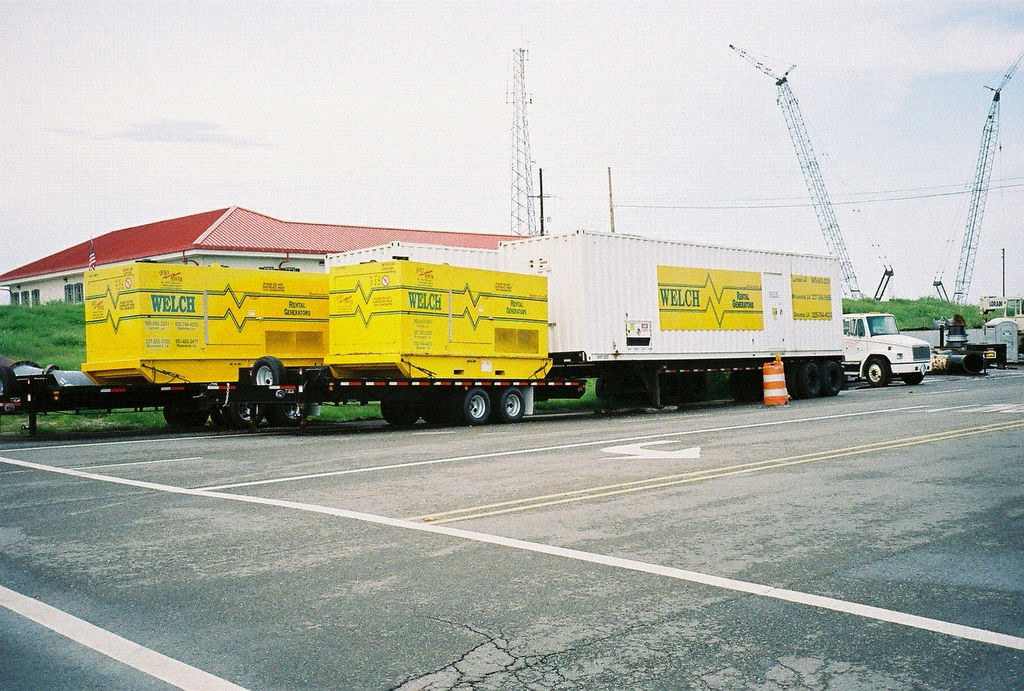
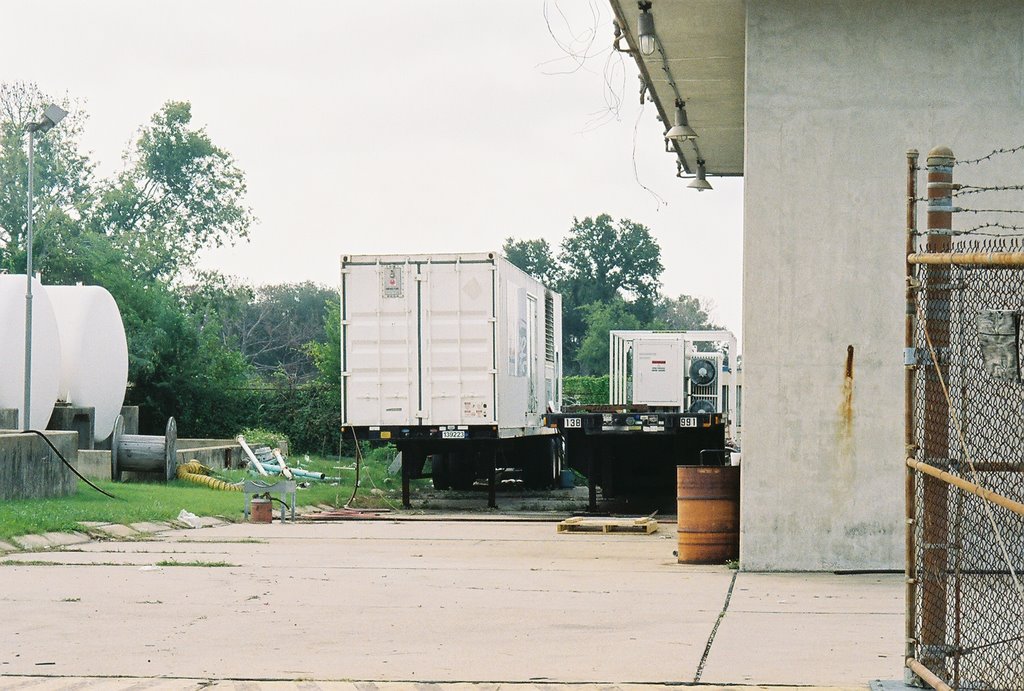
1) Revise the Orleans Parish pump station PIR and Cooperative Agreements (if necessary) to include the placement of 60 cycle rental generators and transformers at the following stations which lack them: 1, 4, 6, 7, Monticello, 10, and 13. I'm just suggesting rental generators that are already mounted on truck trailers and can be brought in on a couple of days' notice. They are commonly available for monthly rentals. I'm not talking about the construction of permanent generators. Here's a picture of rental generators that the Corps rented in July and placed near the 17th Street canal site for over a month. They sat there unconnected to anything. There's enough horsepower in them to run both 60 Hz pumps at station 1, both 60 Hz pumps at station 6, or all the 60 Hz pumps at stations 4, 7, and Monticello combined.


2) In addition, the permanent generator at station 20 is completely destroyed and requires replacement, as the Corps already knows. Quoting from the Orleans Parish PIR about the station 20 generator: "Diesel generator completely flooded and inoperative. Replace generator and diesel engine. New generator and engine should be raised." A rental generator should be placed there as well. The S&WB has a similar situation at station 16 - where the generator requires replacement due to Katrina damage - and went ahead and rented a 1350 kilowatt generator and transformer, which are now powering all four pumps at that station. Here's a picture of that generator, with its accompanying transformer:


3) Move forward with Emergency Procurement contracts with firms like IAP and Welch Generator, both of whom the Corps have given a bunch of business since the storm, and start placing the generators at those stations listed above.

The Corps is promising stormproofing of pump stations some time, maybe 2007, maybe 2008, maybe later. That may or may not include generators. But we need reliable power now, before two or three storm seasons pass.

As further proof of the need, I point you to what happened on July 10th of this year. A 25 Hz generator tripped at the S&WB facility on South Claiborne. Water pressure dropped all across the city for about six hours (not two as reported in the article). What wasn't reported in the media on that rainy day was that all the 25 Hz drainage pumps in the city stopped working at the same time. That's about 60% of the city's drainage capacity - gone in an instant. The only thing left were the 60 Hz pumps. Fortunately, Entergy's power supply was reliable that day and stations with both flavors of pumps were able to switch over to their 60 Hz units. After a few hours, 25 Hz power returned and the older drainage pumps started running again. But what if that had happened during a major storm? Most likely, the city would have had no drainage at all, because Entergy power is very easily lost in a major storm.

Finally, you may be wondering why I'm only talking about 60 Hz generators, when the majority of the system runs on 25 Hz power generated by the S&WB. Well, I'm trimming the low-hanging fruit, so to speak. I have heard that portable 25 Hz generators exist, but I haven't found them during multiple hunts. The 60 Hz variety is much easier to obtain, and the cost of of the rental contract would not be huge, relative to the overall cost incurred by loss of pumping capacity during a storm.

So does that leave any doubt that the argument that rental generators are "not authorized?" It would seem to me that they are very much authorized, and I would even say encouraged, by the plain language of the very regulation upon which the Corps is basing its actions. After all, if the Corps can see fit to include the permanent raising of diesel motors in nine pump stations across two parishes, surely they can agree that the temporary placement of rental generators in a single parish is no greater burden, and would reap just as great rewards.

Why drainage matters

This post is pretty long, but it's essential to understanding the underpinnings of my pushing the Corps to repair the pumping system. I hope you take the time to read it. It also provides some background to the lead editorial in today's Times-Picayune, which says in part (about a proposal to raise flood insurance rates on severe repetitive loss properties):

"Worse, though, is Sen. Shelby's proposal to phase out subsidies for homeowners with at least four flood claims. Reducing the flood insurance program's exposure in these so-called [severe] repetitive flood properties is a fiscally sound goal: They make up only 1 percent of the program's policies, but pre-Katrina accounted for 30 percent of all-time payouts.
"The senator's proposal, however, would ignore projects that have lowered the risk in formerly flood-prone areas, such as in the Broadmoor neighborhood in New Orleans and in large portions of Jefferson Parish. These areas traditionally flooded constantly during heavy rains, but drainage improvements in the past decade changed that. It would be unfair to raise rates based on exposures that no longer exist or have been substantially mitigated."

I live in Broadmoor. It's geographically right in the middle of the east bank (at least the section west of the Industrial Canal). Here's a map showing the location. Four years ago, the Corps of Engineers and the Sewerage & Water Board completed a massive drainage improvement project in the neighborhood. It was part of the constellation of Corps projects collectively known as "SELA." SELA is (kind of) short for the Southeast Louisiana Urban Flood Control Project. The SELA program was started after the May 8, 1995 floods here in New Orleans, which did hundreds of millions of dollars in damage and killed six people. The program is designed to improve drainage in areas around the metro New Orleans area which have traditionally flooded, reducing flood damage and thus flood insurance payouts, which come straight out of the federal treasury. This is done by reshaping old canals, installing new canals, upgrading pumping, or sometimes a combination of some or all those choices. The idea is to spend a little now to get a big savings later, and it makes sense. Louisiana tops the list of states for flood insurance payouts, with the metro-New Orleans area claiming the lion's share.

Under SELA, the federal government, represented by the Corps, paid 75% of a drainage improvement project, with the locals picking up the rest. There are SELA projects all over the area, but they are concentrated mostly in Jefferson and Orleans Parishes. In past years, it had been a real struggle to obtain funding to keep existing projects going, let alone start new ones. But post-Katrina, the rules have changed. Now the projects are 100% federally funded, freeing up millions for local drainage agencies to spend on other priorities. Also, the Corps received more SELA money in this past year - $200 million - than they know what to do with. It was a tenfold increase over typical amounts before 2005.

Broadmoor was one of the first recipients in Orleans Parish of SELA's largesse. Historically, Broadmoor had terrible flooding problems. Evidence was the tremendous concentration of "repetitive loss" properties in the neighborhood. A "repetitive loss" - or RL - property is one that had two or more flood claims of $1000 in any ten-year period since 1978, and Broadmoor had a bigger concentration of them than almost any area in the entire country.

Here's a map showing the number of repetitive loss properties broken down by census tract. Broadmoor is highlighted in red. As you can see when you click on it, there are 167 RL properties in our neighborhood.

We also had a huge concentration of "severe repetitive loss" properties, which are homes with four flood claims totalling over $20,000, or two or more claims which together equal the value of the house.

The SELA project in the neighborhood installed two huge underground culverts down the middle of Napoleon Avenue, to supplement the already big one under the street. Each is big enough to drive a city bus inside it. Similarly sized new culverts were also installed along the southern edge of the neighborhood, along South Claiborne Avenue from Nashville Avenue to Louisiana Avenue. The South Claiborne culverts are part of a planned future expansion of drainage improvements further toward the river along Nashville, Napoleon, and Louisiana Avenue. They don't play a direct role in draining Broadmoor.

The project also paid 75% for one of two new pumps installed at our local pumping station, Station Number 1. Both pumps are 60 Hz, 1200 cubic feet per second (cfs) behemoths. They are the biggest pumps in the city. The addition of the pumps actually gives the station more pumping capacity than it can put into its outlet canal (known as the Palmetto Canal). The pumps were ready in 2001, a year before the canals on Napoleon started accepting storm water.

In addition to a decade's worth of previously completed, locally funded projects in the neighborhood, it is the two new culverts in Napoleon Avenue that provide the storage and flow capacity that has completely reshaped Broadmoor, though one can't see that reshaping with the naked eye.

The SELA project allowed water to drain much more rapidly from the neighborhood. The extra pumping capacity allows for quicker draining, while the bigger canals allow for longer storage of the water in the underground drainage system, rather than on the surface, where it can flood cars and homes. And the proof is in the pudding.

On September 11, 1998, Tropical Storm Frances dropped 12" of rain on Broadmoor in the space of about six or eight hours. There was widespread flooding through the neighborhood. We got over three feet on the street in front of our house. The pumps caught up and the area was pumped dry that evening, but it was a stark reminder of the importance of drainage in a city below sea level.

Four years later in 2002, Tropical Storm Isidore dropped 17" of rain on the neighborhood. It was the first test of the new Napoleon Avenue culverts, which had just been hooked up to the drains on the side streets weeks before. In fact the streets were still torn up.

There was hardly any flooding in Isidore. My street stayed dry the entire time. And the insurance claims data backs up the effectiveness of the project. In 1998, there were 120 flood insurance claims from severe repetitive loss properties in Broadmoor resulting from Frances. In 2002, there were six resulting from Isidore. That's a 95% drop in claims from the "worst offenders" in the flood insurance program. SELA worked! Here's RL claims data for the neighborhood dating back to 1995. The effect of SELA is obvious.

FEMA was watching this, and took notice. I have confirmed that just before Katrina struck, plans were nearly complete to effectively move Broadmoor out of the floodplain on FEMA's flood maps. The "flood zone" designation would have changed from "A" to "X." An "X" zone is one where there is no significant hazard for a 100-year flood (FEMA expresses it as a 0.2% chance). Our Base Flood Elevation (BFE, which is a measure of the depth of water expected in a 100-year flood, for which there is a 1% chance) of 1.5 feet above sea level would have been eliminated; our flood insurance rates would have dropped precipitously, and the entire neighborhood would have become just as popular as other "drier" neighborhoods closer to the river. Similar moves were underway for Jefferson Parish neighborhoods that had also hosted SELA projects, as well as the New Orleans neighborhood of Hollygrove. Hollygrove, like Broadmoor had also gotten SELA money to build a new pumping station and upgraded drainage culverts, because of another cluster of severe repetitive loss properties. In fact, a meeting was held on the Tuesday before Katrina among FEMA and Jefferson Parish officials to discuss the flood map changes resulting from the fabulous success of SELA in JP. We were this close, and then Katrina hit.

FEMA pulled back all the flood insurance studies and changes to the flood maps after Katrina. They expect to have new preliminary flood maps issued for the metro New Orleans area some time in the middle of 2007. In the meantime, we are stuck with the old flood maps (from 1984), which do not reflect the SELA improvements and which are guiding rebuilding right now.

Another factor in rebuilding - one that is not well publicized - is that much of Broadmoor is a National Register Historic District and buildings that contribute to such a district are exempt from FEMA house-raising requirements after a devastating flood. Inside the historic district, 85% of the buildings are "contributing," meaning all those homeowners are not required to raise their houses, even if they received more than 50% damage, which is FEMA's cutoff for requiring "mitigation," aka house raising. Broadmoor is unique in this particular confluence of circumstances: 1) it flooded in Katrina; 2) it has an existing SELA project; 3) it's got a National Register District.

But many people are raising their houses to the existing BFE or way above it, without knowing that they don't really have to. SELA has already proven its effectiveness, and if they live in a contributing property, they are exempt from mitigation requirements anyway. They are operating out of the fear of future levee breaches. But if there's another levee breach and the city floods like it did before, that's pretty much the end of New Orleans anyway, so why bother spending $100,000 putting one's house up on nine foot stilts if the rest of the neighborhood will be empty shells after such a flood? No, the risk to be concerned about is severe rainfall, and Broadmoor is significantly more protected from that risk than it was before 2002.

All of this - the potential flood map changes, the diminishment of the severe repetitive loss problem, the lack of true cause for house raising - depends on the pump stations performing reliably. The pumps are the foundation of the flood maps across this entire area. And when they are upgraded, along with the pipes and culverts leading to and away from them, neighborhoods like mine stay drier longer and more often. But we can't reap those benefits if the damn things don't work.

So that's a big reason I've been so crazed about getting the drainage system back up and running. It's not just the short-term gains from staying dry in any given storm, but there are serious long-term benefits that accrue. They include lower flood insurance rates and higher property values.

Before Katrina, I didn't know anything about this stuff. I've taught myself, along with the help of dozens of individuals along the way. And some people believe I've got an axe to grind against the Corps, because they screwed up the levee designs, resulting in the horror that is Katrina. Yeah, I'm angry about that, but I want the Corps to work to justify the millions they spent in projects that actually help people, like SELA. Broadmoor benefited greatly from our SELA project, and we deserve to continue to do so. Otherwise, it's just money thrown down the drain.

Saturday, September 16, 2006

Tip of the hat to the Corps - roofs finally being repaired

I visited pump station 11 and station 13 on the west bank of Orleans, as well as station 6 (17th St. canal) and station 10 (New Orleans East) this rainy afternoon. I am pleased to report there is massive progress in repairing the roofs to all of these stations.

I'm guessing that the Corps has either extended a pre-existing contract with Crown Roofing Services (perhaps the one listed on here), or signed a new contract with Crown, but has not advertised it. I'm kind of curious about the answer to that question. But I am sure that all the work is being performed by Crown.

However, the important part is that there is finally activity after over a year of waiting. At Station 13, there are two manlifts (aka "cherry pickers") - one with Crown Roofing's name on the side of it. It appears they are at the point in the job where they are ready to install the new sheathing. My guess is that work has been going for about a week there.

At station 11, the contractor (also Crown, I'd wager) has started mobilizing equipment. There is a manlift, a dumpster and two port-a-lets that weren't there a couple of weeks ago. The roof still appears the same from the road, but I didn't check the back of the building because of the pouring rain.

At station 10, parts of the old roof have been scraped off and new roofing underlayment has been placed. Gutters have been pulled off the north side of the building, but I didn't see any new ones on site there yet. There are traffic cones all over the parking lot with "Crown Roofing" written on them. There's about one to three weeks of work left there.

At station 6, there is a manlift and a dumpster (from the same dumpster contractor as all the other stations) full of boxes and cardboard from more roof underlayment. Since the portion of station 6's roof that is being repaired is flat, I couldn't tell the status of the work. But from the contents of the dumpster, I'd estimate two to three weeks of work to completion.

All this work appears to have started within about the last week or so, though I might be off.

I didn't see any work happening at station 3. I still have to check stations 2 and 5.

According to the Corps, those are the seven stations requiring roof repairs. The S&WB counts seven other stations in that number, including station 14 in New Orleans East. I did not see any evidence of work on that station's control room roof. I didn't see any work on the roofs at the I-10 station or station 7 - near City Park - either. I didn't check stations 20, 19, 15, or 2.

Keep in mind that the tarps are still in place over much of the electrical equipment under the leaky roofs in all these stations in Crown's contract, including the breakers and motors. This equipment has over 2000 volts flowing through it.

In any case, while it's awfully late in the game, my thanks still go out to the staff at the Corps' Hurricane Protection Office (whom I doubt even care what I have to say) for getting this work going. I'd also like to thank Crown Roofing Service for their dedicated labor. I am sure the pump operators are also grateful.

Friday, September 15, 2006

Good luck for the next 495 days, Plaquemines Parish

The Corps is moving to finally fix the Plaquemines Parish pumping stations, over a year after Katrina trashed the entire system. They put this solicitation synopsis out today. The solicitation and Technical Data Package will probably go out tomorrow. This work is based on the Plaquemines Parish pumping station PIR, approved January 15, 2006.

This is a good thing, albeit extremely late in coming.

Among the details:

-There will be work on 15 of the 16 stations in the parish.
-Response date for the solicitation from bidders isn't until October 30th.
-And the best part (this is a direct quote): "Estimated time of completion for this project is 450 calendar days after notice to proceed is issued"

That puts the repairs on schedule for completion - assuming issuance of a contract on November 8, 2006, which is very optimistic - some time in early February, 2008. So much for the supposed emergency we in southeast Louisiana are still under.

Now, Plaquemines has managed to restore much of its drainage capacity, but it did so with toothpicks, spit, and duct tape. And it did it on its own, with very little help from the Feds. Now they are being told to wait over a year for complete restoration. This is unconscionable. These repairs shold have been taking place a year ago. By the time the Corps' contractors are done, Plaquemines will have been without a fully functioning drainage system for almost 2-1/2 years.

At the very least, I think the tens of thousands of people who have decided to return to Plaquemines - as well as the many personnel who work at the refineries and the Belle Chasse Naval Air Station-Joint Reserve Base - deserve a little more than a brief mention on a very obscure Corps webpage. Shouldn't there at least be a press release with a schedule of work for each station, so people can tell when their neighborhood will get their drainage back to pre-Katrina levels permanently?

To all of you out in America who assume that the government will take help repair your essential services after a disaster rips away your ability to do so, take this as fair warning - you are expendable.

How? Why? Part 1

Each time I've given a presentation or talked to people about the lack of repairs, the questions of how and why we got to this point come up.

I can answer part of the how, but the why still remains a mystery.

Here's a basic chronology of the actions (or lack thereof) leading us to the current situation. Page numbers refer to the numbers in Adobe Acrobat Reader, not within the document itself. You can see all this in my presentation as well.

September 15, 2005: Corps sends out Notice to Public Sponsors, "notifying them that the application period to request Rehabilitation Assistance for Flood Damaged Flood Control Projects expires on October 15, 2005." In English, this was a letter (with some blanks to fill in) to the drainage departments or boards of Jefferson, Orleans, St. Bernard, and Plaquemines Parishes saying the Corps would help out in repairs if they sent back the letter by October 15. [Orleans Parish pump station PIR, page 8]

October 7, 2006: In the wake of Katrina, Corps approves one-time deviations to their own poicies to, among other things, "…for non-federal flood damage reduction projects, including pumps and pump stations, not active in the RIP, at full federal expense use FCCE funds to … undertake permanent rehabilitation to pre-storm condition." [Plaquemines Parish pump station PIR, page 93]

Note: The RIP, which is sort for Rehabilitation and Inspection Program, is a Corps list of federally funded flood control works. Almost the entire S&WB drainage system is not on the RIP. FCCE stands for Flood Control and Coastal Emergency, which is a Corps pot of money designated for repair of structures on the RIP list after a disaster. It comes out of a law called P.L. 84-99.

October 15, 2005: New Orleans Sewerage & Water Board (S&WB) responds to Corps Notice to Public Sponsors, requesting total federal funding of repair to drainage pumps and pump stations. [Orleans Parish pump station PIR, pages 38-42]

Note: In a particularly cruel twist of the knife, in its 9/15/05 Notice to Public Sponsors, the Corps included the following "complete the sentence"-type question to the public sponsor:

"It is in the national interest to provide permanent rehabilitation of the above described projects for the following reasons:"

It is heartbreaking to imagine Parish officials trying to think of a reason why the nation should care about helping them, especially considering all those parishes were still under water on September 15th. How could someone at the Corps seriously put that question on the form? Did they not watch the news?!? Here's what Plaquemines wrote:

"This area is the gateway to America for shipping and the oil & gas industry. We also have critical infrastructure such as oil and gas refineries, gas plants, and the Joint Reserve Military Base." [Plaquemines Parish pump station PIR, page 41]

Here's St. Bernard's response:

"Home to approx. 70,000 people, commercial marine and fish landings such as: oysters, shrimp, crabs, fish, etc., Port of St. Bernard Parish, oil and gas infrastructure including two major refineries and a natural gas plant, recreational fishing, and critical nesting habitat for a large portion of the U.S. waterfowl that migrate through annually." [St. Bernard Parish pump station PIR, page 29]

And New Orleans' response (yes, New Orleans had to justify its continued existence just 17 days after Katrina):

"New Orleans is one of the largest ports in the world, and the largest in the nation, at the base of the largest river system in the nation serving as a major economic gateway for industry and commerce to the nation and the world including the export market for the nation's grain to the world. There are three petroleum refineries producing fuel at a critical juncture in our nation's energy plan and serving natural gas pipelines serving major portions of the Northeastern United States. The Sewerage and Water Board of New Orleans provides water and sewerage services, and drainage to many of the aforementioned businesses and many residents who are employed in the aforementioned industries and business [sic]. Additionally, the Sewerage and Water Board of New Orleans drains 2200 acres of the adjacent parish, Jefferson Parish." [Orleans Parish pump station PIR, page 39]

You get the idea. Pure cruelty to put local officials through that.

Anyway…

October 17, 2005: Office of Management and Budget (OMB) affirms Corps' one-time deviations from policies, supposedly freeing up funds for permanent pump station repairs. It is unclear what this money is spent on besides damage assessments. It would be nearly seven months before the issuance of pump station permanent repair contracts in Orleans Parish. [Plaquemines Parish pump station PIR, page 29]

December 15, 2005: A relatively heavy rainstorm exposes in dramatic fashion the effects of the Corps' inaction toward repairing the pumps. Pump motors which had been inundated (nearly two dozen of them) were cleaned and dried by the S&WB immediately after the storm, but were not "rewound." Considering the age of the copper windings and insulation on those motors (90 years in some cases), they should have been rewound in a staggered fashion as soon as they were put back into service.

On December 15th, the motor on pump "A" in station 1 caught fire after just a short time in service. We know this because it was in the damage assessments compiled by the Corps (see February 15 below), and was used as justification for future rewinding by the Corps in the May PIR. [Orleans Parish pump station PIR, page 49]

December 30, 2005: Third Katrina Supplemental is signed into law. This bill contains more money for repairs, including cash for pump station repairs. It is very unclear as to what happened between October 17 and December 30, especially considering the urgent need to repair the stations. It would seem the Corps simply ignored the need for repairs to the pumps, concentrating instead on other priorities like levee repairs and floodgates.

Stuff from 2006 to follow. Keep in mind that as of 12/30/05, the S&WB had already been repairing pumps and pump stations for nearly four months, and the Corps had not issued a single pump station permanent repair contract.

Other roofs in need of repair

Lets take a look at the extent of the problem with the unrepaired roofs at the S&WB pumping stations. The Corps agreed to make these repairs back in October, 2005 under emergency authorizations from their headquarters, and then agreed again to do so with money from the Third Katrina Supplemental. They have yet to be repaired.


Station 11, on Orleans' west bank. This station drains English Turn and Lower Coast Algiers. Nearly every piece of control equipment and many of the pump motors inside the station have plastic tarps over them.


Station 13, also on Orleans' west bank. This large station drains much of New Orleans' west bank. I drew the red and green line. Red indicates where there is no copper sheathing, green indicates sheathing. Every pump motor and control box inside the station has tarps over it. Constant Duty pump CD4 actually has a picnic umbrella protecting it from the roof leaks. Here is one of the pump motors inside Station 13:


Station 5, in the Lower Ninth Ward. The building on the right, which is the main pump house, is the one with the roof damage. That is temporary tarp or something along all the peaks. Much of it has blown away since it was installed just after the storm. A generator set used to get the pumps started inside the pump house has a tarp over it. For reference, the building on the left is the control room, which also flooded, but did not lose its roof.

If only the national media crawling all over that neighborhood during the one-year anniversary a couple of weeks back had just trained their cameras on the northern edge...


And finally, another shot inside Station 10, in New Orleans East. This is the control room. Would you feel safe running these controls during a rainstorm?

Keep in mind the irony of this happening at Station 10, which was built in 1989. The control room and all the electrical equipment that is now getting wet is elevated about 25 feet above the ground to keep them from getting wet during flooding.

How widespread is the problem? Here's the Sewerage & Water Board's assessment of the status of their pumping stations, as of June 21 (this document came out of the City Council hearing on June 22). The column on the very left indicates which stations the S&WB considers in need of roof repair, and how critical that need is. 14 of 23 stations are on that list. Four of them are considered a "1" (highest priority): 10, 11, 13, and 14. You've seen the condition of stations 10, 11, and 13 above. I think anyone would agree with the S&WB on the criticality of the repairs at those stations. For your reference, Station 14 is also in New Orleans East. Here's a picture:


The red and white building in the center is the control house that, I assume, has the unrepaired roof damage. Unfortunately, I couldn't get high enough to see the roof and I wasn't able to get into station 14 the day I took this picture in August. I don't know if the roof has been repaired here, but I doubt it. However the picture is instructive because it gives an idea of the elevation of the equipment inside Station 10 just down the road on Hayne Blvd. The S&WB was very, very smart in the construction of these stations west of the Industrial Canal (there's a twin to 14, Station 16, over by Lakefront Airport), installing permanent generators and elevating nearly everything. Here's Station 16 (the generator has been moved off its platform on the left side for repair or replacement):


Station 20, over by the old Macfrugals, also has its critical equipment elevated. But it also has roof leaks. One of the control panels inside its elevated control rooms is covered in plastic sheeting. There's actualy pieces of the roof all over the site at 20. And the generator at 20, which is in its own building and at ground level, is completely smashed. Here's a picture of that generator from the Orleans Parish pump station PIR. As of a couple of weeks ago, nothing has changed. There's still mud in that building, which you can see in the lower left of the photo.

I don't know if both pumps at 20 are working. Last I heard, one of them had a bad shaft, but that was months ago. Sorry, but the pictures of 20 are still on my camera (yes, I am a Luddite still using film).

To see the Corps' assessments of the roofs, just page through Appendix D in the Orleans Parish Pumping Station PIR. It has all the details. Just as an example, here's the assessment of station 13's roof:

"According to the operator, approximately 90% of the copper metal roof blew off. The estimated leaking part of the roof dimensions is approximately 200’ X 50’. Repair with a new metal roof is recommended."

Thursday, September 14, 2006

How to keep tabs on Corps contracts around town

I've got few links on the right hand column of this site. One of them goes to the Corps' New Orleans District Contracting website.

This site shows all the contracts out for bidding currently, and many of the ones whose bidding preiods have passed. Click on the link with "Today" in it to see that day's activities. Other links show you activities in past days. The typical progression is issuance of a "Synopsis," which is available publicly. Usually a day later the actual bid solicitation will be issued, along with a Technical Data Package (TDP) if necessary. The Solicitation and TDP, along with any amendments which might be issued, are not available publicly, since they are behind a firewall called FedTeDS.

FedTeDS is a contracting application that is only available to companies which have registered with the government. To register, you must have a Dunn and Bradstreet number and a bunch of other information proving you're a company and not some pesky citizen. This was changed for the New Orleans District and the Mississippi Valley District (which is above New Orleans in the Corps command chain) just this past February 15 (as seen here), right in the middle of the biggest contracting bonanza since the Reagan Administration. It is all part of the Bush administration's broad-based effort to control information to keep it from falling into the hands of terrorists, though I have a hard time understanding what the terrorists would do with a bid solicitation for dirt.

Before February 15, everything was available to the public, which is how it should be. How in the world are we supposed to trust an organization with our tax dollars if it doesnt let us know how they are being spent?

Another wrinkle is the archiving of solicitations after a certain period. When they're archived, they're gone. But not really. You can go to http://www.fbodaily.com and find solicitations dating back years. The archive interface is a little clunky, but I've pulled stuff out of fbodaily that has been long gone from the Corps' own website.

If you're really interested, you can poke around both of these sites to get a flavor for all the post-Katrina work.

Finally, there is this file that I came across a couple of weeks ago. It seems to have disappeared since then, and I can't find where I got it. In any case, it is an Excel file listing of all the Corps contracts issued for Katrina, Rita, and Wilma through August 24 of this year. It shows over $3 billion spent by the Corps on Katrina alone, some of it a little suspect. I recommend checking out rows 1035, 1048, and 1259 on the Katrina sheet.

In any case, sometimes it's possible to get a peek at a bid solicitation. Here's the one for the rewinding of the pump motors in six stations in Orleans Parish. I got it through a FOIA request. This is the type of document that is essential to understanding how the Corps operates. It shows the exact schedule of rewindings and also the timescale expected of the contractor. This is information that should be available to all citizens.

For reference, rewinding is complete at stations 1, 6, and 7, and remains underway at stations 2, 3, and 5.

How long has the Corps known about the floodgate pump vibration problems?

The Times-Picayune has done yeoman work covering the construction and operation of the floodgates and pumps out at the lakefront. The latest article, from this past Tuesday, talked about continuing vibration problems on all the pumps:

"But serious vibration problems were discovered in the pumps soon after they were tested last month. The motors in 10 pumps at the Orleans canal and 12 pumps each at the London and 17th Street canals have all been rebuilt since then.
"And although some progress has occurred with the six pumps on the west side of the 17th, the results of weekend tests at London and Orleans 'weren't satisfactory,' [Corps Project Manager Jim] St. Germain said. Some pumps pulse less than others, but overall improvement is needed, he said.
"Still, he wouldn't rule out pressing most or all of the pumps into service if the canals are closed against storm surge. The faster the water leaves the canals, the faster the rainwater can drain from surrounding neighborhoods, so he said the corps would make every effort to use as many pumps as possible."

A few weeks ago, when the Corps released their totally useless initial inundation maps the Friday afternoon before the July 4th weekend - the ones with no depths shown - rainfall was dismissed as inconsequential. Here's a quote from a Corps spokesman:

"While the maps do not specify depths, a Corps spokesman said they show areas that would see inches of water and not the several feet that could result from a levee failure. 'This is a lower amount of water that's not going to be standing there for weeks like we had in Katrina,' said Todd Hornback, a Corps spokesman based in New Orleans. While the gates at the canal mouths on Lake Pontchartrain might block a devastating surge from getting in, the complication is that they will also stop some rainwater from draining. But Washington-based Corps spokesman Gene Pawlik argued that rainwater flooding is a lesser evil than flooding from another catastrophic levee rupture. 'A surge from Lake Pontchartrain is a bigger risk overall than rainfall inundation,' Pawlik said."

Now that we have inundation maps with depths that show certain areas receiving over five feet of water from rainfall backing up behind closed gates, we know the earlier reassurances to be untrue. And while it took a while, it appears the Corps is finally coming around to the common sense point of view that flooding is flooding, whether the water stays for a day or a week. That's good thing, and I applaud the Corps for coming over to the good side.

Thus the importance of the pumps at the lake. And my concern that the Corps has known about these vibration problems for months but possibly ignored them.

When the pump vibration problems were first announced four weeks ago on WLAE's "Road to Recovery," Colonel Wagenaar said the Corps was not completely surprised by them. It struck me as odd he would say something like that, because vibration problems on a new system are usually unexpected and surprising.

So I thought about why he would say such a thing. Why would they have been expecting vibration problems? The only answer I could come up with is that they had experienced them already, before the August tests. So I looked at a June 1 Times-Picayune article about pump testing. Read the article carefully. It was a little vague about what exact problems were initially encountered during a round of testing of six pumps at Orleans Avenue in mid-May, but I did learn from other sources that pumps were cavitating (sucking air and water) and generally not performing up to snuff.

I believe they were also vibrating, though perhaps not to the degree as those at 17th Street and London Ave. described by the Corps in August. Vibration would be a normal offshoot of cavitation. When combined with information I got later that seven of the ten pumps at Orleans were not working due to vibrations in recent pre-motor-replacement tests (which would definitely include at least some of those six tested in May), I think there's enough smoke to make everyone wonder about how long this fire has really been out there, and whether it was truly fully investigated.

One more post about documents

There is one more document that was not easily obtained, but which every citizen in New Orleans who lives west of the Industrial Canal should read. It is the Operating Manual for the Floodgates. It includes all the criteria for closure - and opening - of the gates, as well as technical details on the entire system.

It is not an easy document to read. It is filled with jargon, has very few paragraph or page breaks, and is sometimes contradictory. It only has a single diagram and no pictures. It also makes mention of another document meant as a companion - the Water Control Plan. The Water Control Plan apparently lays out the exact timing and scope of shutdown and startup of permanent pumps in Jefferson and Orleans Parishes. I have made a Freedom Of Information Act (FOIA) request for the Water Control Plan, which I know is complete, but the Corps did not respond within twenty days, as their regulations say they must. So I added that request to the pile that is currently included in my Federal FOIA lawsuit against the Corps.

Despite all that, the Operating Manual is key to understanding what to do if a tropical storm approaches. By reading the Manual, you will understand the Corps' thinking. And when considered in light of the inundation maps released by the Corps July 26th, which show the effects of gate closure on the neighborhoods of New Orleans and Metairie, you can plan accordingly. If you have web access as the storm approaches, you can watch the 17th Street floodgates and the London Avenue floodgates on WWL-TV's website. Unfortunately, there is no camera for Orleans Avenue.

More about documents

There is also a PIR for the floodgates at the mouths of the three outfall canals - 17th Street, London Ave, and Orleans Ave. It was issued in January, even before the Corps officially received the money to complete the projects described inside it (the Orleans Parish Pump Stations PIR was issued four months after passage and signing of the Third Katrina Supplemental). It lays out a scope of work that - among other things - includes $29 million for "bank stabilization" contracts along all three canals. This work was never mentioned again, despite what would seem to be a rather urgent need from the verbiage in the document. For example, this is what that report said about London Avenue:

"London Avenue Canal The length of paralllel protection in need of repair is 18,300 linear feet. Seepage analyses indicate a need for relief wells and/or seepage berms from a distance 3,700 feet north of Pumping Station No. 3 to the Robert E. Lee Bridge on the west side of the canal and to the Leon C. Simon Bridge on the east side of the canal. Above the Leon C. Simon Bridge seepage analyses indicated the need for a slurry trench with clay cap tie-in for the existing levee. Not included in the above numbers are the repairs at the two breaches and the repair of the translated wall on the east side of the canal south of the Robert E. Lee Bridge."

This is of interest because of what the Corps is now saying about the London Avenue canal:

"The appropriate water level at London Avenue Canal is still being re-evaluated, but it could drop a bit below its current 5-foot mark, said Walter Baumy, the corps' chief engineer in New Orleans. "'We've done a lot of additional borings and independent analyses, and we suspect that it could go lower. We'll make a decision by the time it has to be made,' he said. 'And if it does go lower, we're looking at how to mitigate that.'"Although most public attention since Katrina has focused on the 17th Street Canal, Baumy said protecting the London canal from surge is more problematic because sand layers are closer to the surface there and seepage -- with potentially catastrophic results -- is a threat."

On WLAE's Road to Recovery last Thursday, Col. Wagenaar, head of the Corps' New Orleans District, said those mitigation measures could include reinforcement of the walls or covering the entire inside of the earthen canal with concrete.

Documents

When conducting an investigation, it is very important to obtain paper documents, since they are permanent and are far tougher to refute than oral statements. During my investigations over the past few months, I have collected a wealth of documents - some publicly available, some not - pertaining to drainage in New Orleans post-Katrina. I'll be posting links to these documents over the coming days. This will allow you to come to your own conclusions, and give some insight as to how I came to my own findings.

I look to the 9/11 Commission as the exemplar of how to conduct an investigation. They kept the public in the loop every step of the way, conducting public hearings and issuing interim reports. This had two effects. It kept pressure on their targets constantly throughout the investigation, rather than just in the short period after the issuance of a final report. It also allowed the public to absorb important parts of the story without being overwhelmed by the detail of a large, final report. One other thing the 9/11 commission did was to communicate in plain English, only slipping into jargon when it was absolutely necessary. That was a large reason the 9/11 Report was a national best seller and was also only the second government report nominated for a National Book Award.

The most important document regarding the Corps repairs to the New Orleans pump stations is the Orleans Parish Pumping Station Project Information Report (PIR)

This report, issued on April 28th and approved by the Mississippi Valley Division on May 1 (four months after passage of the third Katrina supplemental, which supposedly funded the repairs), lays out the entire scope of work for the Corps in New Orleans' pump stations. The document was approved just four days after the Times-Picayune exposed the dangerous lack of rewinding repairs to motors which had been inundated on the front page. Corps projects cannot proceed without an approved PIR.

There are similar documents for Jefferson Parish, St. Bernard Parish, and Plaquemines Parishes. As far as I know, no contracts have been issued for the last two, and only a single roofing contract has gone out in Jefferson.

All four pump station PIR's can also be found on the IPET website, in the "Post-Katrina" section. IPET is the Interagency Performance Evaluation Task Force, which is the official name for the Corps' Katrina investigative team.

The second document the Corps requires to proceed with a project is called a Cooperative Agreement, or "CA." Sometimes it is referred to as a PCA, where P stands for Project.

In the case of the Orleans Parish pump stations, the Corps drafted two CA's. One covers work in facilities which have had previous federal funding directed toward them (pump stations 1 and Pritchard, which got SELA dollars). The other covers work in all the rest of the stations, which are referred to as "non-federal." The agreements are essentially the same, except for which stations to which they apply.

How hard is it to fix a roof?

Here's an example of the lack of repairs at the pumping stations:


That's the roof on station 10, on Hayne Blvd. in New Orleans East. And here's the result:

Those are the starter breaker cabinets. There's at least 2000 volts flowing through those things. Notice the puddles.

What's really notable, though, is that the above picture is taken on a platform that's about 25 feet above the ground. This station was built to keep all the vital equipment from getting wet due to flooding, but it's still getting wet because the Corps has waited a year to fix the roof. Would you like to walk around that equipment when it's running and there's puddles forming?

Here's the outside of the station just a couple of weeks ago. As you can see, the roof is shredded:

Download the presentation

If you want to see the presentation about the lack of repairs to the Orleans Parish pumping stations that I gave on September 6th, you can download it here

Or, you can go to http://www.box.net

Click on "Login" and enter the following:

Username: pumps
Password: password